
No products in the cart.
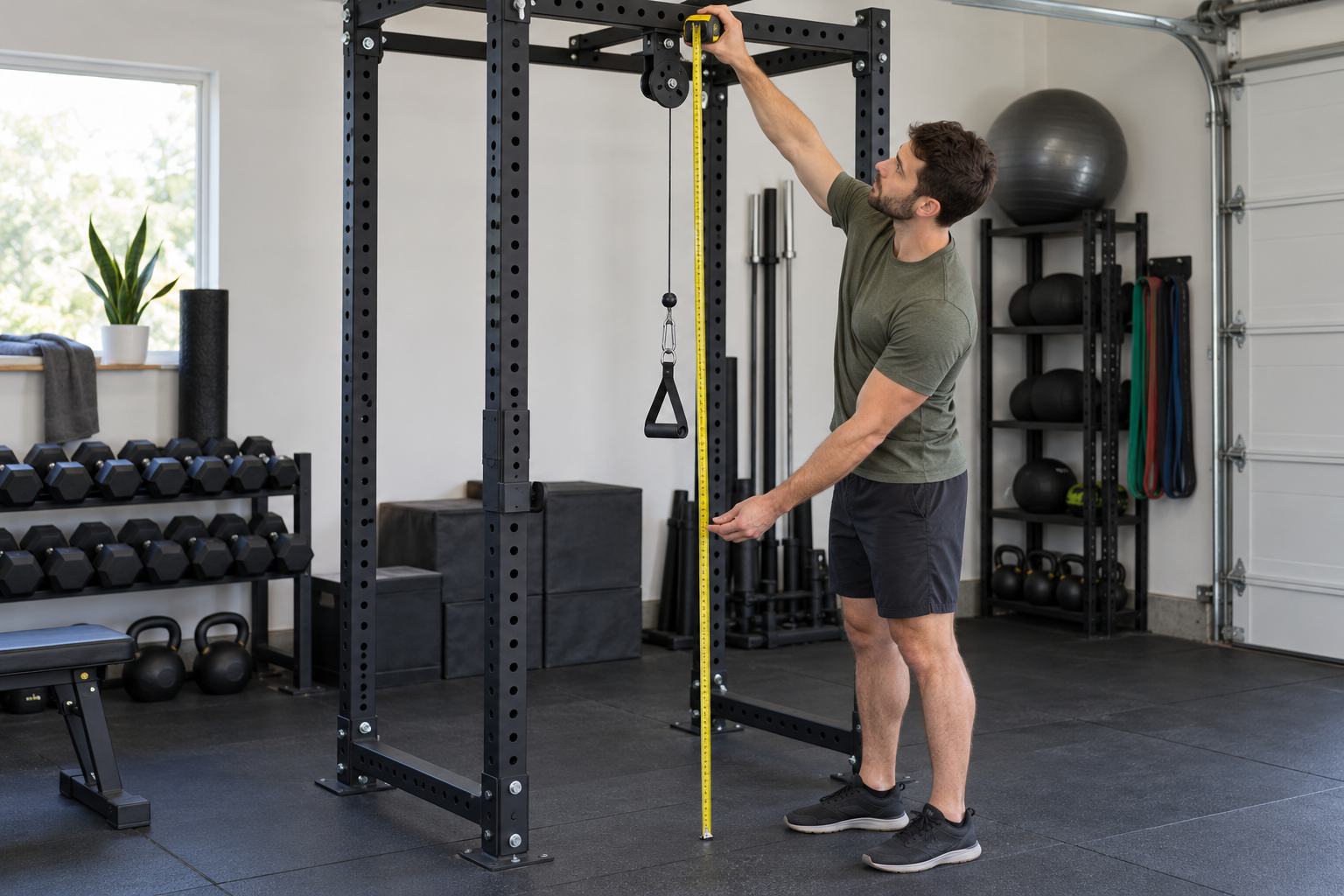
How to Measure a Home Cable Pulley Route Before Setup
Quick answer: Measure the cable route and the movement you need before choosing a pulley system for a home gym. A listed 70-inch or 90-inch cable length is the cable itself; usable handle travel also depends on how the line is routed, where the pulley sits, and how much room the exercise needs. Map the complete setup with a non-load-bearing string first, then compare it with the manufacturer’s instructions and the cable lengths supplied.
This check is useful when a compact pulley will hang from a rack or another approved support. It cannot tell you whether a ceiling beam, pull-up bar, door frame, or wall is safe to carry a dynamic load. If the support point is not clearly rated for the intended use, do not attach the equipment there.
Measure the route, not just the ceiling height
Write down the distance from the intended anchor to the lowest point the loading pin and plates will reach. Then trace the cable path through each pulley and connector to the handle. A route that turns around a pulley uses cable length without adding the same amount of vertical travel at the handle. The length printed on a listing is therefore not a direct promise of how far the handle can move.
- Mark the anchor point. Use only a structural support and connection method approved by the equipment maker. Do not drill or wrap a strap around an unknown beam based on appearance alone.
- Mark the bottom clearance. Account for the loading pin, the plate stack you actually plan to use, and the distance above the floor needed to avoid contact.
- Trace every bend. Follow the planned route around each pulley wheel and connector. Include the section from the cable end to the handle and from the cable end to the loading pin.
- Check the movement envelope. Mark where the handle begins and ends for the exercise you plan to do, leaving space for the user, attachment, and plates to move without striking walls or equipment.
- Compare the path with the supplied cable. A loose string can help visualize the route, but it does not stretch or carry load like the actual cable. Never use a string test as proof that a setup is strong enough.
Think about the exercise before choosing the route
A high pull-down and a low lift-up place the handle, loading pin, and user in different positions. The manufacturer’s product description lists both pull-down and lift-up modes, but it does not provide a custom room-layout drawing for your setup. For each intended movement, check the start and finish positions and confirm the cable remains guided through its pulley without slack, rubbing, or a sharp side angle.
Make one paper sketch for each arrangement you expect to use. A sketch should show the anchor, pulley, cable, loading pin, handle, user position, and nearby obstructions. If you need to move the pulley between exercises, follow the assembly directions and inspect the connection each time; do not improvise knots, splices, or substitute hardware.
Leave clearance for plates and the user
The hanging weight must be able to travel without hitting the floor, rack feet, a bench, or a person. Check the pin’s full path with no load first, then follow the equipment maker’s setup procedure for any loaded check. Keep people out from under suspended weights and out of the cable’s line of travel. Stop if a connector shifts, a cable frays, a pulley binds, or the support moves.
The WaxmanUSA listing describes an upgraded loading pin for standard or Olympic plates and states a maximum load of up to 280 pounds. Treat that as a product-page claim for the listed system only, not as the capacity of your rack, mounting point, plates, or homemade attachment. Those components may have different ratings. Do not exceed the lowest documented limit in the complete setup, and ask the manufacturer or a qualified installer when a support rating is unclear.
What the 70-inch and 90-inch options mean
The product page says the package includes 70-inch and 90-inch sheathed cables. Use the cable and routing intended by the maker for your selected configuration; do not assume the longer cable is automatically better or that it adds resistance. A longer line can provide more routing allowance, but it can also leave excess cable or change the handle’s usable travel. The previous distinction between cable-machine stack labels and resistance is separate: cable length by itself does not tell you the load felt at a handle.
If the product page or instructions do not show which cable goes with a particular route, ask WaxmanUSA before assembling. Do not cut or shorten a cable to make it fit. If neither supplied length gives the clearance and travel needed for a safe setup, choose a different mounting arrangement or equipment designed for that space.
Keep a simple setup record
Record the anchor location, pulley height, cable used, attachment, plate setup, and intended exercise. Take a photo of the unloaded route for your own reference, and compare it with the maker’s current instructions before each setup change. This helps you reproduce a layout; it is not a load test or certification.
The Waxman Fitness LAT and Lift Pulley System listing showed both 70-inch and 90-inch cables, a loading pin, straight bar and triceps rope, and a price of $43.00 USD when checked October 14, 2026. The page did not show a clear stock status in the product details. Price and availability may change; see product page.
Product details: Waxman Fitness LAT and Lift Pulley System

Waxman Fitness LAT and Lift Pulley System, 70- and 90-inch Cables
Product listing describes two cable lengths, a loading pin, straight bar and triceps rope. Confirm the attachment point, routing and clearance for your own rack and movement; the product’s listed load is not a rating for your home structure.
Price checked October 14, 2026: $43.00 USD. Stock status was not stated clearly on the product page. Price and availability may change; see product page.
Cover image is an AI-generated illustration of measuring a generic home-gym cable route, not a product photograph, installation demonstration, or load test. Text drafted with Codex; no coaching or engineering review is claimed.
Leave a Reply