
No products in the cart.
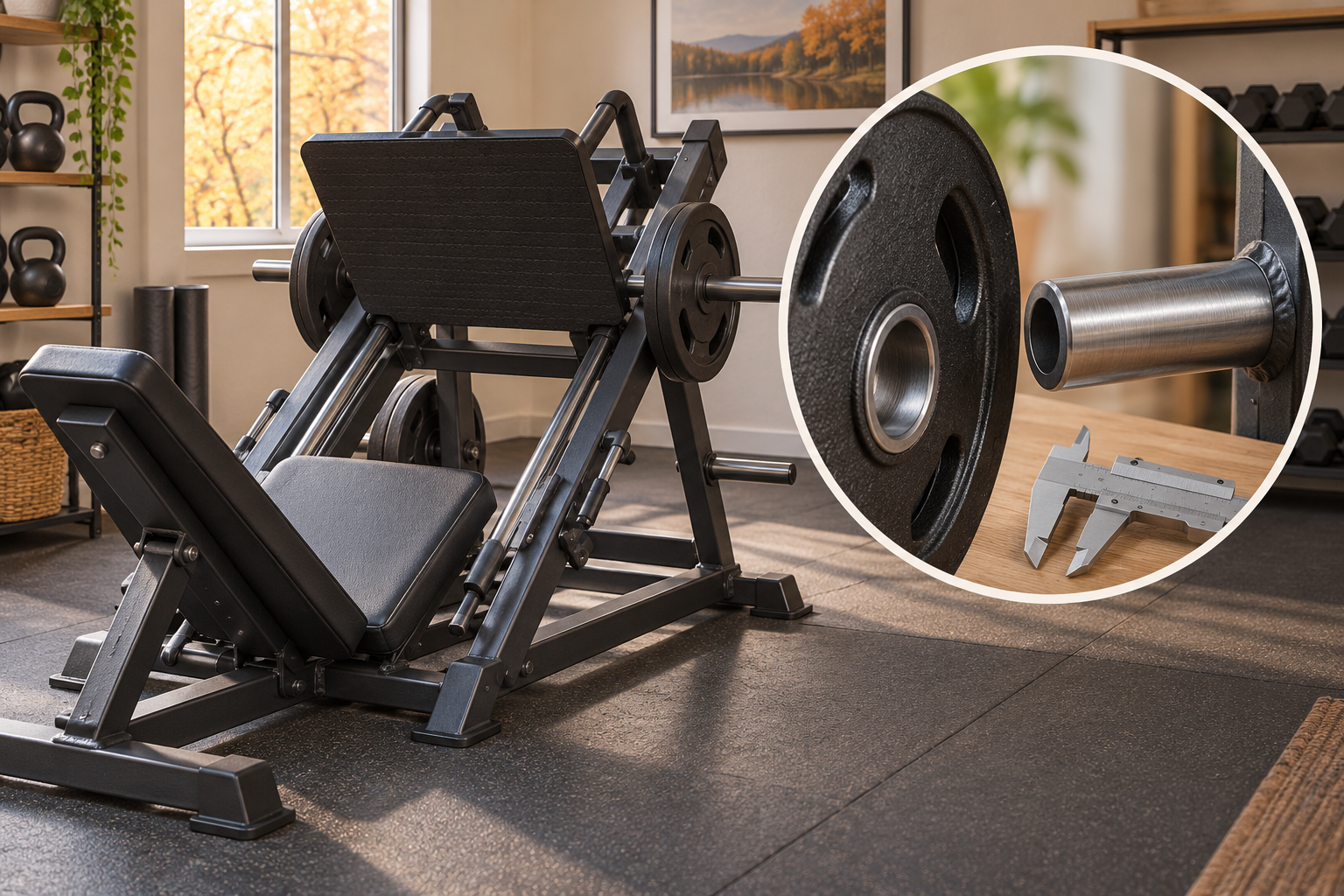
Will Your Existing Weight Plates Fit a Leg Press or Hack Squat Machine?
Quick answer: Your plates fit only when their center openings match the machine’s loading sleeves and the manufacturer approves that plate type. The Waxman leg press and hack squat listing says its plate bars fit 2-inch Olympic-sized plates. That does not mean every plate labeled “standard” or every machine uses the same interface. Check the plate itself, the exact machine instructions, and the collars before loading anything.
For fall and winter home-gym planning, sort out compatibility before moving a machine indoors or ordering a new set. A plate that slides onto a barbell may still be unsuitable for a machine’s loading post; similarly, a storage peg is not necessarily an exercise loading sleeve.
What does “2-inch Olympic plate” tell you?
It describes the intended center opening category, not the plate’s outside diameter, weight, thickness, or the exact measured diameter of every sleeve. For one documented example, Rogue lists its calibrated Olympic plates with a 50.4 mm center hole and notes that fit can vary on equipment that is not held to specification. Use the plate maker’s stated bore and your machine maker’s instructions together. A familiar label is a useful first filter, not a substitute for checking the actual equipment.
The Waxman 2-in-1 leg press and hack squat listing states that its plate bars fit 2-inch Olympic-sized plates. The current listing also shows a 5-degree leg press/hack squat design, adjustable lockout positions, three-level safety limiters, and assembled dimensions of 77.5 × 38.3 × 57.4 inches. These are listing details, not a universal specification for other machines or a guarantee that a particular plate set will fit.
How to check your existing plates before buying
- Find the plate maker and exact model. Check a label, receipt, manual, or product page. “Olympic” and “standard” are commonly used categories, but the exact manufacturer specification is more useful than a name remembered from a previous gym.
- Look up the center-hole or bore measurement. Confirm that the information belongs to your plate model and unit system. Do not measure only the outer rim, and do not infer the bore from the plate’s weight or color.
- Read the machine’s manual for its exercise sleeves. Confirm approved plate type, loading procedure, collars, and any load limits. If the listing says “2-inch Olympic,” ask the seller or manufacturer to clarify the sleeve size and compatible collar when your plate documentation is ambiguous.
- Separate loading sleeves from storage pegs. A machine may have posts for storing plates as well as sleeves used during exercise. Storage posts do not automatically authorize a plate for use on the moving carriage.
What if a plate seems close but does not slide on?
Do not hammer, pry, grease, or force it. A tight fit can signal a mismatch, damage, corrosion, a burr, or a measurement issue. Stop and compare both manufacturers’ specifications. Do not assume an adapter is safe unless the machine maker explicitly approves that exact adapter and setup; added parts can change how a plate is retained.
If a plate slides on, that alone still does not prove the arrangement is safe. Confirm that the collar is the correct type, engages as instructed, and retains the plate through the machine’s full permitted movement. Use the manufacturer’s loading and unloading sequence, and keep hands clear of moving parts. If any part is damaged, loose, or unclear, do not train on the machine until the manufacturer or a qualified service professional resolves the question.
Check more than the center opening
Compatibility has several parts. A plate’s thickness affects how many plates can fit on a sleeve. Its outside diameter and shape can matter for clearance around the frame or floor. The machine’s stated capacity is a separate limit: never treat the capacity printed on an individual plate, rack, or accessory as permission to exceed the machine’s instructions. Confirm whether the stated limit covers the carriage, added plates, or another component before planning a load.
For the Waxman model, the product page advertises 2-inch Olympic plate compatibility and provides a product capacity statement. Follow the manual for the meaning and conditions of every limit; do not calculate a safe working load by combining unrelated numbers from different products. Use only the exercise configuration and adjustments the instructions allow.
A simple pre-purchase checklist
- Record each plate set’s manufacturer, model, units, and documented center opening.
- Confirm the selected machine’s exercise sleeve type—not just its storage-post size.
- Ask about collar compatibility, plate thickness, loading order, and applicable limits.
- Check the machine footprint and delivery route separately from plate fit.
- Keep the answer from the manufacturer with your purchase records if the listing is unclear.
Bottom line: Match documented plate bore to the machine’s approved loading sleeve, then verify collars and operating limits in the instructions. “Two-inch Olympic” narrows the search, but your exact plate and machine documentation decide the fit.

View product and current price
Product price checked October 15, 2026. This is a page snapshot; price and availability may change. Cover illustration is AI-generated and illustrative, not a product photo or test image.
Leave a Reply