
No products in the cart.
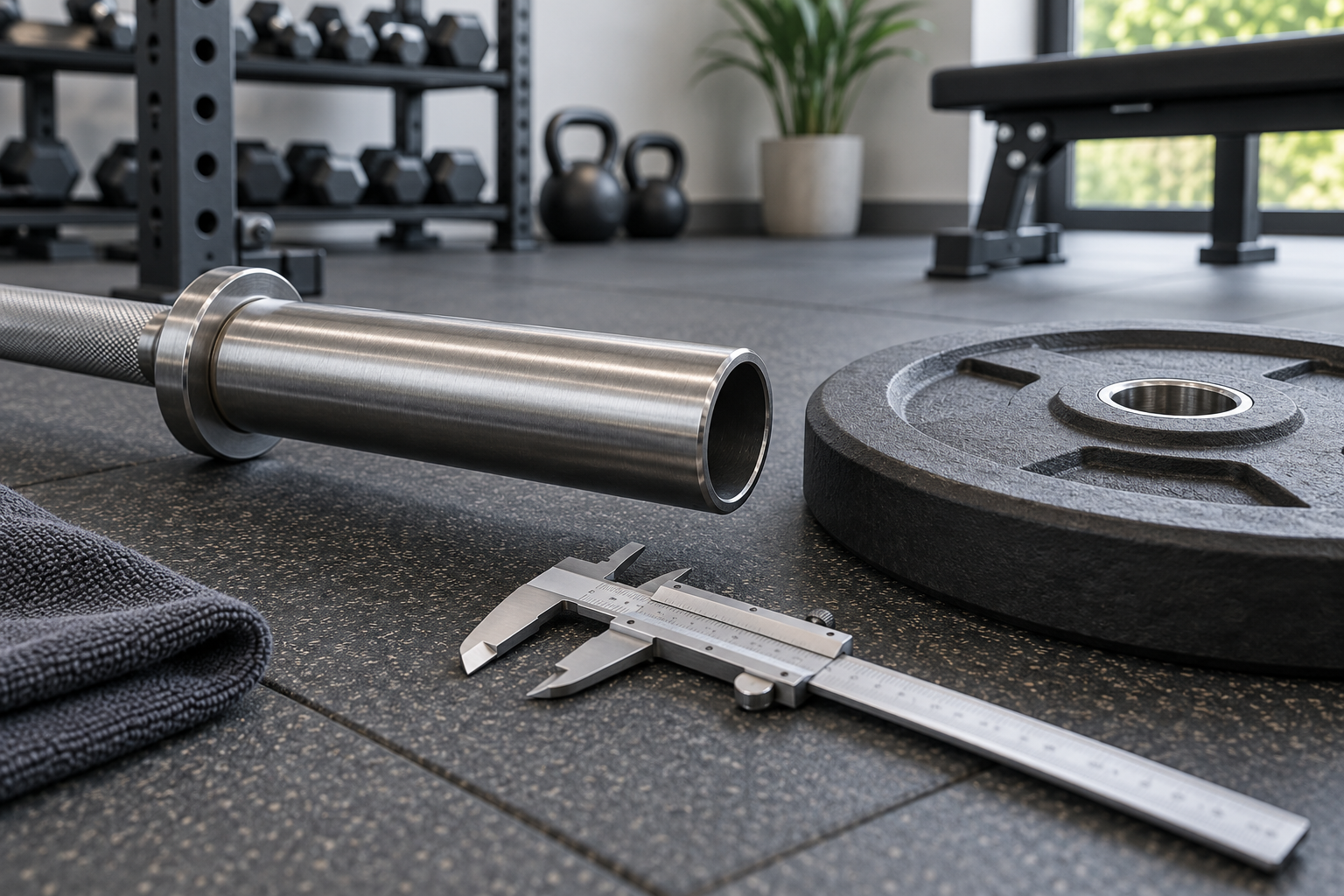
How to Check Whether Weight Plates Fit a Barbell Before Loading
Quick answer: check the bar sleeve diameter and the plate’s center-hole specification before loading. “2 inch” is often a rounded product label, so compare the manufacturers’ compatibility information rather than relying on the wording alone. Test one plate on an unloaded bar. If it binds, rocks excessively, or will not seat normally, stop; do not hammer or force it into place.
Image note: The cover is an AI-generated illustration of a fit check, not a product photograph or a tested setup.
Start with the two parts that must match
A barbell’s loading sleeve is the section that holds the plates. A plate’s center bore is the opening that slides over that sleeve. The relevant comparison is between the sleeve’s outside diameter and the plate bore—not the bar’s shaft diameter, the plate’s outer diameter, or the overall length of the bar.
Look for both measurements in the product manuals or specifications. Some makers describe a standard sleeve and plate bore as 50 mm or “2 inch.” Those labels are rounded: 50 mm is about 1.97 inches, while an exact 2 inches is 50.8 mm. This does not mean every part labeled “2 inch” will fit every other part. Prefer the maker’s explicit compatibility statement, and ask the seller if the bar and plates come from different systems or the documentation is unclear.
Read the listing carefully
Do not use a bar’s length or listed weight as a substitute for sleeve dimensions. A “7 ft, 45 lb” description tells you about the model’s stated overall length and weight, but it does not independently identify every detail of its sleeves, collars, or plate fit. Check the specifications for the exact bar model and the exact plates you own.
WaxmanUSA’s product page describes its 7 ft Olympic barbell as 45 lb and says it fits 2 inch standard weights. That is the seller’s compatibility description for this listing. It is not a universal rule for other bars or plates. If you are pairing components with another manufacturer’s equipment, confirm both sides’ specifications first.
Make a careful unloaded fit check
- Put the bar on a stable rack or on the floor in a way that prevents it from rolling. Keep the area around it clear.
- Check the sleeve and plate bore for dirt, burrs, visible damage, or a bent sleeve. Do not lubricate or modify parts unless the maker’s instructions call for it.
- Slide one plate onto the unloaded sleeve by hand. It should move without being driven by impact and should not be so loose that it can shift unpredictably.
- Remove the plate and repeat on the other sleeve. A problem on only one side can point to damage or a different part specification.
- Check that the collar is intended for the sleeve size and can secure the plate according to its instructions. A collar restrains a compatible plate; it does not make an incompatible plate fit.
This is a basic compatibility check, not an inspection certificate. If you find damage, an irregular fit, or uncertain parts, stop using the setup and ask the manufacturer or a qualified equipment technician to identify the components.
Why a collar is a separate fit question
Collars also have an opening that must match the bar sleeve. For example, Eleiko lists a spring collar with a 50 mm (1.97 in) hole and states that it fits standard 50 mm/2 in bars. That example shows why it helps to compare the actual collar specification instead of assuming that any clamp labeled “Olympic” will fit every sleeve. Use the instructions supplied with your collar and verify that it closes and stays in place as designed.
Keep the collar outside the loaded plates on the sleeve. Before each set, confirm the plates are fully on the sleeve and the collar is secured. If you are unfamiliar with the equipment, ask a qualified coach or gym staff member for an in-person demonstration.
Common reasons a plate does not fit
- Different nominal standards: the bar and plate may use different sleeve or bore sizes despite similar marketing terms.
- Measurement confusion: someone may have measured the bar shaft rather than the sleeve, or the plate’s outer edge instead of its center hole.
- Damage or obstruction: rust, debris, a burr, or a bent part can prevent normal movement even when the nominal sizes match.
- Unclear third-party listing: “standard” and “Olympic” are not enough detail when the actual compatibility specification is missing.
Do not sand, pry, hammer, or otherwise alter a plate or bar to make the fit work. If the fit is uncertain, keep the components unloaded until their sizes and condition are confirmed.

Waxman 7 ft Olympic Barbell, listed as 45 lb
$69.00 USD on October 12, 2026. The product page says it fits 2 inch standard weights. Confirm exact plate and collar compatibility before use; price and availability may change.
Sources
- WaxmanUSA product page (checked October 12, 2026).
- Eleiko, Spring Coil Barbell Collars 50 mm (manufacturer specification for one collar model; used only as a sizing example).
Leave a Reply