
No products in the cart.
How to Check Home Gym Rack Clearance Before You Buy
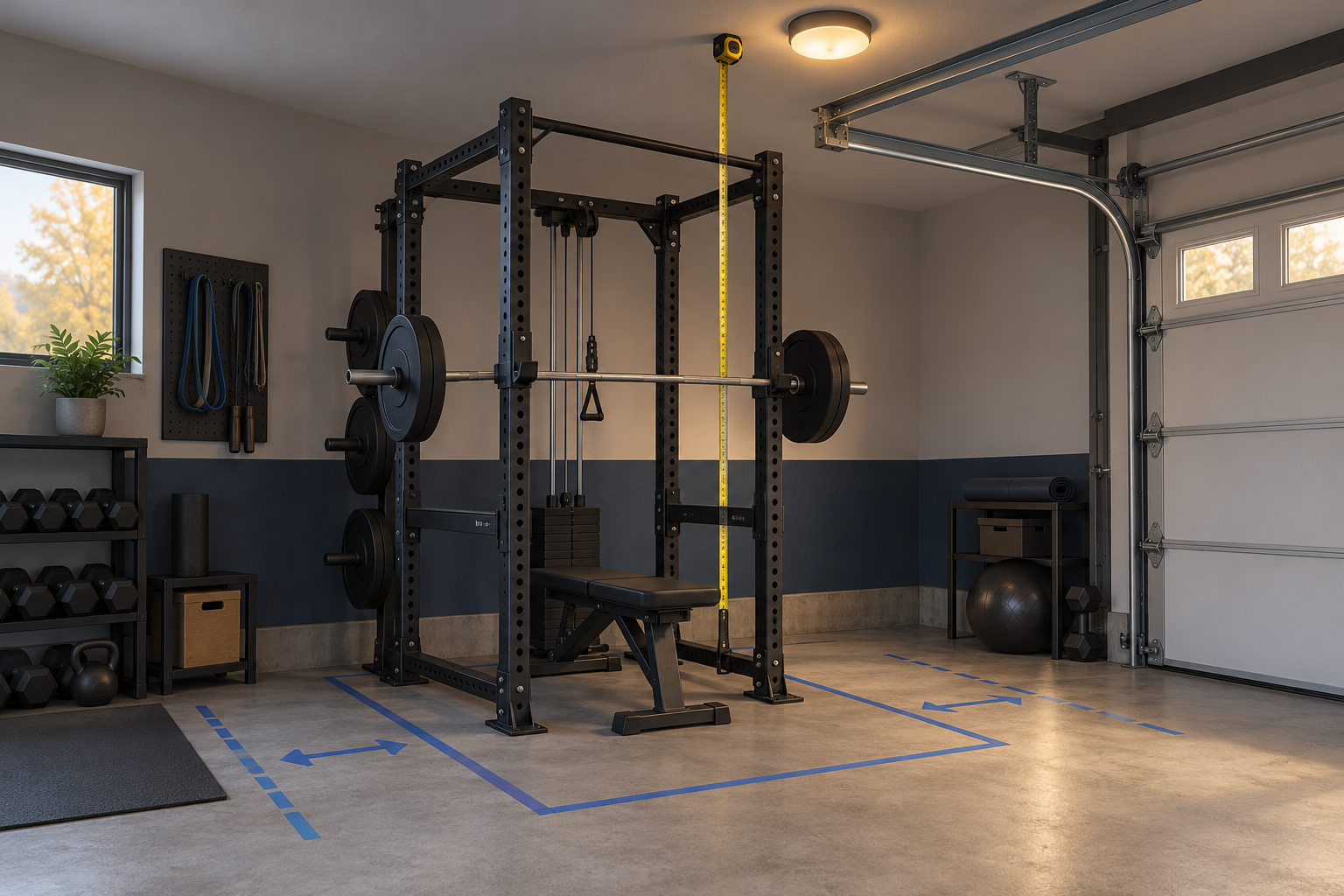
Cover illustration: AI-generated planning visual, not a product photograph or a measured room layout.
Quick answer: Before buying a large home-gym rack, measure the full route into the room, the assembled footprint, overhead obstructions, and the space needed to use every station. Then compare those measurements with a current assembly manual. If a product page gives conflicting dimensions, get written clarification from the seller before ordering; do not guess which number is correct.
This matters especially in fall, when a garage or spare room may be converted into an indoor training area. A frame that appears to fit on a floor plan can still conflict with a garage-door track, ceiling light, low beam, or the movement path of a bar and cable attachments.
Start with the room, not the product photo
Measure the room at the proposed location rather than relying on its advertised width or a real-estate floor plan. Record the clear floor length and width, finished-floor-to-ceiling height, and the lowest obstruction above the equipment area. Include ducts, joists, door tracks, open garage doors, light fixtures, and sloped ceilings. Check more than one point because older garages and basements are not always level.
Mark the candidate area on the floor with painter’s tape. Use the product’s documented assembled length and width only after confirming that they describe the complete assembled machine. A rack’s footprint is only the first check: it does not show how far a bench, bar, or user extends beyond the uprights.
Map each station’s working envelope
A multifunction rack combines different movements in one frame, so test each one on the tape outline. Sketch the bar’s path for a squat or press, a bench’s position, and the cable handles’ travel. Leave a practical route to enter and exit each station and to move plates or attachments without crossing another user’s path. The manufacturer’s manual should identify any required operating clearances; do not treat a generic diagram or another brand’s measurements as a substitute.
Check the whole movement, not just the starting position. A bar can extend beyond the rack’s uprights, and a cable handle can travel sideways. If the instructions do not state how much open space to leave, ask the manufacturer or seller for a model-specific answer before purchase. Avoid putting equipment where a moving bar or attachment could strike a door, window, stored items, or another person.
Measure ceiling and assembly access separately
Compare the room’s lowest clear height with the manufacturer’s assembled height, but do not assume that a close fit will work. Pull-ups, overhead presses, and other movements may require more vertical room than the frame itself. Assembly can also need temporary clearance to raise or join sections. Ask for both the operating-height requirement and the assembly method for the exact model; a product’s standing height alone does not answer either question.
Also measure the delivery route: door openings, hallway turns, stair landings, and the narrowest point into the garage or basement. A listing’s shipping-box dimensions help only if all packages and the actual assembly plan are understood. Large equipment may require multiple people to assemble; follow the maker’s instructions and do not improvise lifting or anchoring steps.
Resolve dimension conflicts before you commit
Use a simple checklist: model name and version; assembled height, length, and width; operating clearance around each station; assembly clearance; package count and dimensions; and any floor or anchoring requirements. Save the product page and written answer with the date, since listings can change. If the seller cannot reconcile a mismatch, choose a product with complete dimensions or wait for clarification.
For example, the Waxman listing for its Smith Machine WAX-SM-S02 states an assembled dimension of 87.2 inches high by 71 inches long by 48 inches wide in one section. The same page’s specifications table separately shows “Item Dimensions” of 83 x 6.7 x 13 inches, alongside a package dimension of 81 x 15 x 7 inches. These entries do not explain how they relate to the assembled frame. Treat the size as unresolved and ask Waxman to confirm the assembled measurements and required use and assembly clearances before deciding whether it fits.
Consider the floor and the rest of the room
Before placing a heavy rack, check the floor type and the equipment maker’s guidance for the intended surface and any anchoring. The product page’s stated maximum capacity is not a floor-load assessment and does not establish that a particular garage slab, raised floor, or installation is suitable. If the room is above another occupied space or you are uncertain about the structure, consult a qualified building professional rather than inferring capacity from the product listing.
Keep a clear route to the room’s exit and preserve access to electrical panels, water shutoffs, garage controls, and other required utilities. Store loose plates and accessories where they cannot roll into a walkway. These are practical layout checks; they are not a substitute for model-specific installation and safety instructions.
Product details to verify
The Waxman Smith Machine WAX-SM-S02 product page describes a combined Smith machine, rack, cable crossover, and pull-up station. The page lists a current price of $1,999.90 USD and a maximum weight recommendation of 2,200 lb; neither detail resolves room fit, floor suitability, or the dimension discrepancy above. Price and availability may change. Check the page and request written confirmation before purchase.

Waxman Smith Machine WAX-SM-S02
Listed combination rack, Smith machine, cable crossover, and pull-up station. The page’s size entries conflict; confirm the assembled dimensions and clearances with Waxman before relying on fit.
$1,999.90 USD (listed Oct. 13, 2026). Price and availability may change; see the product page.
A short pre-purchase fit check
- Measure the actual room and lowest overhead obstruction.
- Confirm complete assembled dimensions, operating clearance, and assembly requirements for the exact model.
- Tape out the footprint and simulate the bench, bar, and cable movements without equipment.
- Check the delivery route, floor guidance, and required anchoring instructions.
- Get written clarification when listing measurements conflict; postpone the purchase if they remain unresolved.
Scope: This is a room-planning checklist, not an installation approval or individualized exercise advice. Use the manual supplied for the exact product and consult a qualified professional for structural questions.
Leave a Reply