
No products in the cart.
Do You Need a Periodized Plan for Leg Press Workouts?
Cover image: AI-generated illustration for context. It is not a product photograph or evidence of workout results.
For most healthy adults doing general resistance training, a complicated periodized plan is optional. The American College of Sports Medicine’s 2026 position stand says complex periodization did not consistently change outcomes for the average healthy adult. A simple, repeatable schedule that you can follow is a reasonable place to begin. More detailed cycles may help when you have a specific sport or performance goal, but general guidance cannot build an individualized program for you.
What periodization means
Periodization is a planned way of changing training variables over time. A program might rotate higher- and lower-effort weeks, change the number of sets, or emphasize different outcomes in successive blocks. This can be useful for a defined goal, but the word does not automatically make a workout more effective. The 2026 ACSM review found complex periodization did not consistently change outcomes for the average healthy adult. That finding is not a claim that all programs are identical or that planning is pointless.
A weekly routine is still a plan. You can choose a realistic schedule, record your leg-press work, and make gradual adjustments without writing a multi-month cycle with many phases. If an elaborate spreadsheet makes you skip sessions, simplify it. Consistency and a plan that fits your circumstances matter more than adding complexity for its own sake.
Use a repeatable baseline first
- Choose one machine mode. If your machine can be used as a leg press or hack squat, follow the manual for the selected mode. Record the mode so that later sessions are comparable.
- Use a stable setup. Set the seat, foot platform, lockout, and safety limiter according to the specific product instructions. Do not infer a position from another user or from this article.
- Log your work. Write down the date, mode, machine settings, plates, sets, repetitions, and any reason you stopped. Plate totals do not translate directly between different machines.
- Repeat before changing. Keep enough of the setup consistent to notice whether the planned work is manageable and whether you can recover for the next scheduled session.
- Adjust one variable at a time. If your work is consistently manageable, you might gradually change a load, repetition target, or number of sets. Avoid changing all three at once, and stop if technique or comfort deteriorates.
This is a tracking framework, not a prescribed workout or a promise of a particular result. ACSM’s recommendations are general guidance for healthy adults. Training history, goals, schedule, recovery, and health conditions can change what is suitable.
When a more detailed cycle may make sense
Athletes preparing for a competition, people following a coach-designed plan, or experienced trainees with a defined performance objective may have reasons to vary training in a structured way. ACSM notes that sport-specific or avid trainees can require more specific planning. In those cases, work with a qualified coach who can account for the full program rather than periodizing one machine exercise in isolation.
You may also need to modify a plan because of a changing schedule, recovery, or advice from a health professional. Those changes are not failures. A useful plan should remain safe, practical, and compatible with the rest of your activity. Do not increase training simply because a calendar says a new phase has begun.
Keep the question tied to the right decision
“Do I need periodization?” is different from “When should I add weight?” If your current repetitions are controlled and your setup is repeatable, see our guide on deciding when to increase leg-press weight. If you are choosing between strength and muscle-growth priorities, read how those training emphases differ. These questions can be addressed without assuming that every trainee needs a complex block plan.
With a two-mode machine, keep leg-press and hack-squat notes separate. The sled, angle, and machine mechanics affect how a load feels, so do not treat the same number of plates as an equivalent effort in both modes. Use the manufacturer’s instructions for adjustments and safety controls, and contact the maker if the manual or a control is unclear.
Product context
The WAXMAN Leg Press Hack Squat Machine listing describes a plate-loaded, two-in-one leg press and hack squat, with three-level adjustable safety limiters and bars listed for 2-inch Olympic-sized plates. Those are product-listing details, not a training prescription or confirmation that the machine suits every user. Follow its exact manual for setup and operation.
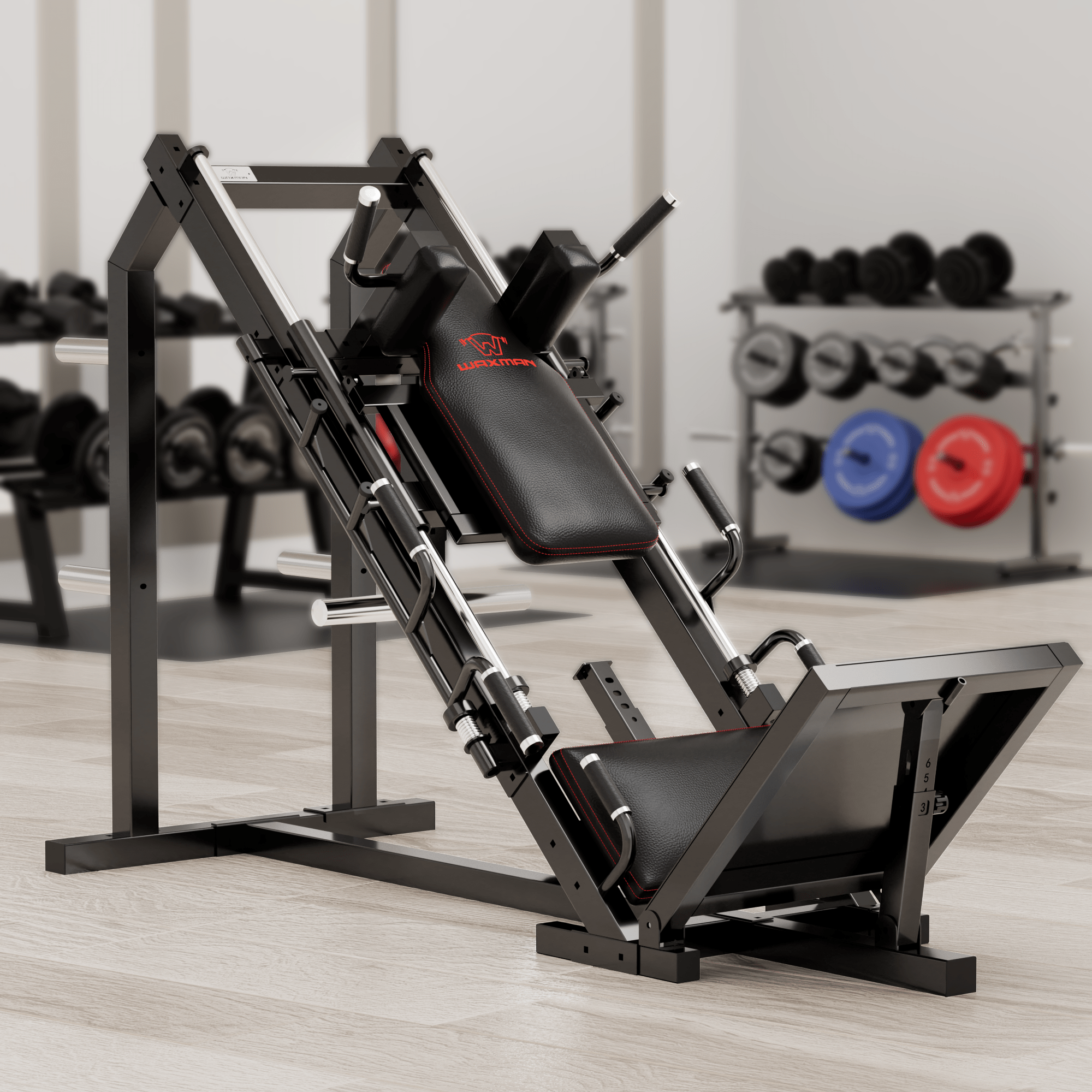
WAXMAN Leg Press Hack Squat Machine
Two exercise modes; three-level adjustable safety limiters; listing specifies 2-inch Olympic-sized plates.
$799.00 USD $1,499.00 USD
Price checked October 7, 2026. Price and availability may change; see product page.
Source: American College of Sports Medicine, 2026 resistance-training guideline summary; Waxman product listing, checked October 7, 2026.
Written with Codex assistance; no coach review or product/workout test is claimed.
Leave a Reply