
No products in the cart.
Leg Press Training for Strength vs. Muscle Growth: What Should Change?
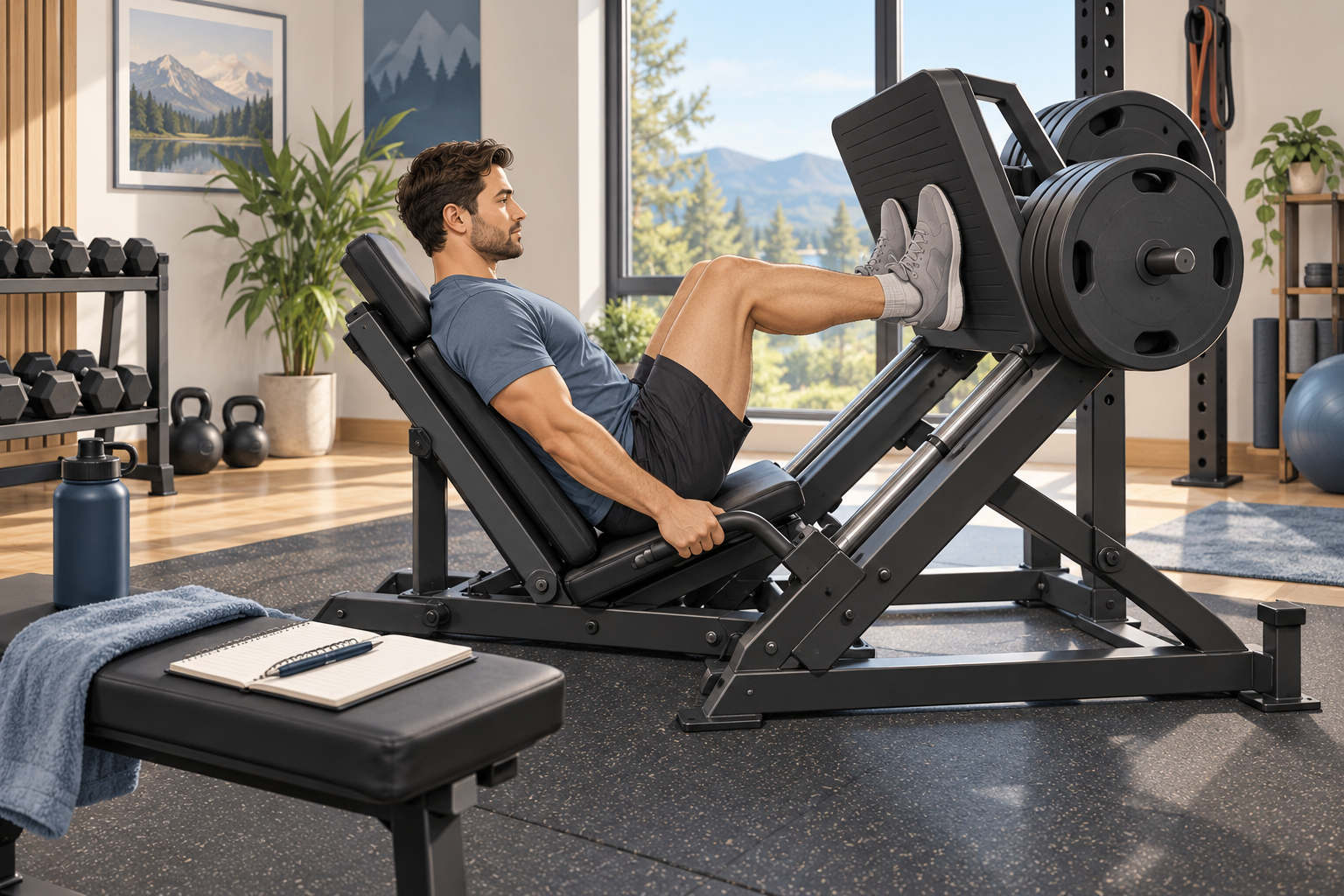
Illustration disclosure: The cover image is AI-generated and illustrative. It is not a product photo, workout demonstration, or tested result.
If you use a leg press for strength, prioritize a manageable number of controlled sets with a relatively heavy load; if your main goal is muscle growth, plan enough challenging weekly work that you can recover from and repeat. You do not need a different machine for each goal. The American College of Sports Medicine’s 2026 guidance highlights heavier loads for strength and higher weekly training volume for hypertrophy, while emphasizing a routine that fits the person and can be followed consistently. These are general principles for healthy adults, not an individual prescription.
The question is not simply “How many reps should I do?” First decide which outcome matters most, then choose a repeatable leg-press setup and a training plan that matches it. Keep the machine’s own instructions in charge of seat or back-pad settings, safety limiters, movement range, and entry or exit.
What changes between strength and muscle growth?
Strength is your ability to produce force in a task. To emphasize it, ACSM’s 2026 summary recommends heavier loads—around 80% of one-repetition maximum (1RM)—for two to three sets per exercise. A 1RM is the most weight someone can lift once under specified conditions. It is not necessary to test a true maximum on a home machine to use the broader idea: strength-focused work generally gives priority to challenging loads, controlled execution, and adequate recovery.
For hypertrophy, or increasing muscle size, the same ACSM summary points to higher weekly volume, approximately 10 sets per muscle group as a useful reference. That figure is a general programming point, not a mandatory quota or a guarantee of growth. It refers to total weekly work for a muscle group, not ten sets on every exercise or in every session. Your current training, recovery, schedule, and tolerance all affect what is practical.
The overlap matters: a program can improve both strength and muscle size. The difference is which quality you emphasize when time and recovery are limited. If you want both, use a sustainable mix rather than trying to make every session maximal.
Turn the goal into a workable leg-press plan
If strength is the priority
Choose a load that feels challenging while letting you keep the same deliberate technique for each repetition. Rest enough between sets to repeat that effort without rushing. Record the machine mode, seat setting, load, repetitions, and how the set felt. Comparing sessions is useful only when the setup and movement are reasonably consistent.
Do not infer a precise percentage of your 1RM from the number of plates on a sled. Machine angle, carriage mass, friction, and leverage vary, and the manufacturer’s stated capacity is not a recommended training load. If you are not accustomed to heavy training, get an appropriately qualified coach to help establish a starting point; you can train without a one-repetition maximum test.
If muscle growth is the priority
Think across the week, not just about one hard workout. Count your challenging lower-body sets in the context of the rest of your program, then add volume gradually only if you can recover and maintain your normal activities. You do not have to reach momentary failure on every set; ACSM reports that advanced methods such as training to failure did not consistently improve outcomes for the average healthy adult.
Use a load that allows controlled repetitions through a comfortable range. Stop a set when you can no longer maintain the movement or when discomfort changes your technique. A high weekly set target is not useful if it leads to rushed repetitions, persistent soreness that disrupts training, or missed sessions. Consistency is part of the plan.
Keep comparisons fair and the machine setup safe
A leg press and a hack squat are separate exercise modes, even when one frame offers both. Do not compare their plate totals as though the resistance were identical. Choose one mode for the training block, follow its instructions, and use the same adjustment points when logging sessions. If you later switch modes, treat it as a new exercise and select the setup and load again from the manufacturer’s directions and your own ability.
Before each session, check the machine and work area, use the prescribed locking and safety limiter procedure, and keep bystanders clear. Do not copy another person’s foot position or depth as a universal standard. If the manual is unavailable or a lockout control is unclear, contact the maker before loading the carriage. Stop for sharp pain, dizziness, chest discomfort, or unusual shortness of breath; seek clinical guidance when health conditions or injury affect exercise choices.
A simple decision rule
- Mostly strength: prioritize heavier, controlled work and enough rest to repeat it well.
- Mostly muscle growth: plan challenging sets across the week and build volume only as recovery allows.
- Both: choose a sustainable balance and track the outcome you care about, rather than changing several variables at once.
ACSM’s recommendations summarize evidence for healthy adults. They cannot determine your personal load, diagnose pain, or replace the exact machine manual or individualized coaching. For a related progression question, see our guide on when to increase leg-press weight.
Product details
The WAXMAN Leg Press Hack Squat Machine is listed as a plate-loaded, two-in-one leg press and hack squat with three-level adjustable safety limiters and plate bars for 2-inch Olympic-sized plates. The listing shows assembled dimensions of 77.5 × 38.3 × 57.4 inches and a current displayed price of $799.00 USD, with a $1,499.00 comparison price, checked October 7, 2026. These listing details do not establish an appropriate training load or suitability for every user. Price and availability may change; see the product page.
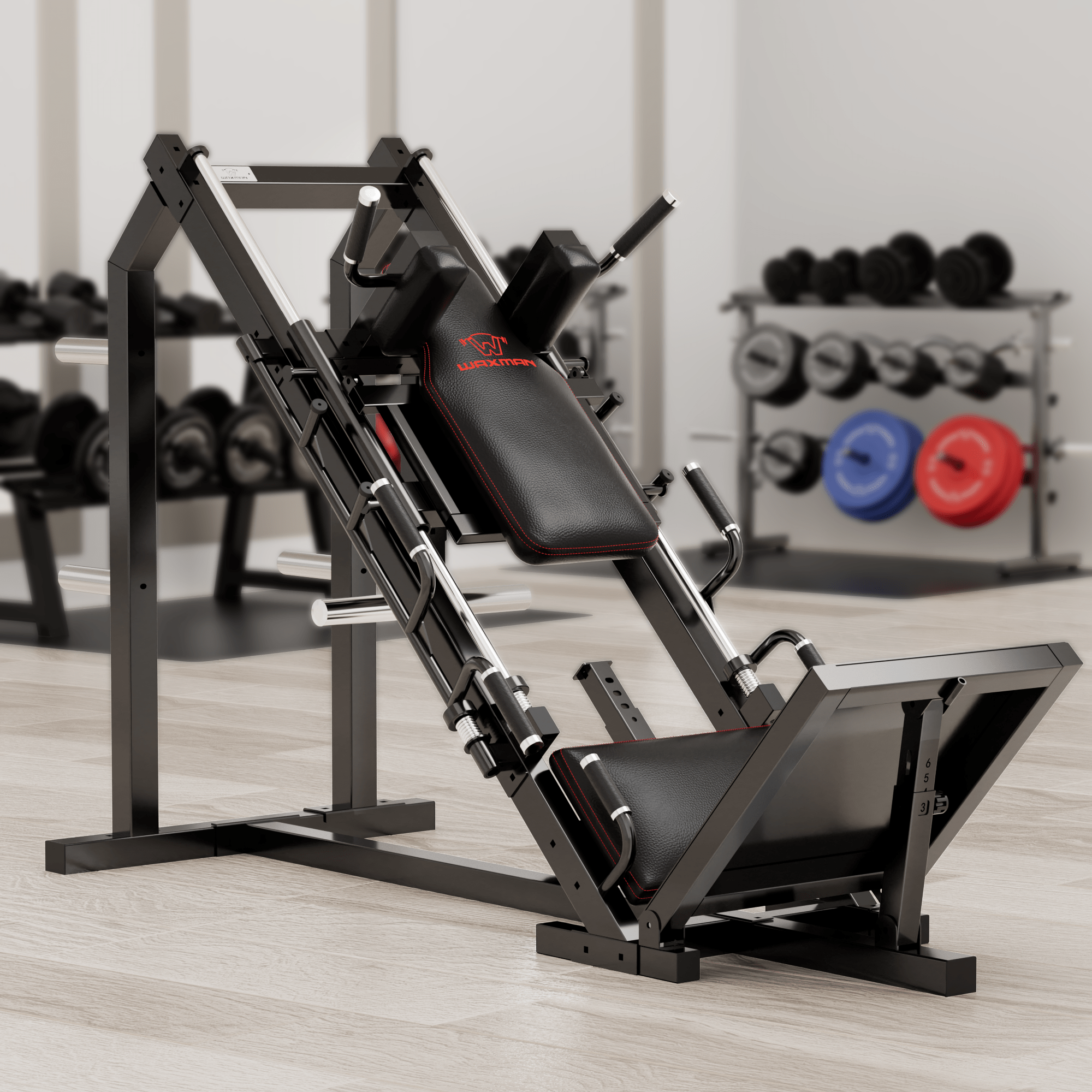
WAXMAN Leg Press Hack Squat Machine
Two exercise modes; three-level adjustable safety limiters; fits 2-inch Olympic-sized plates, according to the listing.
$799.00 USD $1,499.00 USD
Price checked October 7, 2026. Price and availability may change; see product page.
Written with Codex assistance; no human review, workout test, or product test is claimed.
Leave a Reply