
No products in the cart.
Does Leg Press Foot Position Change Which Muscles Work?
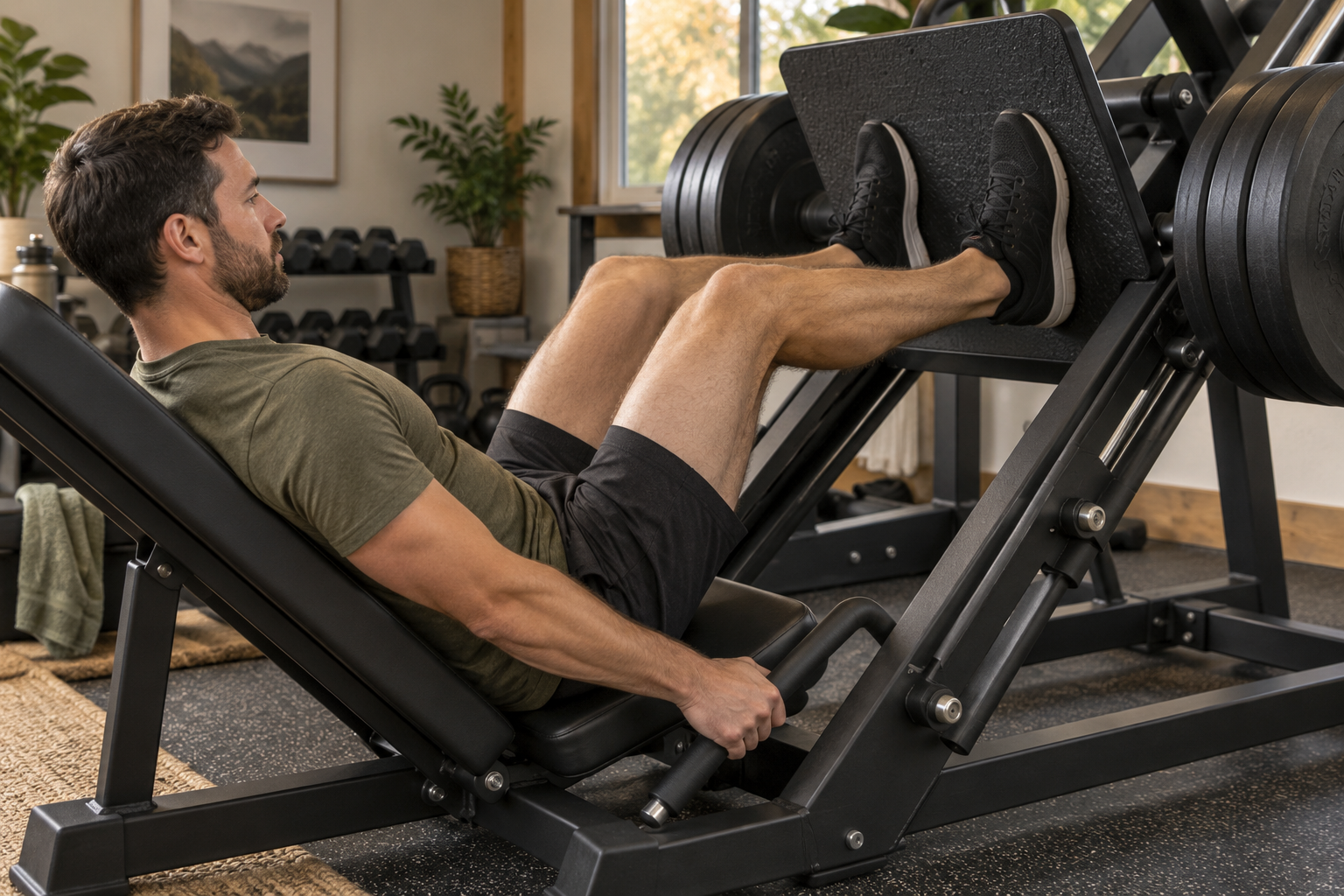
Cover image: AI-generated illustration of a generic leg-press setup. It is not a Waxman product photograph or a training test.
For most home lifters, there is no proven “magic” foot position on an inclined leg press that reliably shifts the exercise to one muscle group. In a study of 28 healthy, resistance-trained young adults, researchers found no significant differences in measured muscle activation across the tested foot widths and toe angles. Start with a position that feels stable and comfortable, keep your feet in contact with the plate, and follow your exact machine’s instructions. The study does not prove that every stance is equivalent for every person or machine.
What the research tested
Martín-Fuentes, Oliva-Lozano, and Muyor compared five inclined leg-press conditions: feet about hip-width apart or 1.5 times hip width, toes facing forward or turned outward by 45 degrees, and two movement speeds. The researchers recorded surface electromyography (EMG) and movement measures during the exercise. They reported no significant muscle-activation differences tied to the tested stance width or toe angle.
This is useful evidence against treating a narrow, wide, high, or turned-out stance as a guaranteed way to isolate a muscle. But it was a single acute study with 28 young adults who already had at least a year of resistance-training experience. It examined an inclined leg press, specific positions, and short-term EMG—not long-term muscle growth, injury risk, every body type, or every machine design. EMG readings are not the same thing as proof that one setup produces more muscle growth.
Use comfort and control to choose your stance
Begin with both feet fully supported on the footplate, roughly around hip width if that feels natural. Keep your heels and the front of each foot in contact as you press. Let your knees travel in the same general direction as your toes, without forcing an exact angle. A small change in foot width or toe angle may feel more comfortable for one person than another; it does not need to be framed as a special muscle-targeting trick.
Use a light load while you check the setup. Move through a controlled range that you can manage without your heels lifting, knees collapsing inward, or hips and lower back shifting away from the back pad. These are practical observations, not a medical assessment or a universal range-of-motion prescription. The machine’s design, your mobility, and the model manual determine what setup is appropriate. If you feel sharp pain, numbness, or unusual symptoms, stop and consult a qualified health professional.
Change one variable at a time
- Set up the machine first. Follow the maker’s instructions for seat/back position, carriage release, and safety stops. Do not copy another machine’s adjustments.
- Choose a comfortable starting stance. Use a width and toe angle that allow your whole foot to stay supported and your knees to move comfortably.
- Try several unloaded or lightly loaded repetitions. Notice whether your heels stay down, your feet remain planted, and the carriage moves smoothly through the range you can control.
- Make a small adjustment only if needed. Move your feet slightly wider, narrower, or rotate them a little, then reassess comfort and control. Avoid changing stance, depth, and load all at once.
- Keep the position that you can repeat. If your goal is to track progress, consistent setup makes sessions easier to compare. You do not need to keep changing foot position to make the exercise effective.
Why “high feet for glutes” can overstate the evidence
Popular cues often promise that placing the feet higher or wider will “target” a particular muscle. The study above did not test every possible foot height, every machine angle, or every individual, so it cannot settle every variation. At the same time, a small change in where you feel effort does not establish a long-term training advantage. Use a comfortable stance for controlled repetitions and select exercises based on your broader program, rather than chasing a foot position that is advertised as a guaranteed shortcut.
The WAXMAN Leg Press Hack Squat Machine listing describes a plate-loaded two-in-one leg press and hack squat with three-level adjustable safety limiters and bars for 2-inch Olympic-sized plates. Those are listing facts; the product page does not establish a universally correct foot stance. Confirm the exercise mode and adjustment procedure in the instructions supplied for your equipment.
Quick answer
Try a stable, comfortable stance and prioritize repeatable control. Research on one inclined leg-press model found no measured EMG advantage for the specific widths and toe angles it compared. That result is limited to those conditions and does not compare long-term muscle growth or guarantee safety. Follow your machine’s instructions and ask a qualified coach or clinician for individualized help when needed.
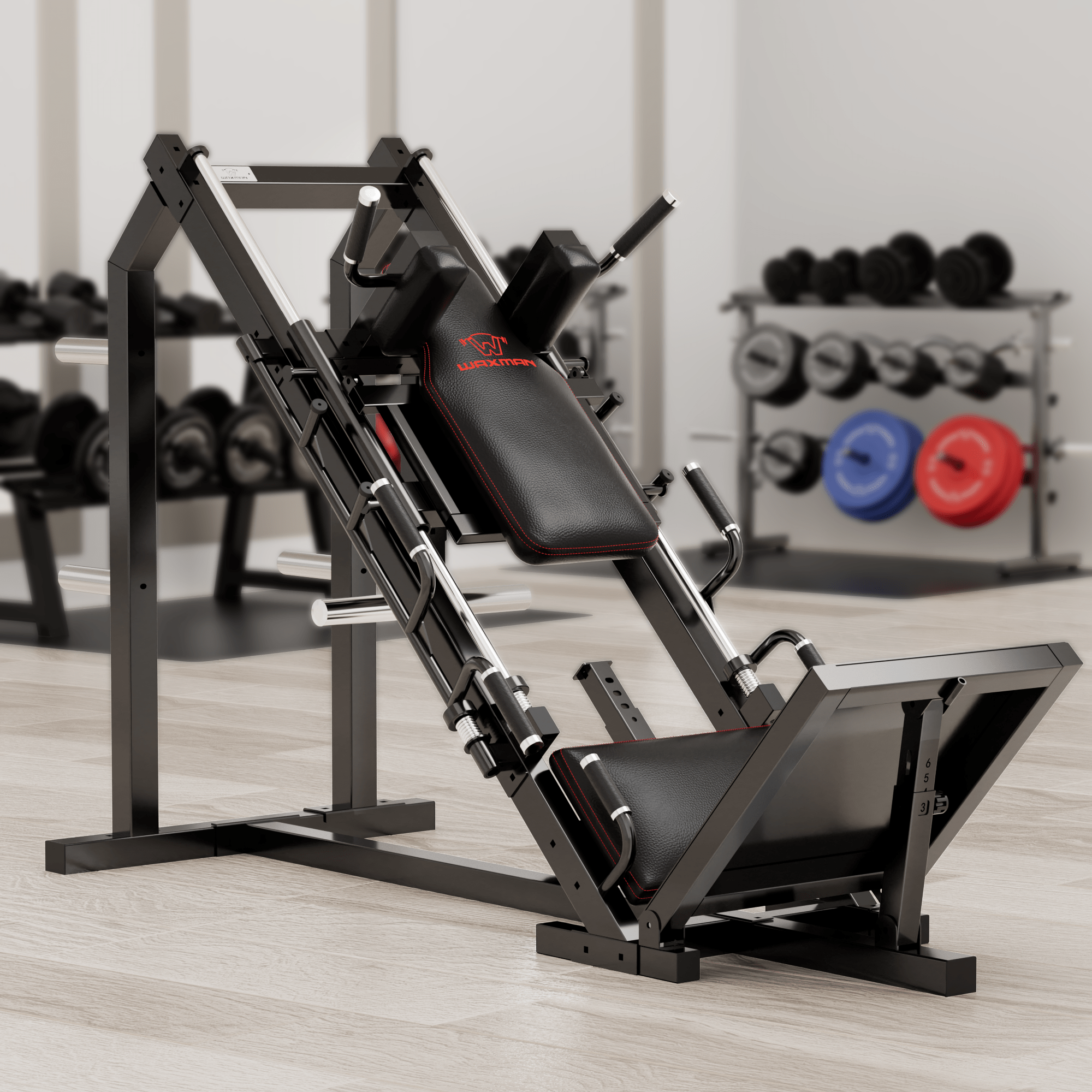
WAXMAN Leg Press Hack Squat Machine
Plate-loaded two-in-one leg press/hack squat. Listing details include three-level adjustable safety limiters, 2-inch Olympic-sized plate bars, and assembled dimensions of 77.5 × 38.3 × 57.4 in.
$799.00 USD (listing price checked October 7, 2026). Price and availability may change; see product page.
General educational information, not an individualized exercise prescription. Stop if the movement causes pain and seek qualified guidance for persistent symptoms or a relevant medical condition.
Leave a Reply