
No products in the cart.
Can You Put a Smith Machine on an Uneven Floor? Check Before Assembly
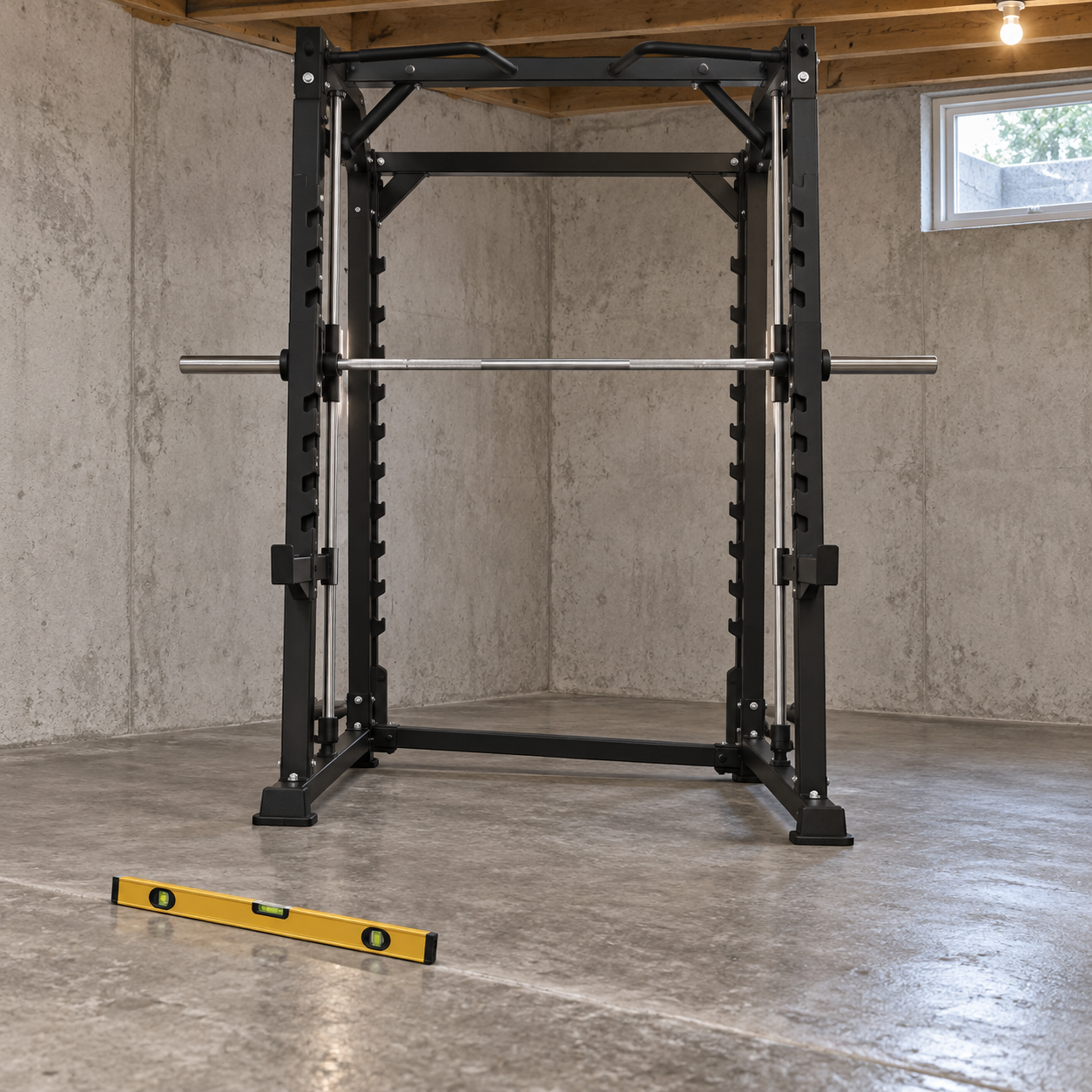
Cover illustration: AI-generated concept art showing a Smith machine on an uneven floor. It is not a photograph of a WAXMAN product, a tested installation, or evidence of machine performance.
Short answer: Check the floor before assembling a large Smith machine, and do not use the equipment if its base rocks, a foot does not sit firmly, or the machine appears out of square. The WAXMAN M4 product listing identifies the model and its dimensions, but does not publish a floor-level tolerance or instructions for correcting an uneven surface. Measure the room, document the condition, and ask WAXMAN for model-specific guidance. Do not assume that a rubber mat, loose shim, or tightening a fastener makes an unstable machine safe.
Why floor level matters for a large machine
A floor can look flat while having a slope, a raised seam, a low spot, or a soft area under one foot. A multi-station frame has several contact points and moving parts. If the frame sits unevenly, you may see a gap beneath a foot, rocking, twisting, or a bar that does not travel smoothly. Those observations are reasons to stop and investigate, not proof of a particular defect or a measurement of how much unevenness is acceptable.
The WAXMAN product page describes the M4 as a Smith machine, power cage, cable crossover and pull-up station. It lists an assembled footprint of 71 inches long by 48 inches wide and a height of 87.2 inches, plus a product-stated maximum capacity. That capacity is not a floor-leveling tolerance, a guarantee for every configuration, or permission to use equipment that moves or binds. The listing does not say that the feet adjust to compensate for a sloped floor.
Check the site before assembly
- Choose the final location first. Move boxes and loose objects away, and inspect the floor across the entire intended footprint. Avoid placing a tall, heavy frame across a floor transition, drain channel, broken tile, or visibly soft or damaged area.
- Check in more than one direction. Use a straightedge or level on the floor at the front, back, and sides of the proposed footprint. Repeat in both orientations. A level can reveal a slope or local variation; it cannot certify the floor’s load capacity or establish a safe tolerance for this machine.
- Look for contact and movement. During assembly, follow the product instructions and use the recommended number of helpers for the heavy components. Before loading any plates or using attachments, check whether the assembled base sits firmly as directed by the manufacturer. Do not rock, pull, or load the machine as a stress test.
- Keep the base and frame square. If the written instructions specify a tightening sequence, follow it. Do not force one connection into alignment by over-tightening another. If holes do not line up, a foot is unsupported, or the frame twists, stop and contact the seller or manufacturer.
What to do if the floor is uneven
First, distinguish a surface issue from a building-floor issue. A small tile lip, a damaged plank, a sloping slab, and a flexible upper floor are different conditions. A mat may protect a surface, but it does not automatically level a frame or prove that a floor can support the machine and its users. Likewise, stacking loose wood, cardboard, folded rubber, or improvised wedges under a foot can shift or compress and should not be treated as an approved repair.
Ask WAXMAN support whether the M4 has adjustable leveling feet, what floor variation is permitted, whether a particular leveling method is approved, and whether anchoring is required for your installation. Send the exact model name (WAX-SM-S02), photos of the location and base, and your measured floor variation. Request written instructions for that model. If the floor is damaged, visibly sloped, or feels springy, consult a qualified flooring or building professional about the floor itself; equipment support cannot assess the structure of your home remotely.
Do not start a workout until the setup is resolved
After assembly, follow the manual’s inspection steps. With no user or added load on the machine, check only the manufacturer-described items: secure connections, foot contact, and unobstructed movement. If the machine rocks, shifts, makes a new mechanical noise, or its Smith bar or cable path binds, stop. Do not try to diagnose a structural problem by lifting heavier weight. Keep children and other people away while the equipment is awaiting inspection.
Once the manufacturer confirms an acceptable setup and the machine passes its prescribed checks, keep the area around it clear and recheck the base after moving the machine or changing the floor underneath it. Recheck after a leak, flooring repair, or other event that could change the surface. Use the product manual for assembly and use; this article is a site-planning checklist, not a substitute for those instructions.
Product information

WAXMAN M4 Smith Machine (model WAX-SM-S02)
Official listing describes a Smith machine, power cage, cable crossover and pull-up station. Listed dimensions: 87.2 in high × 71 in long × 48 in wide. Listed price checked October 16, 2026: $1,999.90 USD. The listing does not state floor-level tolerance or availability.
Price and availability may change; see the product page.
View product
Quick checklist
- Inspect and measure the floor across the full footprint before assembly.
- Follow the M4 instructions; do not infer that it has adjustable feet.
- Stop if a foot is unsupported, the frame rocks, or movement binds.
- Ask WAXMAN for written model-specific correction and anchoring instructions.
Written by Codex from the sources listed below; no hands-on installation or equipment test was performed.
Leave a Reply