
No products in the cart.
Can a 15-Minute Home Strength Workout Be Worth Doing?
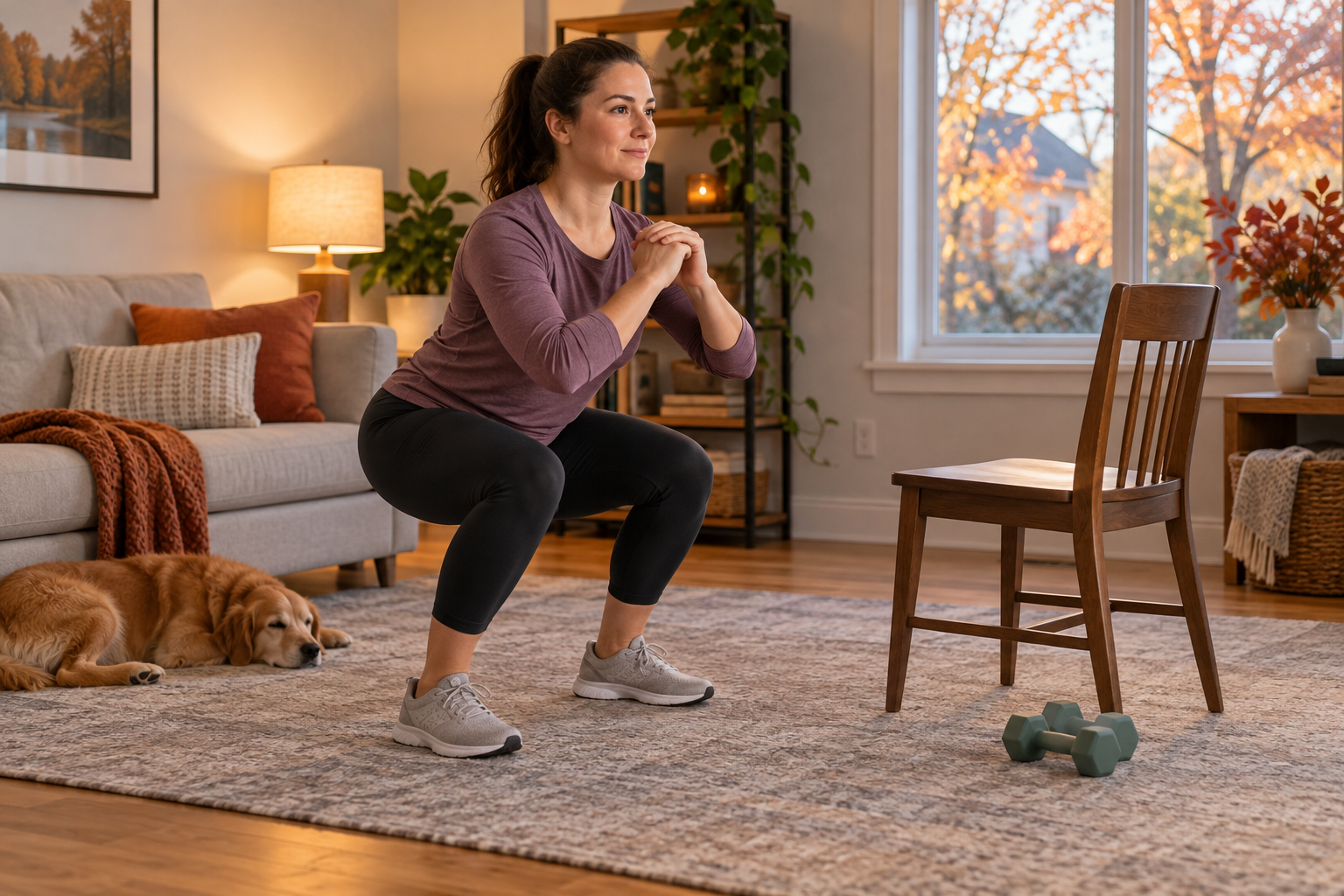
Cover illustration: AI-generated example of a home strength session. It is not a photograph of Waxman equipment or a record of a tested workout.
Short answer: Yes. A 15-minute session can be a practical way to do some resistance training when a full workout will not fit. Treat it as a useful short session, not a shortcut that automatically meets every weekly activity recommendation. Pick a few basic movements, warm up briefly, use a pace that lets you keep good control, and repeat the session on another day if it fits your schedule.
Short sessions can be especially useful when fall schedules change, evenings get busy, or a long gym trip is unrealistic. The aim is to make a repeatable plan from the time you have. The American College of Sports Medicine’s 2026 resistance-training guidance emphasizes regular participation and training the major muscle groups at least twice a week for healthy adults. The Centers for Disease Control and Prevention also says that some physical activity is better than none. Neither point means every 15-minute workout is enough for every person or goal.
What 15 minutes can and cannot do
A brief workout can let you practice several movements and add a strength session to your week. Bodyweight, bands, and home-based training are legitimate options; ACSM’s recent evidence summary does not require a gym or elaborate program for the average healthy adult. A short session may be a good starting point if your alternative is skipping movement entirely.
But 15 minutes of strength work does not by itself satisfy the CDC’s separate aerobic recommendation of 150 minutes of moderate-intensity activity each week, and one brief session does not equal two weekly muscle-strengthening days. Keep track of your whole week rather than judging progress from one workout. If your goal is a specific sport, substantial muscle growth, or rehabilitation, a generic short circuit may not be enough.
A simple 15-minute structure
Use a clear stop time so the session remains manageable. This example is a general template for an adult who can exercise comfortably; it is not an individualized prescription.
- Warm up for 3 minutes. Walk in place, move your shoulders and hips gently, and practice a few easy sit-to-stands. Warm up with movements that feel comfortable rather than forcing a stretch.
- Move through five exercises for 10 minutes. Work for about 40 seconds, then take about 20 seconds to change position. Repeat the circuit twice at a controlled pace. Choose a comfortable squat or chair sit-to-stand, a hip hinge, a wall or counter push-up, a resistance-band row if you have a safely secured band, and a standing calf raise or supported march.
- Cool down for 2 minutes. Walk slowly, breathe normally, and note which movements felt easy, challenging, or uncomfortable. The time split is a planning suggestion, not a tested training protocol.
Keep the range of motion comfortable and use a stable chair or counter that will not slide. For exercises with a band, inspect it for damage and attach it only to a secure anchor designed for that use. If a movement causes sharp pain, dizziness, chest discomfort, or unusual shortness of breath, stop. Do not rush between exercises simply to beat the clock.
Make the session fit your ability
Choose easier variations first: use a higher counter for push-ups, sit to a chair, or hold a stable support during a standing movement. When a movement feels controlled and repeatable, you can gradually add a few repetitions, use a slightly more challenging variation, or add resistance. Change one factor at a time so you can tell how your body responds.
Do not assume every set must end with shaking or failure. ACSM’s 2026 summary says training to momentary failure did not consistently change outcomes for the average healthy adult. The guidance also distinguishes goals: someone focused on maximal strength may need heavier loads and multiple sets, while a quick introductory circuit serves a different purpose. A short session is a useful unit of activity, not a universal strength prescription.
Fit it into the week
Try two short sessions on nonconsecutive days as a practical starting schedule, with easy movement such as walking on other days if that suits you. The weekly goal is to cover major muscle groups on at least two days and build toward the broader activity recommendations at a pace that works for you. If a busy week allows just one short session, do what is feasible and return to your plan rather than trying to cram missed work into one exhausting workout.
Pick a time and a small space you can use consistently. Keep the equipment simple, put it away safely, and write down the date and movements so you can resume without rebuilding the plan each time. The CDC recommends choosing activities that match your abilities and that you enjoy; those practical details matter more than making a 15-minute session look complicated.
When to get individual advice
This general routine is not medical advice and does not account for a health condition, injury, pregnancy, disability, or recent surgery. The CDC advises people with chronic conditions to discuss suitable activity with a health professional; it also recommends that people who have been inactive seek advice before starting vigorous activity. If you have symptoms or movement restrictions, get guidance before following a new routine.
Bottom line: A short home strength workout can be worth doing when it helps you move consistently. Use it as one manageable part of a weekly plan, progress gradually, and keep the limits of a brief session clear.
Leave a Reply