
No products in the cart.
How to Organize Leg Press Plates in a Shared Garage This Fall
Answer: Give every weight plate a stable home before using a leg press in a shared garage. Keep the machine’s moving area and the route to the door clear; place plates where you can reach them without stepping around the sled or leaning across a loaded machine. Use only storage locations whose limits and instructions you have checked for your exact equipment. Fall is a useful time to reset the layout, because cars, wet shoes, and seasonal storage often return to the same floor space.
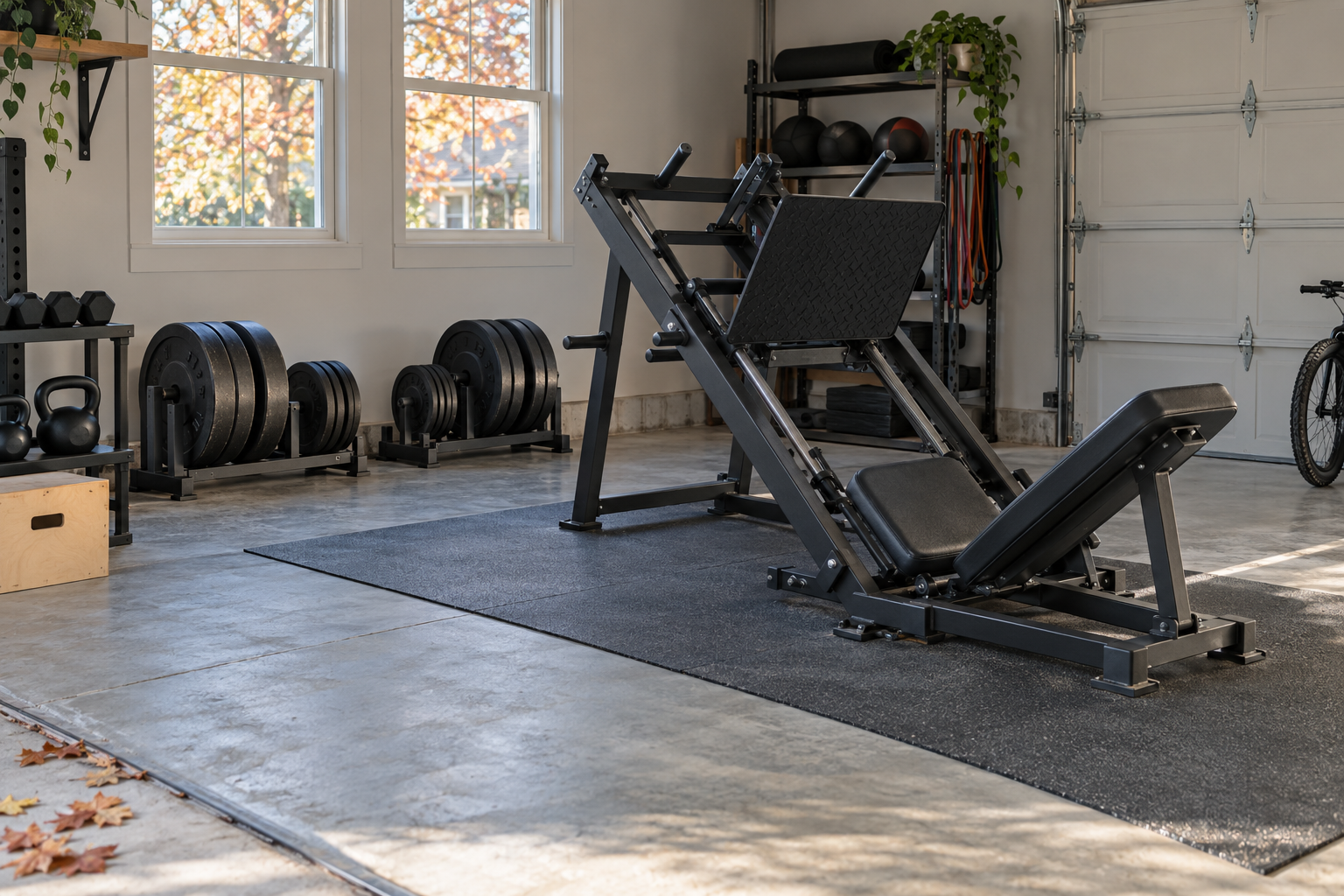
Featured image: AI-generated illustration of a generic garage gym, not the Waxman product, an installation plan, or a tested safe clearance.
Draw the daily route before moving plates
Stand where the Waxman leg press and hack squat machine will be used. Trace three separate movements: entering and leaving the machine, bringing a plate to a loading point, and walking from the garage to the house or outside. Repeat with the garage door open and with the car in its usual position. A plate rack that looks tidy when the gym is empty can block a door or force a person to squeeze past equipment when the car is parked.
The product page lists assembled dimensions of 77.5 inches long, 38.3 inches wide, and 57.4 inches high. These describe the listed machine, not its operating envelope. Allow additional room for people, plate handling, any moving parts, and the manufacturer’s specified clearances. Mark the footprint with tape or cardboard, then walk the real routes. Avoid publishing or relying on a universal “safe inchesâ€� rule: garage layouts, door swings, machine configuration, and the user’s movement differ.
Separate plate storage from the exercise zone
Sort plates by type and the sleeve size your exact equipment requires. The Waxman listing says its plate-loaded bars fit 2-inch Olympic-size weight plates. Check the sleeves and plate bores in person before use, especially when mixing older plates with new equipment. The listing also describes integrated weight storage, but it does not provide a verified storage-post load rating in the material reviewed here. Confirm that limit in the current manual or with the seller before putting plates on those posts.
If you use a separate plate tree or rack, follow that item’s own assembly and loading directions as well. Place it on a sound, level surface outside the machine’s moving area. Avoid leaning loose plates against a wall where they could roll or tip, and avoid stacking them in front of the emergency exit route. Keep collars, pins, and other small accessories in a labeled container that does not sit underfoot. The goal is a repeatable place to return equipment between sets, not maximum storage density.
Store heavier plates where the rack maker directs, and follow the maker’s sequence if it specifies one. Do not infer a safe load from the size of a peg or from a photograph. Likewise, a product’s exercise-capacity claim is not a storage-post capacity. If the instructions for your exact machine are missing, leave the built-in storage unloaded until the specification is confirmed. A practical layout can be planned without guessing a number.
Make a fall garage reset part of the routine
Leaves and rainwater can arrive under a garage door during autumn. Before a session, look at the floor where you will lift, load plates, and walk; clear debris and address wet spots. Check whether a mat lies flat and whether moving the car has shifted a plate rack. Keep boxes, yard tools, and holiday decorations out of the route to the machine. These are housekeeping checks, not substitutes for the machine’s inspection and operation instructions.
When the workout is finished, return plates to their assigned storage points rather than leaving them on the floor or relying on the machine as a general shelving unit. Count small accessories so that a forgotten collar or pin does not get swept under a tire. If several people share the space, post a simple storage map and agree that the walking path stays empty even when no one is training. Recheck the arrangement whenever the garage changes for winter storage.
Use a short layout check before buying more storage
- Confirm the exact equipment: use its current manual and inspect the assembled machine; verify the plate interface and approved storage points.
- Mock up the footprint: include room for the person loading plates and for the paths used by other household members.
- Assign storage: choose stable approved posts or a separate rack, and keep loose items off the floor.
- Test the shared garage: check the setup with the car, door, and seasonal items in their ordinary positions.
This article is about arranging a shared space. It does not tell a reader how much weight to load, how to use a safety limiter, or how to perform a leg press or hack squat. Those questions require the exact equipment instructions and, for personal exercise decisions, qualified guidance.
Sources and limits
The product identity, listed dimensions, plate-bar description, storage feature, official photo, and price snapshot come from the Waxman product page and its public product data, checked October 5, 2026. We did not find a model-specific manual in the reviewed material; the article does not assign a safe load to storage posts or prescribe machine use. Written with Codex assistance; no hands-on equipment test or independent human technical review is claimed.
Leave a Reply