
No products in the cart.
When Should You Stop Using a Damaged Home Gym Pulley Cable?
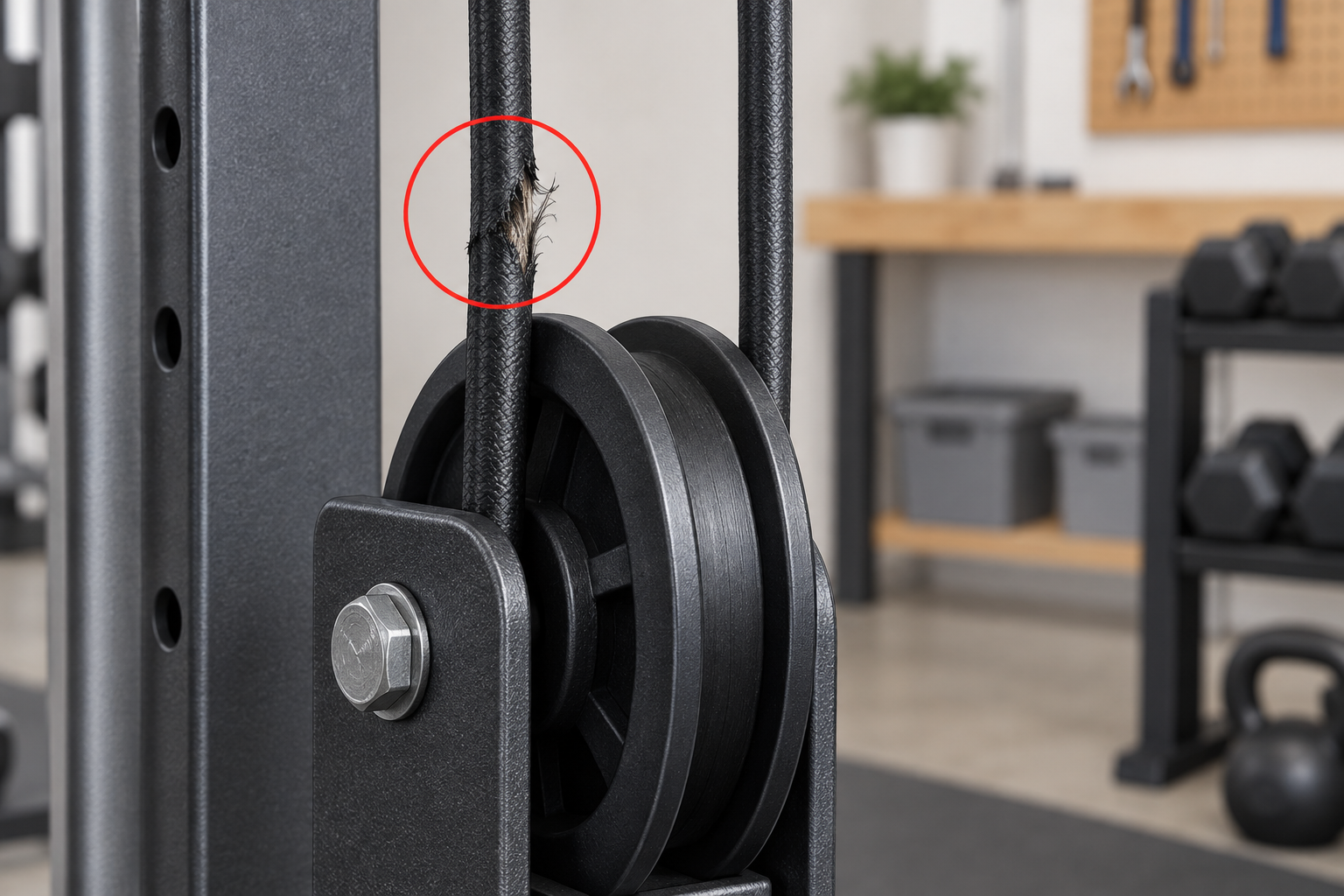
Quick answer: Stop using a home cable pulley if its cable has frayed wires, a split or torn coating, a kink, a bulge, an unusual wave, or slack that changes how it tracks. Remove the load and keep the setup out of use until the cable and related hardware have been assessed and the correct replacement or repair is confirmed. Do not test a suspect cable under weight. The Waxman listing describes sheathed cables, but it does not provide a model-specific inspection interval or replacement procedure; use any instructions supplied with your unit and contact the seller or a qualified repair provider for model-specific service.
What visible cable damage means
A cable may have a protective outer covering around its load-bearing wire rope. A smooth covering does not prove the wire beneath it is intact, and damage to the covering is a reason to look more closely rather than a cosmetic issue to ignore. Sportsmith’s home-gym cable inspection guide says to replace a cable if wire strands are frayed, and identifies split, cracked, or torn coating, unusual twists or lumps, and lost proper tension as wear indicators. Its guidance is general maintenance information, not a Waxman service manual.
Stop before your next repetition if you see any of these conditions:
- Exposed or frayed wire strands: do not touch protruding strands with bare hands, and do not continue using the cable.
- Split, cracked, or torn sheath: the coating is no longer continuous. Do not assume the underlying cable remains safe because the damage looks small.
- A kink, bulge, wave, or twist that remains: these can indicate the cable is no longer tracking normally or has internal wear.
- Unexpected slack, jerking, or a change in travel: stop and check the whole setup without added resistance. A cable can be affected by routing or pulley condition as well as visible wear.
- Damaged hardware: inspect the end fitting, connector or carabiner, pulley wheel, and its mounting point. A cracked, bent, loose, or badly worn part needs attention before use.
How to inspect without loading the cable
- Unload the system first. Set the attachment down and remove plates only if you can do so without putting yourself beneath a suspended load or handling unstable equipment. Keep other people clear.
- Look along the full accessible cable. With the system stationary, inspect both visible runs, the ends, connection points, and the parts that pass over the pulley. Do not run a bare hand along a damaged cable; sharp strands can cut skin.
- Check the path and pulley. Look for a cable riding against an edge, a pulley that is visibly damaged, or a connector that does not close or sit as intended. Do not dismantle a loaded or suspended assembly to investigate.
- Stop if the cause is unclear. A quiet repetition or a brief test with weight is not proof that a damaged cable is safe. Keep it out of service until the appropriate instructions or a qualified inspection resolve the concern.
This is a visual screening routine, not a certification or a substitute for the product’s instructions. A cable can have internal damage that is not obvious from one angle. If a cable has been overloaded, sharply bent, pinched, or exposed to an event that may have damaged it, ask the manufacturer or seller whether it needs inspection even if the sheath looks intact.
Do not improvise a cable repair
Do not wrap damaged cable with tape, tie a knot, splice it, shorten it, add a generic connector, or substitute a cable based only on a similar-looking diameter. A replacement must match the exact equipment design, ends, length, construction, routing, and intended load. The Waxman Fitness LAT and Lift Pulley System listing describes 70-inch and 90-inch sheathed cables and its pulley modes, but the public listing does not specify a replacement part number or repair method. Confirm compatibility and installation instructions with Waxman before ordering or fitting a part.
Likewise, do not treat the product listing’s stated maximum load as a repair tolerance or permission to keep using a worn cable. The maximum is a seller-listed product claim for the system; it does not establish the condition of an individual cable, validate a mounting point, or tell you when a component must be replaced.
When can training resume?
Resume only after the damaged component has been repaired or replaced using a confirmed compatible part and the full assembly has been checked according to the manufacturer’s instructions. If you cannot identify the right part or verify the repair, do not return the pulley to service. A qualified fitness-equipment technician can inspect the cable route, pulley, connectors, and anchor together.
For a new or repaired setup, begin with no added plates and move the attachment slowly through the intended travel while staying clear of the load path. Stop if the cable rubs, jumps, binds, or changes tension unexpectedly. This unloaded movement check helps reveal an assembly problem; it does not replace any manufacturer inspection or prove the system’s rated capacity.
Product context
The Waxman Fitness LAT and Lift Pulley System listing describes two sheathed cable lengths, detachable handles, and pull-down and lift-up configurations. Its currently displayed price was $43.00 USD when checked on October 9, 2026; availability was not stated in the page content reviewed. Price and availability may change, so check the product page for the current listing. Those listing details identify the product discussed here; they are not a service specification.

Waxman Fitness LAT and Lift Pulley System
Listing describes 70-inch and 90-inch sheathed cables, detachable handles, and pull-down/lift-up modes. Model-specific cable repair details are not listed. Price snapshot: $43.00 USD checked October 9, 2026; availability not stated. Price and availability may change; see product page.
Editorial note: Written by Codex from the sources listed below. No product testing or human technical review is claimed. This article provides general visual screening guidance, not a diagnosis, repair instruction, or guarantee of equipment safety.
Leave a Reply