
No products in the cart.
How to Set Up a Home Cable Lat Pulldown Without Excessive Leaning
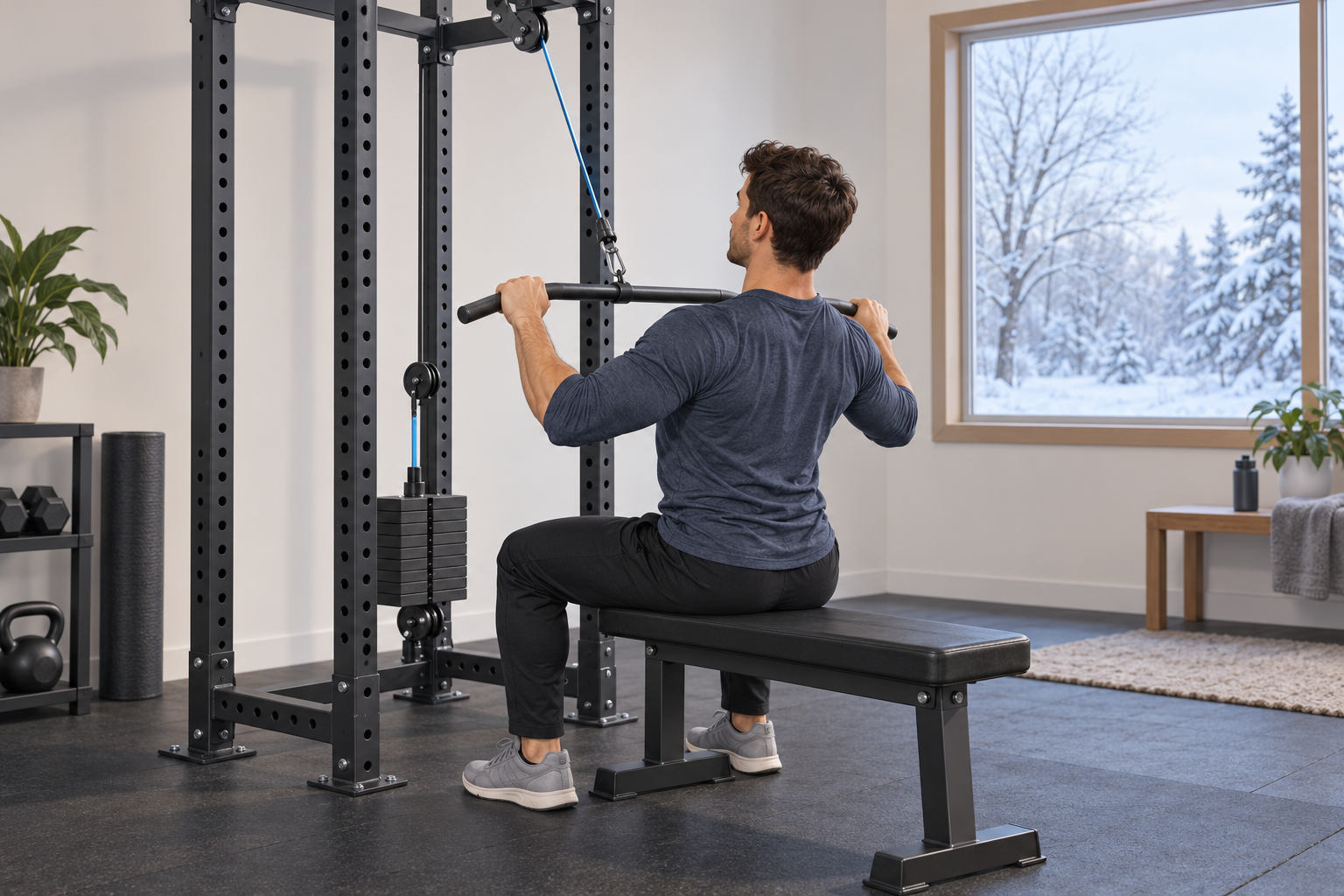
Quick answer: Set the high pulley so the cable clears your head, use a secure anchor and a stable seat, and pull the handle toward your upper chest while keeping your torso nearly upright. A small natural lean can be reasonable, but rocking backward to move a heavy load means the resistance or setup is beyond what you can control. The attachment’s stated load capacity does not rate your rack, anchor, bench, or floor.

Check the anchor and cable path before loading
A lat pulldown pulls down on the attachment and can also pull the user toward the pulley. Before adding plates, read the pulley system and rack instructions. Confirm that the anchor point is approved for the intended direction of force, all straps and connectors are fully seated, and the rack cannot tip, slide, or shift. A product listing may describe compatible equipment, but that does not prove that every bar, beam, door, or installation is safe.
Route the cable so it runs freely through the pulley without rubbing a sharp edge or crossing an obstacle. Check the cable sheath, pulley, carabiners, and loading pin for visible damage or looseness. Keep the plate stack clear of feet and furniture, and leave enough space behind and beside the seat to get in and out. If the anchor rating or installation is unknown, do not use it under load.
Choose a stable seated position
Use a bench or seat that stays planted when you pull. Sit facing the high pulley with both feet supported on the floor or a stable platform. Keep your knees comfortably bent and your hips centered; do not wedge yourself under furniture that was not designed to restrain you. If your seat slides, tips, or forces you to lean far back to reach the handle, change the layout before exercising.
Start with the handle overhead and arms extended comfortably. Set your ribs over your pelvis and brace gently so your lower back does not arch to create range. A modest backward angle may feel natural, but your chest should not swing behind your hips during each repetition. The seated lat-pulldown instructions from ACE describe a slight lean and warn against adding more backward lean as the bar comes down; that guidance is for a selectorized machine, so treat it as general movement context rather than certification of a home pulley setup.
Use a controlled pull and return
- Begin with a load light enough to practice the motion without jerking or holding your breath.
- Draw your shoulders down, then guide your elbows toward your sides as the handle travels toward your upper chest.
- Stop when your elbows can no longer travel down without moving backward or changing your torso position. Do not pull behind your neck.
- Pause briefly, then let the handle rise slowly until your arms return overhead without losing control of the plates.
Keep wrists comfortable and avoid using momentum to finish a repetition. Exhale during the effort and breathe in as you return. If you have to kick, rock, shrug, or shorten the movement to complete a rep, reduce the load. Mayo Clinic’s general strength-training guidance likewise recommends controlled technique, choosing a manageable resistance, and stopping an exercise that causes pain.
Common setup problems and fixes
- The cable pulls you forward: Recheck the seat distance and cable route. Do not solve this by bracing against an unstable object.
- You lean farther back on every rep: Lower the load and use a shorter, pain-free range while keeping your torso quiet.
- The plates swing: Slow the repetition and stop before the stack begins to pendulum. Let the plates settle before changing position.
- The handle reaches your face or neck: Stop, adjust the attachment height or your position, and verify the route before continuing.
- Your shoulder or back hurts: Stop the set. Do not force a range or continue through sharp or worsening pain; seek qualified guidance if symptoms persist.
Where this home setup has limits
The Waxman LAT and Lift Pulley System listing describes high-pulley pull-down and low-pulley lift-up modes, 70- and 90-inch cable options, and an advertised maximum system load of up to 280 lb. That is a listing claim about the product; it does not establish a safe working load for a chosen anchor, rack, bench, or the user. Confirm each component’s instructions and ratings separately, and follow whichever limit is lower. The product page does not provide a universal layout chart for every room or rack.
Product details checked October 9, 2026. Price and availability may change; see the product page.

Waxman Fitness LAT and Lift Pulley System
Listing describes 70-inch and 90-inch sheathed cables, pull-down/lift-up modes, and a loading pin. Advertised maximum system load: up to 280 lb; this is not an anchor rating.
$43.00 USD (page listing checked October 9, 2026). Price and availability may change; see product page.
Sources and scope
- ACE: Seated Lat Pulldown — machine-specific form cues, applied here cautiously.
- Mayo Clinic: Strength training — general technique and pain guidance.
- Waxman product listing — listed modes, cable options, product claims and price snapshot.
Leave a Reply