
No products in the cart.
Barbell or Dumbbells for a First Home Gym?
Quick answer: For a first home gym with limited floor space or no safe barbell setup, start with adjustable dumbbells. Choose a barbell when the lifts you want to practice need a straight bar, you have room for the full bar and plates, and you can set up appropriate supports and learn the movements safely. You do not need both to begin strength training; the better choice is the one you can use consistently and store safely.
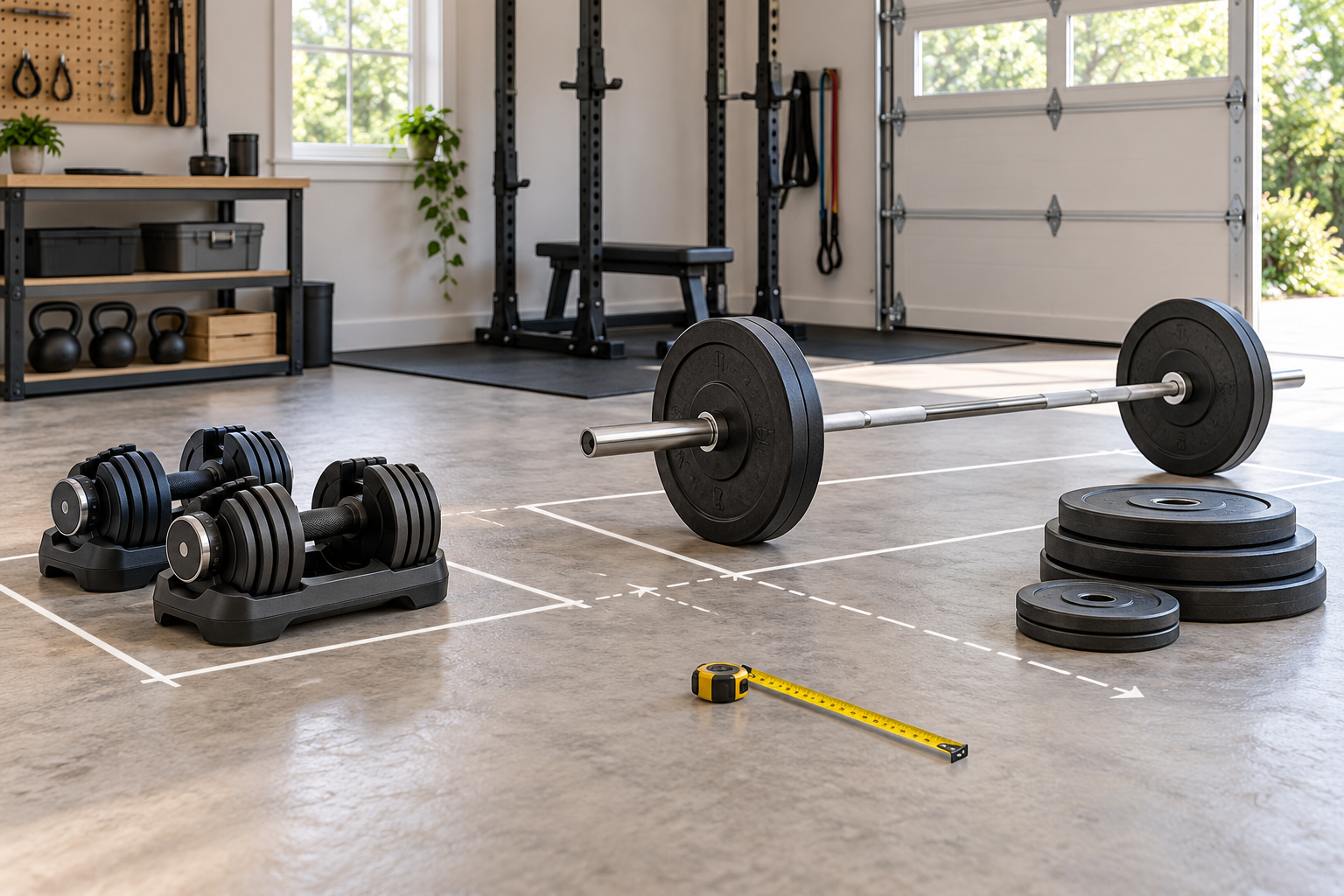
Cover illustration: AI-generated comparison of dumbbells and a barbell in a home gym. It is illustrative, not a product photo, equipment test, or room measurement.
Start with your actual workout space
A barbell is long even when it is not loaded. Measure the usable floor area, ceiling height, doorways, storage locations, and the space needed to load plates and move around the bar. For lifts that move the bar overhead, check clearance and nearby lights or garage tracks. A rack also takes space and must be suitable for the movements you plan to do; this guide does not verify a particular rack, wall, floor, or installation.
Dumbbells are shorter and can often be stored on a compact stand or in a designated corner. Adjustable models reduce the number of separate pairs, but check the actual adjustment range, locking mechanism, dimensions, and storage footprint of the exact set. Do not assume that “adjustable” means quick to change or easy to handle. If you share the room, also consider where equipment will sit between sessions and whether it blocks a route through the space.
Compare the kinds of exercises you want to do
A barbell lets you hold one implement with both hands for movements such as a squat, deadlift, or press. Plates make it possible to change the total load in steps, but the bar itself has weight and takes time to load. A barbell setup usually involves more decisions about storage, collars, rack or supports, and clear space. It can suit someone who has a specific barbell-based plan and enough room for the whole setup.
Dumbbells let each hand move independently. They are useful for one-arm or one-leg variations and can make it simpler to train when the room cannot accommodate a full-length bar. That flexibility is not automatically safer or easier: a heavy dumbbell still needs a controlled pickup, secure storage, and enough room to lower it without hitting furniture or feet. Both tools require learning movements with a load you can control.
For general activity, equipment is only one part of the decision. The U.S. Physical Activity Guidelines recommend muscle-strengthening activity involving all major muscle groups on two or more days each week for adults. They do not require a barbell or dumbbells specifically. Choose exercises you can perform with control and build a routine around your schedule; a tool that sits unused does not help your plan.
Think about setup and progression
Ask what the next few months of training should look like. If a qualified coach or a trusted written program calls for barbell movements, confirm that your home has the right space and supports first. If you mainly want a small, flexible set of strength options, compare the dumbbell weight increments and whether those increments can support the movements you intend to practice. Do not buy a set based only on its maximum advertised load.
Make a short checklist before you order: list the exercises, identify the equipment each requires, measure the complete operating footprint, record where each item will be stored, and note how you will learn unfamiliar movements. If you have pain, a health condition, balance concerns, or uncertainty about an exercise, ask an appropriately qualified health or fitness professional for individual guidance.
Use a simple decision rule
- Pick dumbbells first if compact storage and independent hand movement are your main needs, or you cannot safely fit a bar and supports in the room.
- Pick a barbell first if your plan specifically uses barbell lifts, you have the full length and loading clearance, and your support and storage setup are appropriate.
- Wait before buying either if you have not measured the room, cannot identify a safe storage spot, or do not know how the equipment will fit your planned sessions.
For a barbell comparison point, the official Waxman site lists its 7-foot Olympic bar at 45 lb and for 2-inch weights. Those are listing details, not a claim that it fits your room or rack. Confirm your own plates, supports, clearances, and the current product information before purchase.

Waxman 7ft Olympic Barbell
Official site listing: 45 lb; fits 2-inch weights. Price checked October 19, 2026: $69.00 USD on the official homepage. Availability was not stated in the information checked.
Price and availability may change; see the product page.
Keep the decision practical: match the tool to your room and routine, and leave enough space to handle and store it. Read the current Physical Activity Guidelines for general activity recommendations; they do not prescribe particular gym equipment.
Leave a Reply