
No products in the cart.
Leg Press vs. Hack Squat: Which Machine Fits Your Home Gym?
Quick answer: Pick the machine that lets you use a controlled, comfortable range of motion and repeat the setup consistently. A leg press and a hack squat both train the lower body, but the support and body position differ. For a home gym, space, safe loading, and a machine’s exact adjustments matter as much as the exercise name. A combination machine can offer both patterns, but it is not automatically the right choice for every lifter.
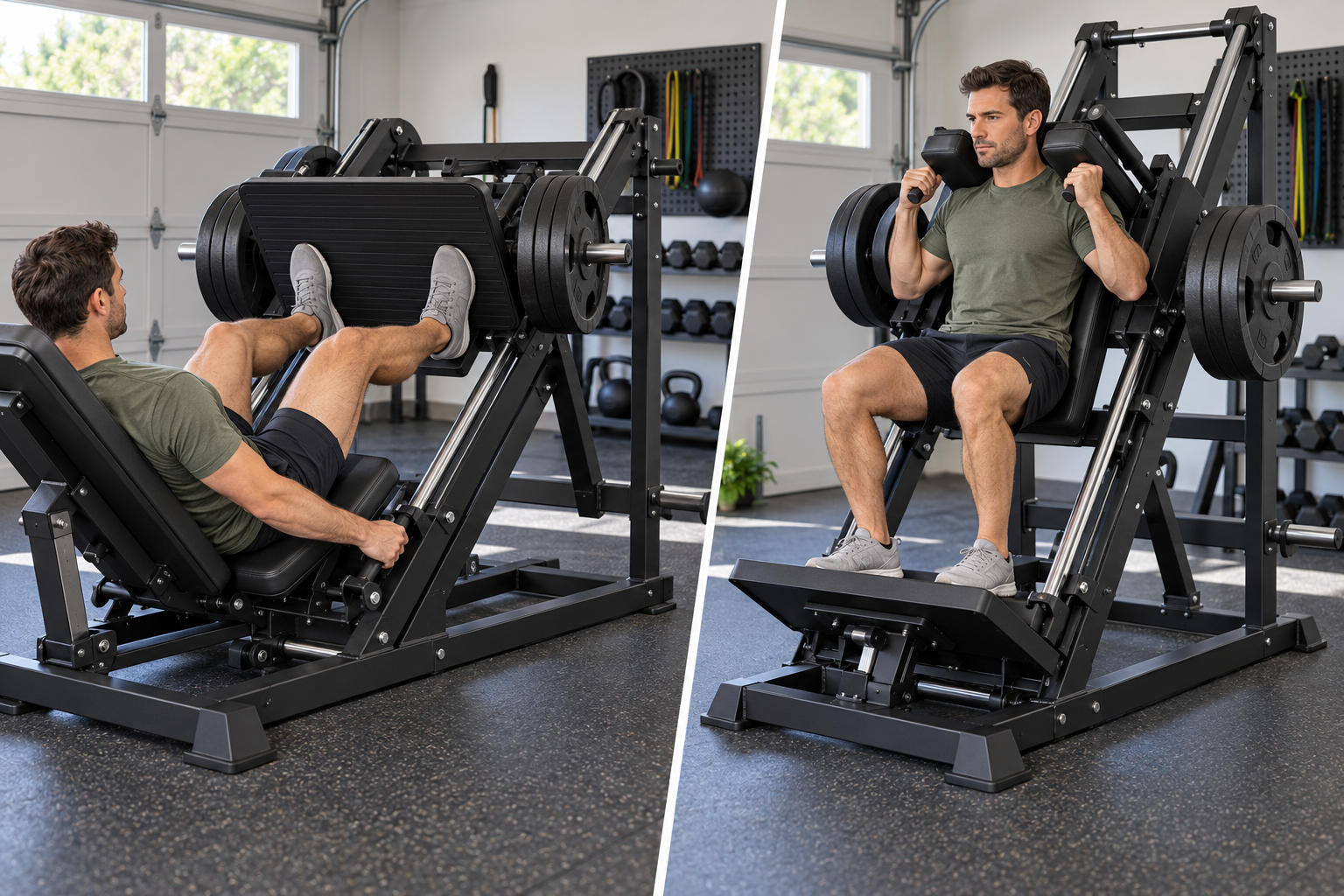
Illustration note: the featured image is an AI-generated instructional illustration. It is not a product photograph or a depiction of the exact Waxman machine.
What changes between the two movements?
On a typical leg press, your back and hips rest against a seat while you press a footplate away. The machine supports your torso, and the track constrains the path. On a typical hack squat, your shoulders and back rest against a moving carriage while your feet stay on a platform; you bend and extend your knees and hips as the carriage travels along its rails. Designs vary, so check the actual machine instead of assuming every model has the same posture, starting angle, or safety stops.
Both exercises involve the quadriceps, glutes, and other lower-body muscles. The movement path, depth you can comfortably reach, and where the machine supports you change the experience. Research comparing squat and leg-press patterns finds that joint loading can differ by exercise and setup; it does not establish that one named machine is universally safer or better for muscle growth. A leg-press number also cannot be compared directly with a hack-squat number because sled angles, carriage weight, friction, and leverage vary.
Choose by fit, control, and goal
- Start with fit: Sit or stand in the unloaded machine and check that your hips, back, shoulders, and feet can rest where the maker intends. If you cannot find a stable, comfortable position, that model is a poor fit.
- Check the usable range: Move slowly through a shallow range first. Stop before your lower back rounds or lifts from its support, your joints feel pinched, or you lose control. A machine’s maximum travel is not a target you must reach.
- Match the pattern to your program: Use either movement as one resistance exercise within a balanced plan. Neither replaces every other leg pattern. The American College of Sports Medicine’s 2026 guidance emphasizes consistency and matching training choices to a person’s goal and ability; it does not require a particular machine.
- Test the setup process: Confirm that you can reach the lockouts and safety limiters without twisting or stepping under an unstable load. Read the model’s instructions, learn how the carriage is secured, and begin with no plates.
- Leave room around it: Measure the full assembled footprint and the path needed to load plates, change configurations, and enter or exit. Do not use a product’s footprint as the whole clearance plan.
When does a combo machine make sense?
A combination unit may suit someone who wants both supported patterns but has room for only one large station. Check how the machine converts between modes, whether each mode has a separate safe lockout, what plate diameter it accepts, and whether the manual explains the transitions. Confirm delivery access and assembled dimensions before ordering. A combo machine is still a substantial piece of equipment; it does not become compact simply because it has two functions.
The WAXMAN Leg Press Hack Squat Machine is listed as a plate-loaded 2-in-1 unit with three-level safety limiters, lockout positions, and bars for 2-inch Olympic plates. The manufacturer lists assembled dimensions of 77.5 × 38.3 × 57.4 inches and says it ships in three packages. Those are listing details, not an independent safety or performance test. Review the instructions and verify the footprint and delivery route for your room before purchase.
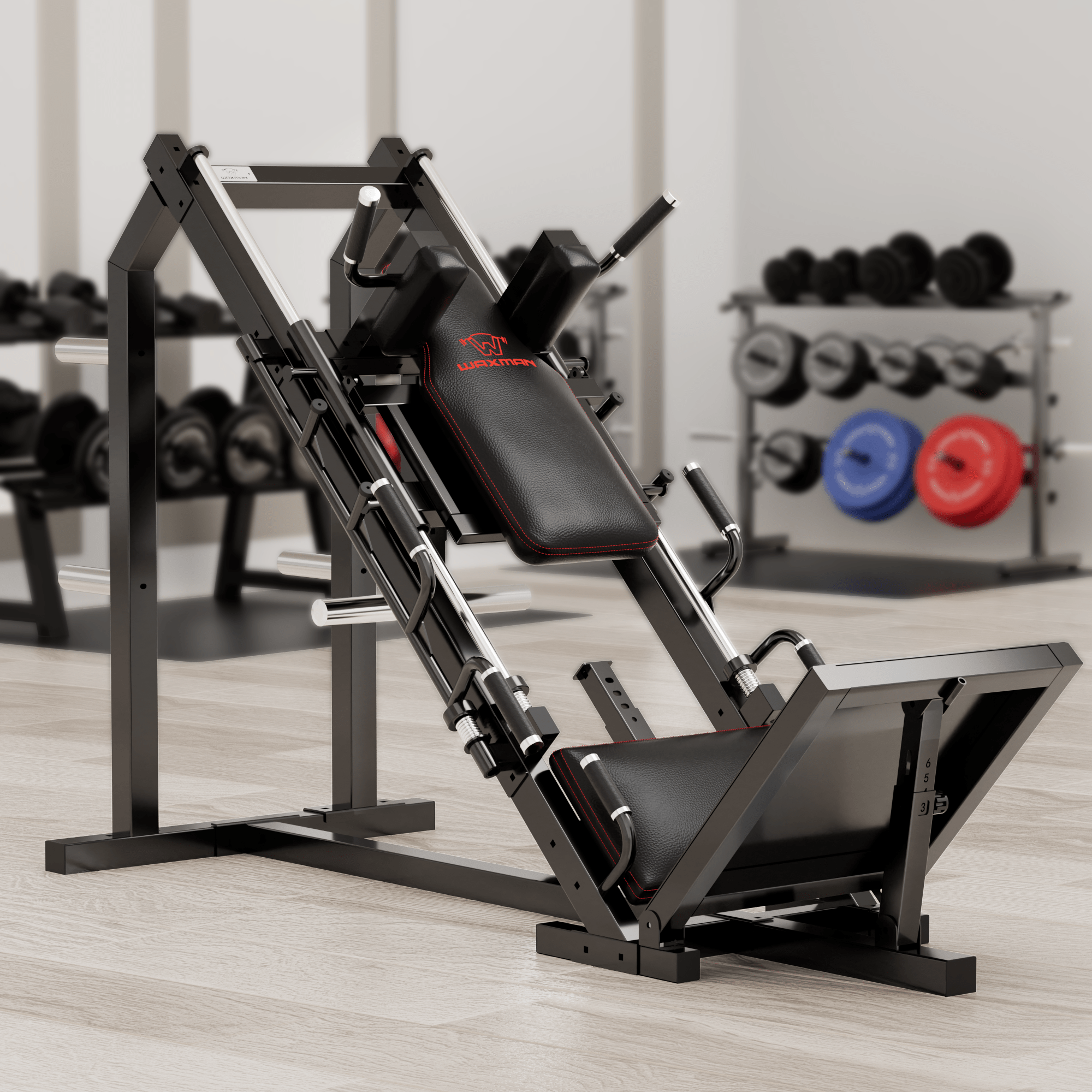
WAXMAN Leg Press Hack Squat Machine
Listed features: two exercise configurations, adjustable safety limiters, and Olympic plate loading. Choose it only if its dimensions, setup, and instructions suit your space and experience.
$799.00 USD — product page checked October 20, 2026. Price and availability may change; see product page.
Use a simple first-session check
Set the machine exactly as its manual directs. With no plates, rehearse the movement and locate every lockout. Add a light load that allows smooth repetitions; do not test a maximum on an unfamiliar station. Keep your feet planted, move without bouncing, and end the set while you can still control the return. If the setup causes pain, stop rather than trying to solve it by changing foot position under load. Anyone managing an injury or medical condition should get individualized advice from a qualified clinician or exercise professional.
For most home-gym buyers, the decision is practical: choose the movement you can perform comfortably, the machine you can operate safely, and the equipment that fits the room. Consistent training matters more than owning both labels.
Sources
- ACSM position stands (2026 resistance-training guidance).
- Comparison of joint and muscle biomechanics in squat and leg-press exercise (study-specific findings; not a direct comparison of every hack-squat machine).
- Manufacturer product listing (model features, dimensions, plate fit, and current listed price; checked October 20, 2026).
Leave a Reply