
No products in the cart.
Should You Anchor a Wall-Mounted Squat Rack? Check the Wall and Manual First
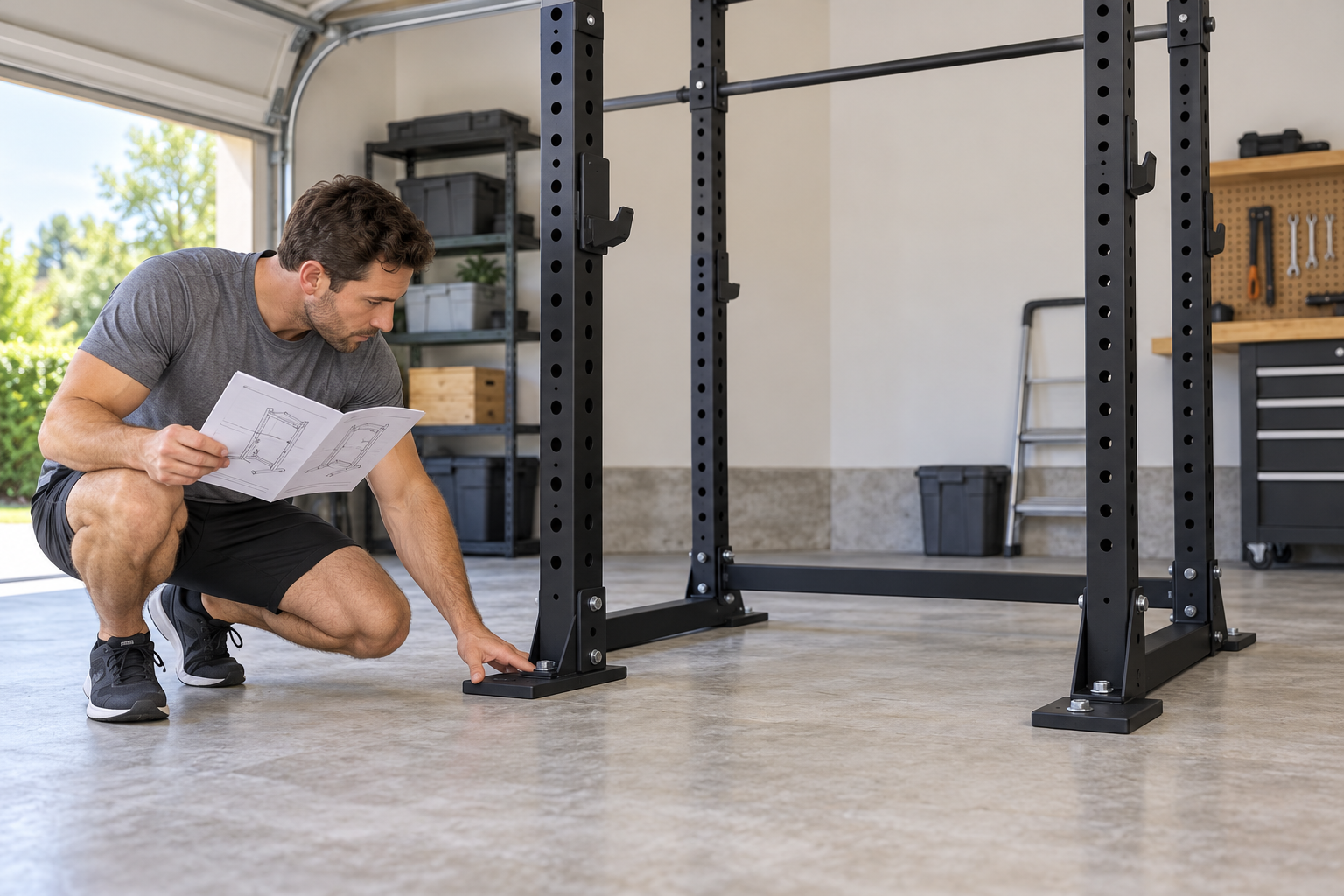
Illustration: AI-generated instructional illustration, not a product photograph or installation demonstration.
Short answer: A wall-mounted squat rack must be installed into a suitable structural support using the exact fasteners and method specified for that rack. Drywall alone is not a structural anchor. If you cannot identify the wall construction, locate the framing reliably, or confirm that the included hardware is appropriate for it, stop and ask the rack maker or a qualified installer before loading the rack.
Why wall attachment is part of the rack
A folding wall rack transfers force through its mounting points into the wall. The wall connection is not an optional convenience or a substitute you can improvise with whatever screws are on hand. Pull-ups, racking a bar, and shifting loads can put changing forces on the structure. Product capacity statements do not tell you that every wall, fastener, or installation is suitable.
Waxman’s listing for its 2.36-inch by 2.36-inch folding wall-mounted squat rack describes a wall-mounted design and mentions a stringer and metal studs in the installation description. That listing is useful for identifying the product, but it does not establish that every home has compatible framing or that a particular fastener works in every wall. Use the manual supplied for the exact model and configuration as the controlling instruction.
Check these items before installation
- Confirm the exact model and instructions. Match the rack name and revision on the carton or frame to the manual. Check whether the instructions specify a wall type, spacing, fastener, stringer, or minimum clearance. Do not transfer instructions from a visually similar rack.
- Identify the wall behind the finish. Drywall, plaster, masonry, and framed walls require different methods. A stud finder can help locate likely framing, but it does not prove the framing size, condition, or suitability. Be alert to wiring, plumbing, and other concealed services before drilling.
- Verify the fastening plan. Use only the manufacturer-specified hardware and installation pattern. Do not replace lag screws, anchors, or a supplied mounting board with generic hardware based only on diameter or appearance. If instructions do not cover your wall type, ask the manufacturer or a qualified professional.
- Check the surrounding space. Measure the rack both open and folded, plus the bar path, bench position, ceiling clearance, and room needed to move safely. Check that doors, vehicles, storage, and people will not collide with the rack or bar.
- Inspect after assembly. Follow the manual’s tightening sequence. Before use, verify that all connections are secure, the rack opens and closes as intended, and the frame sits square without movement. Recheck fasteners at the intervals stated by the maker.
When to pause and get help
Do not load the rack if the wall is damaged, damp, visibly bowed, or built in a way the manual does not address. Pause if the mounting points do not line up with sound structure, a fastener spins, the rack shifts, or you cannot tell whether a wire or pipe is behind a drilling point. Do not solve a mismatch by adding more screws or relying on drywall anchors unless the rack maker explicitly specifies that method for your exact installation.
Renters should also check lease terms and get any required written approval before drilling. In a condo or multifamily building, ask about restrictions on structural walls and shared services. A professional installer can assess the wall and hardware; the installer should have the rack manual and know the intended exercise loads.
What a product capacity does—and does not—mean
A stated rack capacity is not a wall rating. It does not certify your studs, masonry, fasteners, workmanship, or the condition of an existing wall. Likewise, a rack being advertised for home gyms does not mean it can be mounted to any surface. Treat the rack, the wall, the fasteners, and the installation as one system, and follow the most specific model instructions available.
Product reference
The Waxman 2.36-inch folding wall-mounted squat rack is a product example relevant to this question. Its official listing describes an alloy-steel, folding wall rack with listed open dimensions of 47 by 19.7 by 85.8 inches; verify the current manual and configuration before planning an installation. Price checked October 21, 2026: $299.99 USD. Price and availability may change; see the product page.

Waxman folding wall-mounted squat rack
Alloy steel; listed dimensions 47 × 19.7 × 85.8 inches when open. Wall compatibility and fasteners must be checked against the current instructions and your actual wall. View product
Price checked October 21, 2026. Price and availability may change; see product page.
Sources
- Waxman product listing (model type, listed dimensions, materials, product description; checked October 21, 2026).
- Rogue Fitness rack installation guidance (general reminder to follow product-specific installation instructions; not a substitute for the Waxman manual).
Leave a Reply