
No products in the cart.
How to Plan a Compact Home Gym Around a Weight Bench
Quick answer: Place a weight bench where you can get on and off without squeezing past a wall, door, or stored weights, then test the exact movements you plan to do with the bench unloaded. Measure the bench in every position you will use, include the reach and movement path of your arms and legs, and keep the exit route clear. A room’s floor area alone cannot tell you whether a particular exercise setup fits.
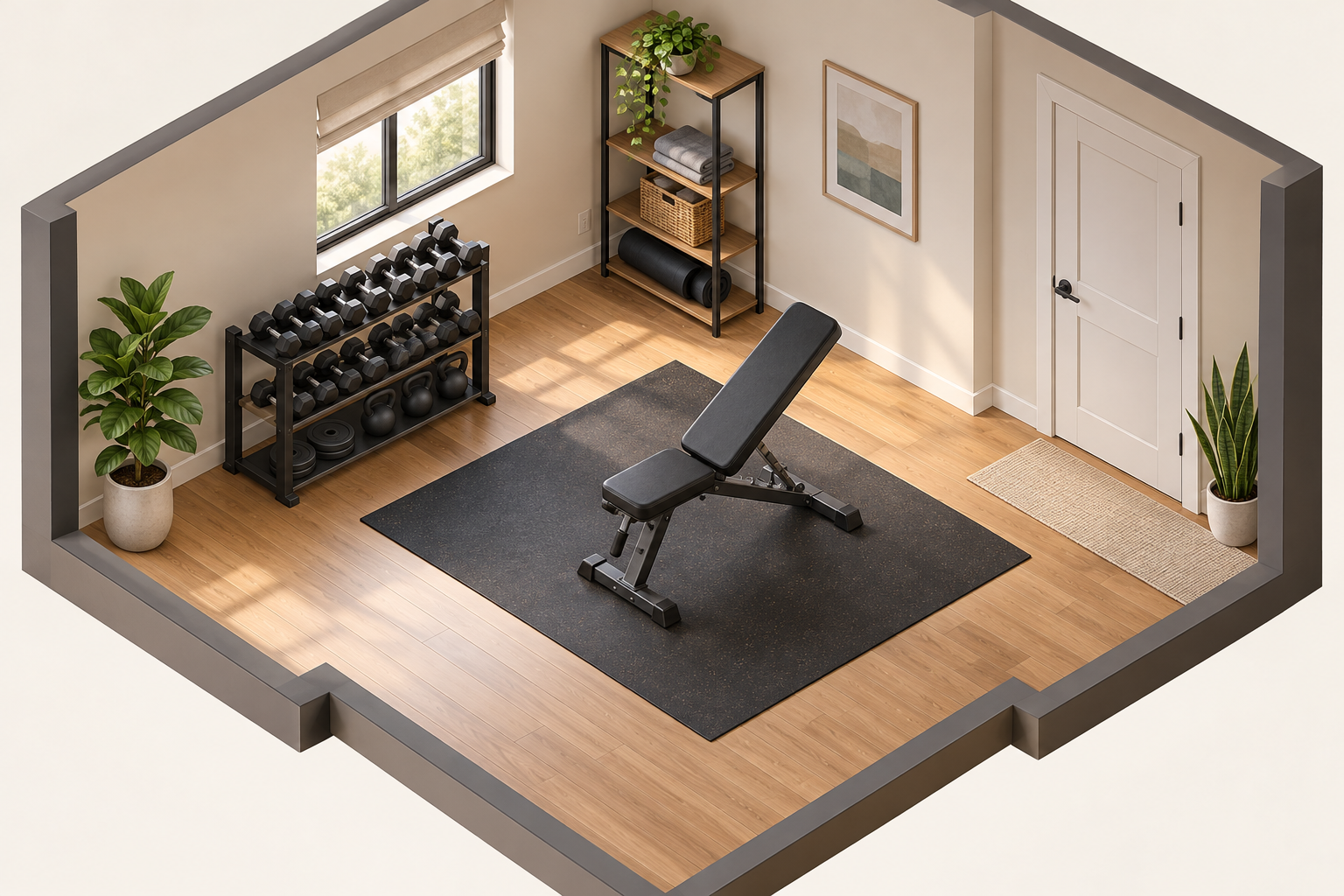
Cover illustration: AI-generated generic home-gym layout. It is illustrative only, not a measured room plan or a product photograph.
Start with the movements, not the equipment footprint
Write down the exercises you expect to perform and the equipment each one needs. A bench used for seated dumbbell work has a different movement envelope from one used for a press, step-up, or an exercise that requires carrying weights into position. Include the space to pick up and set down each weight, move around the bench, and stand up safely. If you train with another person or a spotter, account for that person too.
Do not treat a published room-size suggestion as a universal clearance rule. The American Council on Exercise has recommended an 8-by-8-foot area for clients completing virtual home-training sessions, but that is context-specific guidance, not a guarantee that every bench, exercise, or lifter fits in that footprint. Your usable area depends on the equipment, movement, room layout, and the manufacturer’s instructions.
Measure the bench in its actual configurations
Measure the bench’s length and width on the floor, then check the manufacturer’s listed overall dimensions if available. For an adjustable model, repeat the check in the flat, incline, or decline positions you intend to use. The backrest may extend beyond the frame or change the space needed around it. Record the largest footprint and mark it on the floor with painter’s tape before moving other furniture.
Now sit or lie on the bench in the planned position without lifting a weight. Notice whether your feet can contact the floor where the exercise requires it, whether your head and shoulders have room, and whether your elbows or hands could strike a wall, ceiling fixture, shelf, or nearby equipment. For overhead movement, check the highest point reached by the weights, not just the bench height. If a movement requires a range of motion that the room cannot provide, choose another exercise or location rather than shortening the motion in an unsafe way.
Keep access and the floor clear
Plan a direct route from the room entrance to the training area. Do not place the bench where a door can swing into it or where someone has to step over a dumbbell to leave. Keep cords, loose rugs, bags, and small objects out of the movement area. ACE also advises home trainees to remove tripping hazards and uneven transitions. A clear path matters when carrying equipment as well as during a set.
Put weights on a stable rack or in a designated storage spot when they are not in use. Avoid stacking equipment where it can roll, tip, or block ventilation or access to electrical panels. If a floor mat bunches, slides, or makes the bench rock, remove it or use a surface appropriate to the equipment; do not compensate with loose blocks or improvised shims.
Do a no-load layout rehearsal
- Place the bench in the proposed location and set its adjustment mechanism according to the manual.
- Walk the route to it while carrying no weights, and confirm the room exit remains open.
- Rehearse mounting, dismounting, and the intended range of motion with empty hands.
- Check nearby walls, windows, lights, shelves, and other people or pets that might enter the area.
- Move the bench and repeat the rehearsal if any part of the movement feels constrained.
This is a space-planning check, not a test of the bench’s load capacity or structural condition. Inspect and assemble the bench according to its own manual. If it rocks, has a damaged part, or its adjustment does not lock securely, stop and resolve that issue before exercising.
Compare product dimensions with your measurements
For example, the Waxman Adjustable Weight Bench product page identifies a bench with an adjustable backrest and currently lists it at $269.00 USD. The page description gives several angle values while the title advertises a different position count, so verify the exact configuration and assembly details directly with the seller before purchase. Do not infer a complete room footprint from the product image; compare the seller’s current dimensions with your taped floor layout and exercise plan.
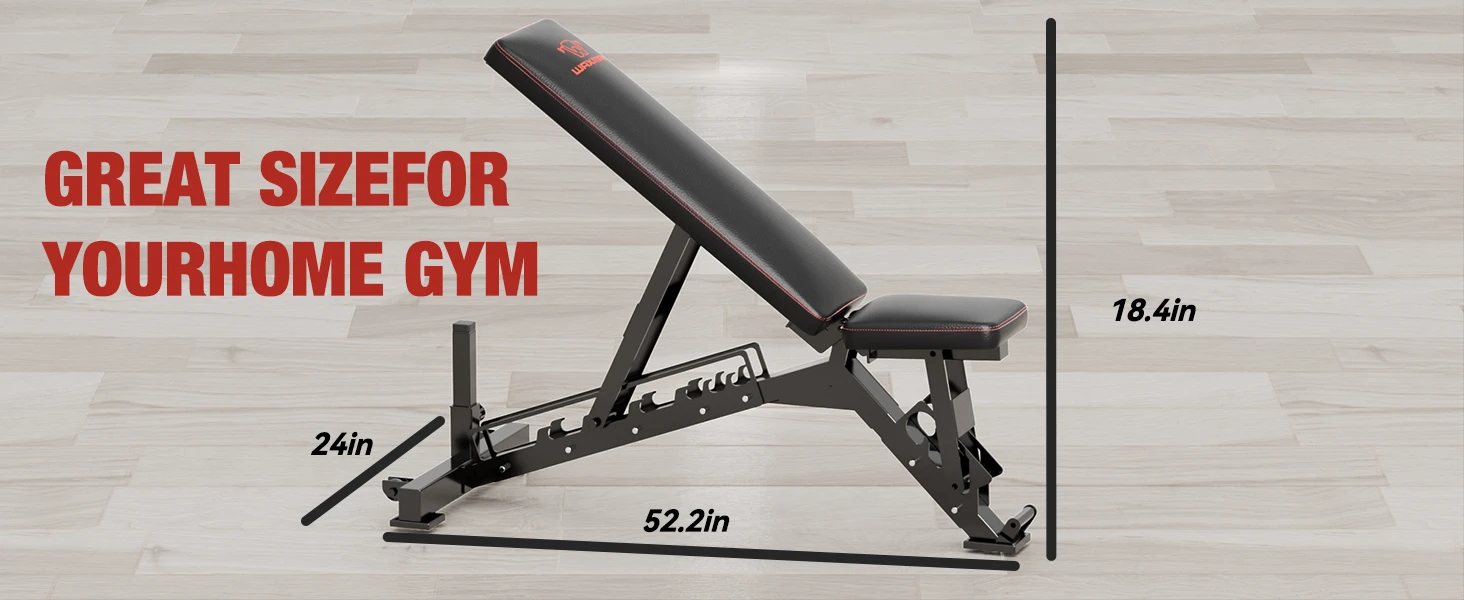
Waxman Adjustable Weight Bench
The listing describes an adjustable backrest; its current page price is $269.00 USD. Confirm dimensions and the exact adjustment configuration before ordering.
Price checked October 27, 2026. Price and availability may change; see product page.
When a corner is too tight
If the bench blocks a doorway, leaves no clear way to get off, or forces a weight path into a wall or ceiling fixture, the space is not a good fit for that setup. Try a different orientation or room, remove nonessential furniture, or choose movements and equipment suited to the available area. Do not assume a compact bench makes every exercise possible in a compact room.
Sources
- American Council on Exercise, Tips for In-home Training — context-specific home training space and hazard guidance.
- American Council on Exercise, Body-weight Interval Training — clear floors, obstacles, and trip hazards.
- WaxmanUSA product listing — current product identity, description, and displayed price checked October 27, 2026.
Written with Codex assistance. No product or exercise-space test was conducted; no independent human review is claimed.
Leave a Reply