
No products in the cart.
Feet Don’t Reach the Floor on a Weight Bench? Safe Setup Options
Quick answer: If your feet do not reach the floor when you lie on a weight bench, use a firm, stable raised platform that supports both feet, or choose a different bench or exercise setup. The American Council on Exercise describes placing the feet on the floor or a raised platform during an incline chest press so the exerciser can maintain a neutral spine and keep stable contact points. Do not balance your feet on loose plates, stacked books, a rolling chair, or anything that can slide.
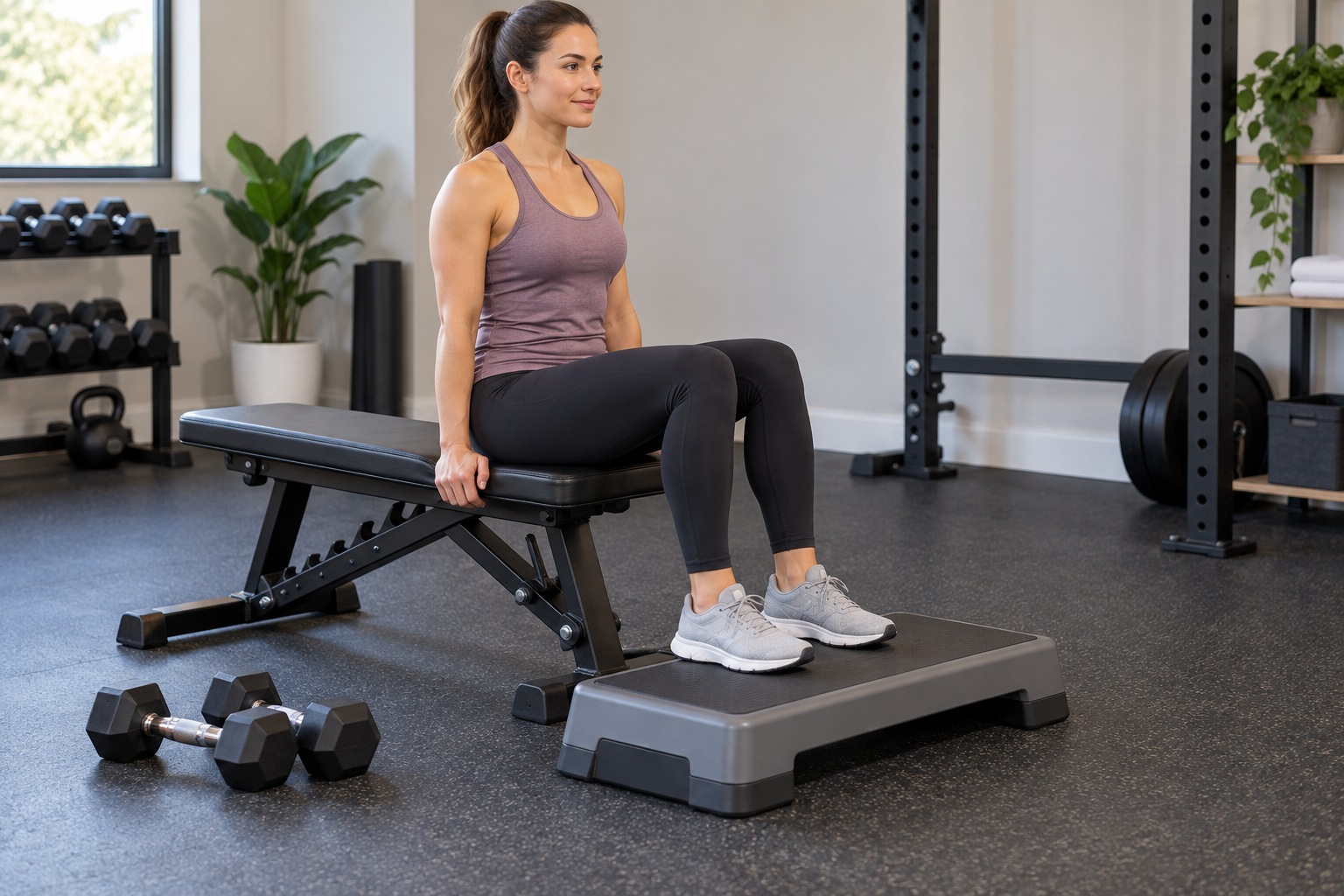
Cover illustration: AI-generated example of a generic bench and stable foot platform. It is illustrative, not a tested workout or Waxman product photo.
Why foot support matters
A bench that is too high for your leg length can leave your feet dangling or reaching for the floor. You may feel less settled while setting up or moving weights. The answer is not to force a rigid posture or change your body to fit the bench; it is to create a stable starting position that suits the exercise and the equipment instructions.
For its incline chest press, ACE describes the feet on the floor or on a raised platform, with the head, shoulders, buttocks, and feet maintaining contact during the movement. This is useful exercise guidance, not a universal medical rule for every lift. The best setup can differ by exercise, bench angle, individual proportions, mobility, and coaching needs.
Try a stable platform before loading weights
- Set up the empty bench. Place it on a level, firm surface and adjust the backrest only as directed by its manual. Confirm that the selected position locks fully before sitting or lying back.
- Check your position without weights. Sit or lie on the bench as the exercise requires. Let your feet rest naturally. If they do not reach, do not begin the set while your legs hang unsupported.
- Choose a broad support. Use a purpose-built exercise step or similarly rigid, non-slip platform that is wide enough for both feet. It should stay flat on the floor and not rock or shift when you press down on it.
- Recheck your body position. Put both feet fully on the support and check that you can keep a comfortable, controlled position without sliding, twisting, or straining to reach it. If support changes your posture in a way that feels unstable, stop and choose another setup.
- Test the empty movement. Rehearse the start and finish with no weights. Only add a light load when the support, bench, and your position remain stable and the exercise is within your ability.
What should you not use as a footrest?
A loose pile of weight plates, a narrow box, a stack of books, a folding chair, or a wheeled object can tip or move. A soft cushion may compress unevenly. Do not prop your heels on a bench frame, adjustment ladder, or other moving part. Avoid a platform that blocks the bench legs or prevents you from reaching the floor safely when getting on and off.
Keep the platform close enough that both feet can stay planted without stretching. It should not interfere with the bench’s base or adjustment mechanism. If your gym’s floor is slick, uneven, or crowded, move the equipment to a clearer location before training. A mat that bunches underneath the bench or step can also undermine a stable setup.
If a stable foot platform does not solve it
Try a different bench height or a variation that lets you keep a stable base. Ask a qualified trainer to observe your setup if you are unsure whether your feet, back, and shoulders are positioned comfortably for a particular movement. If a medical condition, pain, injury, or mobility limitation affects your position, seek individualized guidance from an appropriate clinician or exercise professional rather than forcing the setup.
Do not use a bench whose adjustment lock shifts, whose frame rocks, or whose parts look damaged. A foot platform cannot correct a faulty bench. Follow the bench manual for adjustments and weight limits, and use a spotter when the exercise or equipment instructions call for one.
Product example: verify fit before you buy
The Waxman Adjustable Weight Bench listing describes an adjustable backrest and three cushions. It displays $269.00 USD when checked October 27, 2026. The product page does not state a seat height in the visible specifications, so compare your body position in person or ask Waxman for that measurement before purchasing. Price and availability may change; see the product page.

Waxman Adjustable Weight Bench
The listing describes an adjustable backrest and three cushions. Ask Waxman for seat-height and fit information if foot reach is a concern.
$269.00 USD listed October 27, 2026. Price and availability may change; see the product page.
Quick setup checklist
- Follow the exercise and bench instructions.
- Use the floor or a stable support that carries both feet.
- Keep the support clear of the bench base and moving parts.
- Rehearse the movement unloaded before adding weight.
- Stop if the bench or support shifts or your position feels unstable.
Sources
- American Council on Exercise: Incline Chest Press — feet on floor or raised platform and maintaining body contact during the described movement.
- Waxman Adjustable Weight Bench product listing — adjustable backrest, cushion description, and displayed price checked October 27, 2026.
Written with Codex assistance. No exercise or equipment test was conducted; no independent human review is claimed.
Leave a Reply