
No products in the cart.
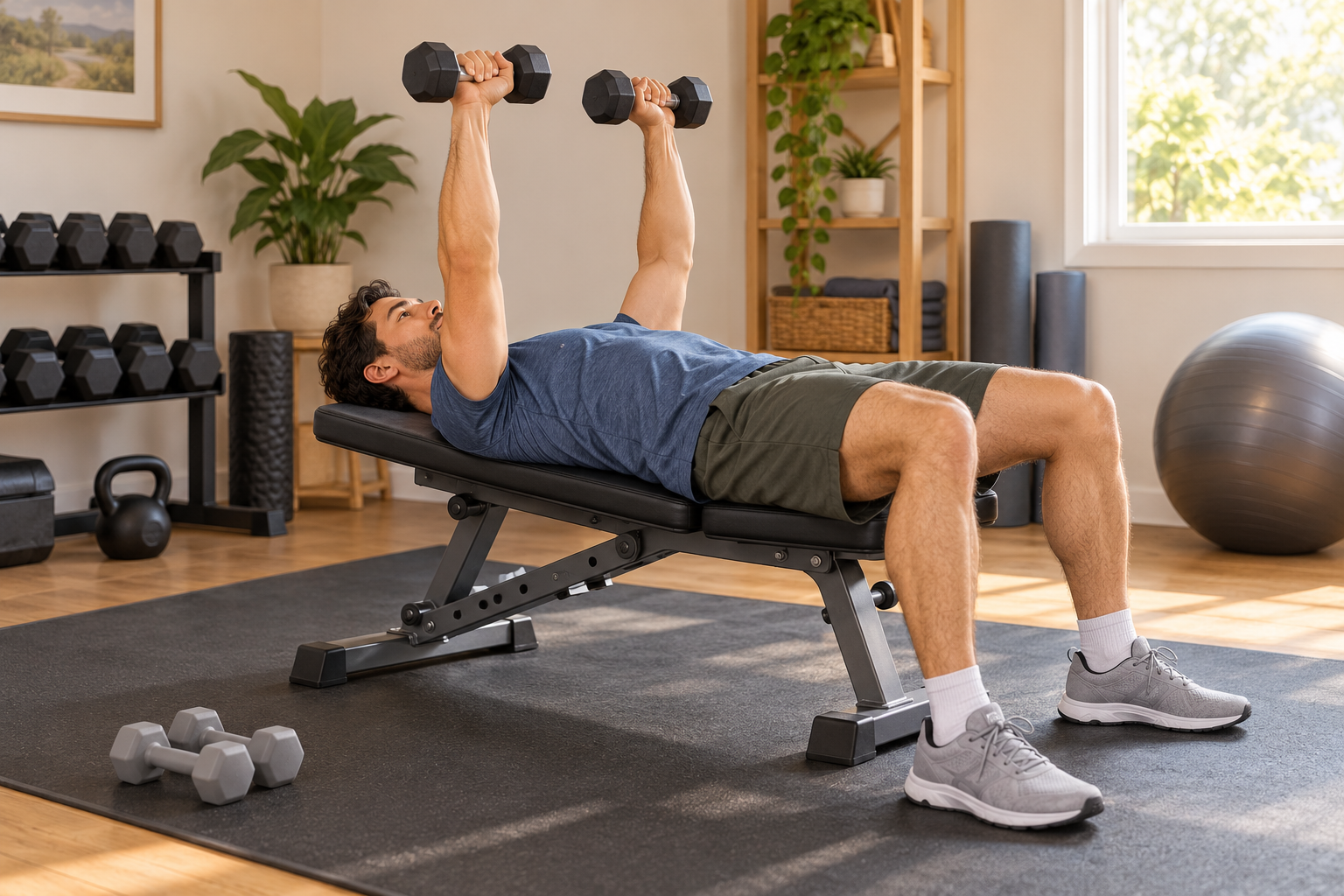
How to Choose a Starting Dumbbell Weight for a Bench Press
Quick answer: Choose a pair of dumbbells light enough that you can set up steadily, lower them with control, and finish your planned repetitions without changing your position. For a first session, begin lighter than you think you need; the goal is to learn the movement and find a repeatable starting point, not test your maximum. If you cannot keep a controlled path or need help getting the weights into position, reduce the load or choose another exercise.
This guide is for generally healthy adults learning a dumbbell chest press. It is not individualized medical or coaching advice. If you have pain, an injury, balance concerns, or a condition that affects exercise, ask a qualified clinician or fitness professional before starting.
Set up before choosing the load
Use a stable, level bench on a clear floor. Check that its adjustment is locked in the position you intend to use; follow the exact bench instructions. For a first trial, a flat position keeps the setup simple. Wear shoes that grip the floor and keep the dumbbells within easy reach. If you are unsure how to get into and out of position safely, ask a qualified spotter or coach to show you before adding weight.
Sit with a dumbbell resting securely on each thigh, then lower yourself under control only if you already know a safe way to do so. Set your head and upper back on the pad, keep your feet supported on the floor or a stable riser, and hold the dumbbells with wrists in line with your forearms. If your feet cannot reach a stable support, do not brace on a rolling chair or stack of loose objects. Choose a suitable setup or ask a coach for an alternative.
Use a light practice set
ACE’s beginner guidance recommends starting relatively light so a new lifter can establish stability and a baseline. Its chest-press instructions emphasize keeping the head, shoulders, buttocks, and feet supported, lowering the dumbbells under control, and avoiding a bounce. Use those ideas as a form check rather than treating one repetition range as a requirement for everyone.
- Begin with the lightest practical pair available, or practice the motion without weights if you need to learn the setup.
- Perform a few slow repetitions. Lower only as far as you can while keeping control and a comfortable range of motion.
- Notice whether both sides move smoothly and whether you can maintain your points of contact without arching or twisting to finish.
- Stop the set while you can still return the weights safely. Do not test a one-repetition maximum to find a starting weight.
The correct first load may feel almost too easy. That is useful information: it gives you a safe baseline to repeat while you learn. If the smallest dumbbells still make the setup awkward, practice unloaded or choose a simpler variation with a qualified coach.
Adjust one step at a time
After resting, increase by the smallest available increment only if the practice set felt controlled and comfortable. Repeat the same movement and compare: can you still lower each dumbbell smoothly, keep the wrists steady, and finish without bouncing, shortening the motion unexpectedly, or losing your position? If not, return to the lighter pair. Dumbbells jump in fixed increments, so there is no need to force the next size; repeat the lighter load on another session or use a different exercise until the jump feels manageable.
Do not use a fixed number of repetitions as proof that a weight is right. Fatigue, experience, the bench angle, range of motion, and the day’s condition all affect what feels manageable. A practical starting load lets you practice the intended movement with control and stop before technique deteriorates. Progress gradually, changing one variable at a time rather than increasing weight, repetitions, and sets together.
When to stop or get help
- Stop if you feel sharp pain, dizziness, unusual shortness of breath, or sudden weakness. Seek appropriate medical guidance for concerning symptoms.
- End the set if the dumbbells wobble, your wrists fold, your body shifts, or you cannot lower them under control.
- Ask for instruction if you cannot safely position or put down the weights. Never drop dumbbells beside the bench where they could strike your feet or damage the floor.
- Do not train through a damaged bench, an unlocked backrest, or a bench that shifts. Follow the product manual and request service if a part is loose or defective.
Choose equipment that fits your setup
A bench does not determine what dumbbell weight is appropriate; the lifter’s control and the exercise setup do. The Waxman Adjustable Weight Bench listing shows a three-cushion design and several backrest angles. Check the current product details and instructions before use; the listing’s title and description differ on the position count, so this article does not rely on a specific count. A bench cannot replace instruction or guarantee safe lifting.

Waxman Adjustable Weight Bench
Listing price: $269.00 USD (checked October 27, 2026). The product page describes three cushions and an adjustable backrest. Review the listing and instructions for the exact configuration and use details.
Price and availability may change; see the product page.
Cover artwork is an AI-generated illustration for editorial use, not a product photo or evidence of a measured training result.
Leave a Reply