
No products in the cart.
Will 2-Inch Weight Plates Fit an Olympic Barbell? Measure First
Quick answer: A plate can fit an Olympic-style bar only when its center hole is made for that bar’s sleeve diameter. Many Olympic bars use sleeves close to 2 inches (about 50 mm), while plates sold as “standard” often have smaller holes. Match the actual dimensions printed for the bar and plate; don’t rely on the word “standard” or the plate’s outside diameter. If the plate does not slide on freely, don’t force it or lift with it.
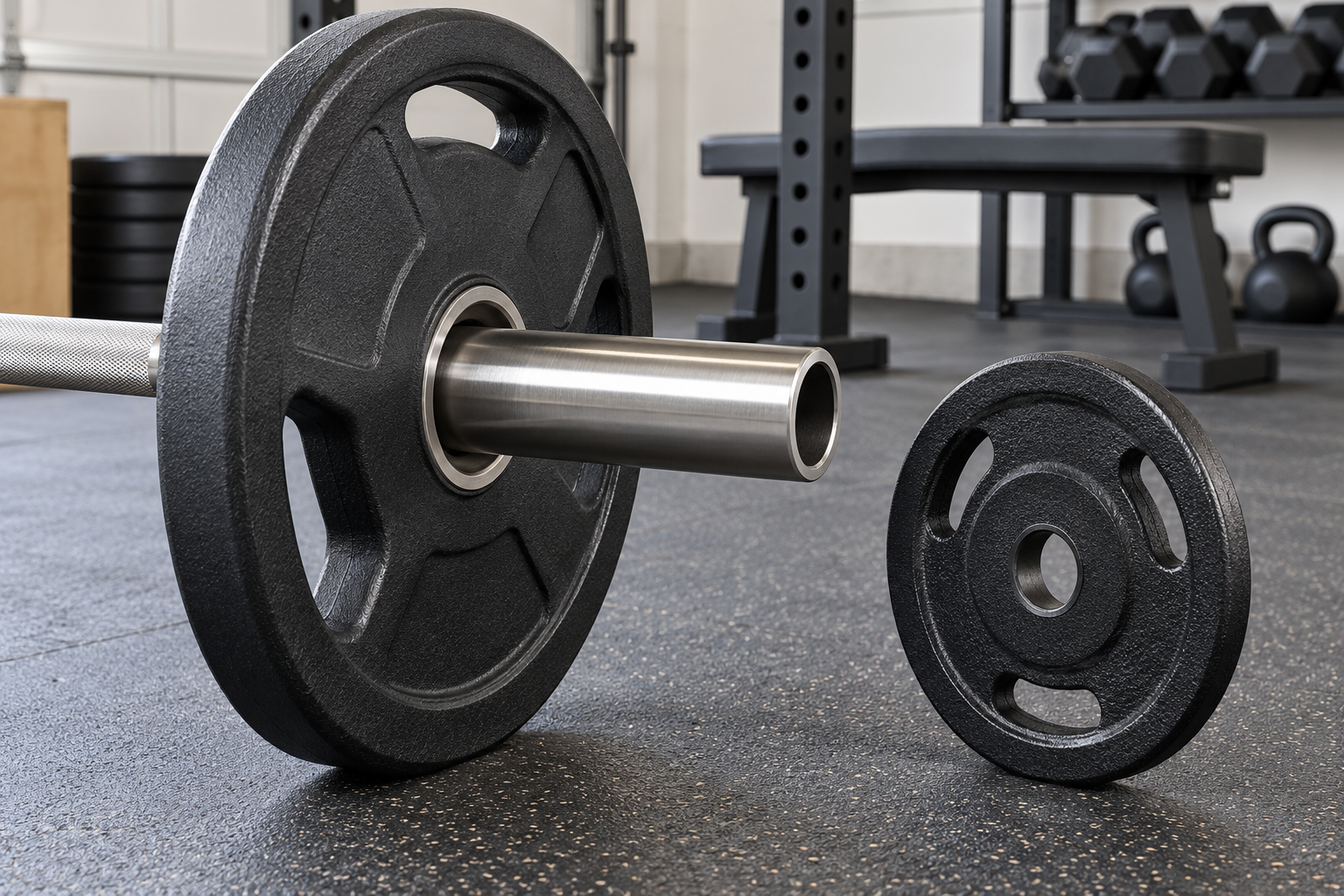
Cover image: AI-generated compatibility illustration. It is conceptual, not a product photo, measured scale drawing, or fit test.
What “2-inch” means
The relevant measurement is the diameter of the bar’s sleeve—the part where the plate slides on—and the diameter of the plate’s center opening. The hole must be slightly larger than the sleeve so the plate can be loaded and removed. It should not be so loose that the plate shifts excessively. The outside diameter of the plate tells you how large it looks, not whether it fits your bar.
In common retail terminology, “Olympic” plates are designed for larger sleeves, often around 2 inches, while “standard” plates often refer to a smaller opening around 1 inch. Retail wording is not always consistent. For example, a Waxman bar listing calls the bar “Olympic” and also describes it as fitting “2-inch standard weights.” Treat that phrase as a seller’s compatibility claim, not as proof that every plate marketed as standard will fit. Before ordering, confirm the sleeve and plate-hole dimensions with the manufacturer.
Check the fit before you load the bar
- Find the bar specification. Look for sleeve diameter in the manual or product listing. If the listing gives only a category name such as Olympic, ask the seller for the actual measurement.
- Find the plate opening. Check the plate’s center-bore measurement, not just a product photo or the plate’s weight. Confirm whether the measurement is in inches or millimeters.
- Compare like with like. One inch is 25.4 mm, so a sleeve described as roughly 50 mm is about two inches. Small measurement differences and manufacturing tolerances still matter; do not assume a rounded label means an exact fit.
- Try one unloaded plate. With the bar secured and no load on it, slide one plate onto the sleeve by hand. It should move on without hammering, prying, or wobbling excessively. Stop if it binds or rocks.
Rogue Fitness describes its Olympic-spec bar sleeves as 50 mm and pairs them with Olympic plates sized for that system. That is useful context for common equipment, but it does not certify another brand’s bar or plate. Use each manufacturer’s stated dimensions for the specific items you own.
If the plate does not fit
A small-hole plate will not go over a larger sleeve. Do not hammer it on, grind the plate, or try to stretch the opening. If the hole is much larger than the sleeve, the plate may move around; don’t rely on a collar to correct an obvious size mismatch. Do not improvise with tape, loose spacers, or an adapter unless the bar maker explicitly approves a compatible sleeve reducer for that model.
When a plate appears to fit but has unusual play, confirm the measurements and the bar’s condition. Check that the sleeve is not bent or damaged and that the plate opening is not cracked or distorted. If the source specifications are unclear, pause and ask the seller or manufacturer. A photograph or AI-generated illustration cannot establish fit.
Check the full setup after confirming compatibility
Once the plates fit, load them evenly and secure them with collars made for the sleeve. Follow the bar and collar instructions. Keep the bar on a rack or stable surface while loading, and keep hands and feet clear of moving plates. Make sure the plate stack leaves enough sleeve exposed for the collar to engage fully.
Fit is only one part of safe equipment selection. Check the rated capacity of the bar, collars, rack, and any other equipment in the setup. The lowest applicable limit governs; a high capacity claim on one component does not raise the rating of the others. If you plan to drop weights, use equipment specifically rated for that use and follow the manufacturer’s instructions.
Waxman bar listing
The Waxman equipment catalog lists a 7-foot Olympic barbell and describes compatibility with 2-inch weights. Its catalog wording also uses “standard weights,” so confirm the exact sleeve and plate dimensions with Waxman before buying plates or relying on fit. The product detail page was not available during this check; the linked catalog is the source for the name and price snapshot below.

Waxman 7ft Olympic Barbell
The Waxman equipment catalog describes it as a 7-foot Olympic bar and states compatibility with 2-inch weights. Confirm exact sleeve and plate-bore dimensions with the seller; the product-detail page was unavailable during this check.
Price: $69.00 USD, as listed in the Waxman equipment catalog on October 27, 2026.
Price and availability may change; see the product page.
Bottom line
Match the plate’s center hole to the bar’s sleeve measurement, then try one unloaded plate by hand. A mismatch is a reason to stop and verify the specifications—not to force the parts together. Product labels such as “Olympic,” “standard,” or “2-inch” are clues; the exact dimensions decide fit.
Sources: REP Fitness plate and bar compatibility guidance · Rogue Fitness barbell sleeve specifications · Waxman equipment catalog.
Leave a Reply