
No products in the cart.

How to Check Ceiling Clearance for a Seated Dumbbell Press
Quick answer: Check the full space your hands and weights occupy, not just the bench height. Sit on the bench in the position you plan to use, raise empty hands through the intended range, and leave enough room that neither your hands nor equipment can touch a light, fan, beam, or ceiling. If the path is cramped, choose a lower-impact range, use a different movement, or move the bench. Do not test clearance with heavy dumbbells.

Measure the movement, not only the room
A ceiling measurement from the floor is only a starting point. Your seated height, bench setting, arm length, grip, and the way you move the weights all affect the space needed. A ceiling fan, pendant light, exposed beam, sloped ceiling, or low duct can reduce usable clearance even when the room seems tall enough.
Set the bench on a level floor where you intend to train. Use the exact backrest position you expect to use, then sit upright with feet planted. Without weights, slowly move your hands along the planned path. Check the highest point above your hands and look around the full arc, including slightly forward and outward. Your hands may travel higher or wider than the bench back.
A safe, unloaded clearance check
- Inspect the area. Identify fragile fixtures and anything that could swing or hang into the movement. Turn off and secure a ceiling fan according to its instructions before exercising nearby; do not rely on a stationary fan being out of reach.
- Set the bench. Lock the adjustment exactly as its manual requires, place it on a stable surface, and keep it clear of walls enough to mount and dismount normally.
- Rehearse without weights. Sit down and move empty hands through a comfortable range. Do not force the arms to an overhead position if that causes pain or requires arching or twisting to avoid an obstacle.
- Check the equipment envelope. If you later use dumbbells, include their length and the space needed to bring them into and out of position. First practice those transitions with no load. A weight that clears at the top may still strike a fixture while being picked up or set down.
- Keep a margin. Do not aim for a near miss. Leave room for ordinary movement and small setup variation. There is no single clearance number that fits every body, bench, ceiling feature, or exercise.
What to change when clearance is limited
First move the bench to a more open part of the room and repeat the unloaded check. If the movement still approaches an obstruction, use a different exercise that does not require the same overhead path. Some people can perform a shorter, controlled range, but only if it remains comfortable and the weights stay clear throughout the whole repetition. A shortened range is not a reason to push through shoulder pain or compensate by leaning back.
Do not improvise by placing the bench on a platform, changing its feet, or removing a ceiling fixture. Those changes can create stability, electrical, or installation hazards. Follow the bench manual for adjustment and use. If you are unsure whether a movement suits you, ask a qualified fitness professional; persistent pain or a recent injury warrants advice from a healthcare professional.
Check the bench details separately
An adjustable bench can support different exercise positions, but adjustability does not guarantee a fit for every room or movement. Confirm the bench’s folded and in-use dimensions, adjustment instructions, and setup requirements on the current listing and manual. Product titles and descriptions can use different position counts, so verify the exact configuration rather than relying on a headline alone.
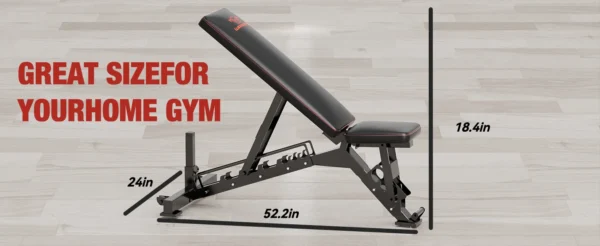
Waxman Adjustable Weight Bench
Official listing describes an adjustable backrest and multiple exercise positions. Confirm dimensions and setup instructions for your room before ordering.
$269.00 USD (checked October 27, 2026). Price and availability may change; see the product page.
Before each session
Repeat a quick unloaded check if you move the bench, change its angle, switch to a different exercise, or install equipment overhead. Keep the training path clear and stop if the bench shifts or the movement becomes uncomfortable. Room planning can help prevent contact with obstacles, but it cannot determine whether an exercise is appropriate for an individual.
Product price checked October 27, 2026. Price and availability may change. This article offers general space-planning guidance, not individualized medical advice or a tested workout demonstration.
Leave a Reply