
No products in the cart.
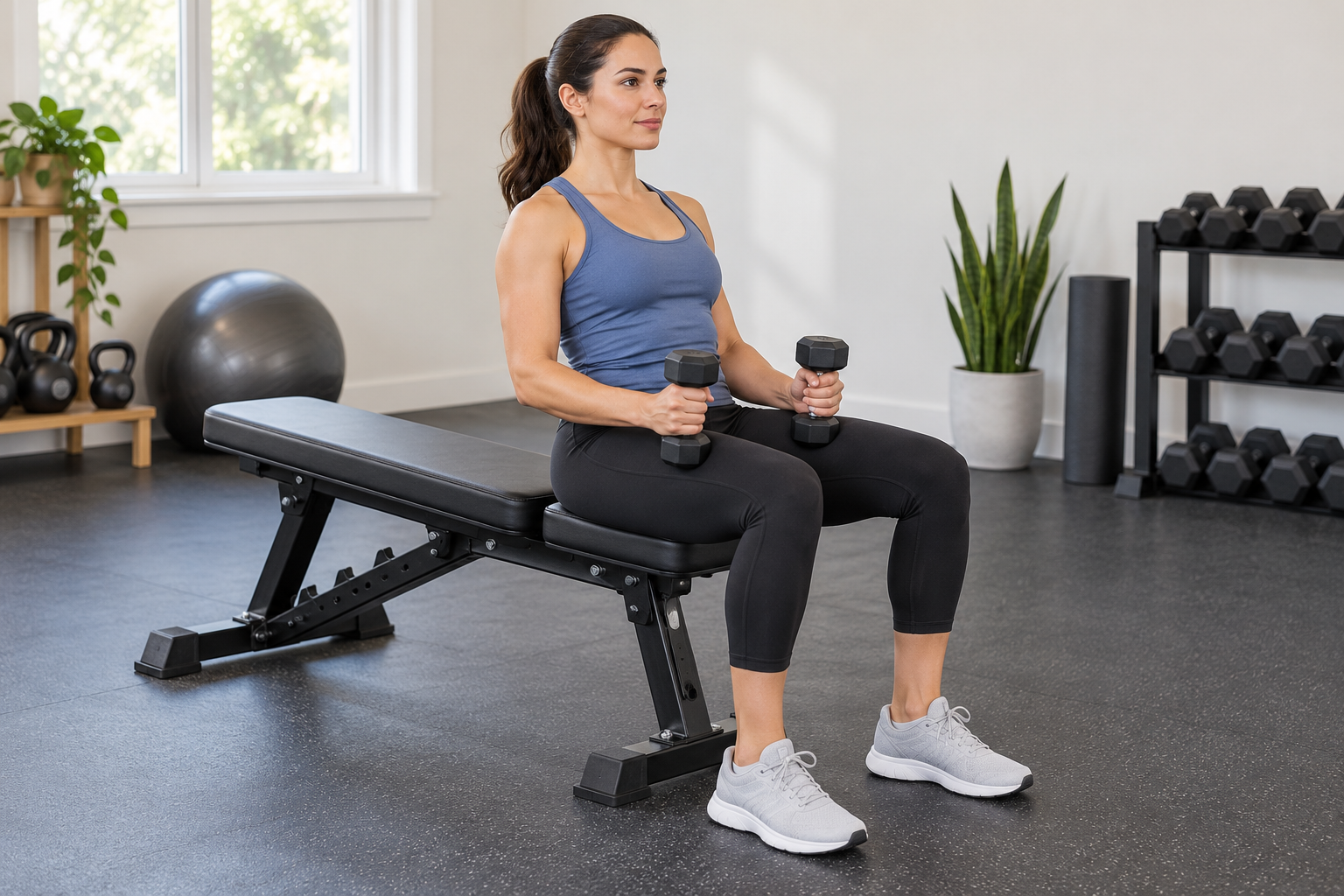
How to Get Into Dumbbell Bench Press Position Safely
Quick answer: For a dumbbell chest press, sit near the end of a stable, correctly adjusted bench with the dumbbells resting upright on your thighs. Brace them there, then lie back under control while guiding them toward your chest. Start with a load you can position without strain; if you cannot get into or out of position smoothly, use lighter weights or ask a capable spotter to help.
This setup question is different from choosing a bench angle or checking room clearance: the challenge is controlling the dumbbells during the transition from sitting to lying down, before the first repetition and after the last.
Set up before picking up the dumbbells
Place the bench on a level, clear surface and confirm that its back and seat are locked in the position you intend to use. Follow the exact bench manual for its adjustment mechanism and load limits. Look for loose hardware, damaged upholstery, or movement under a gentle unloaded check; do not use a bench that appears damaged or unstable.
Choose a clear route to the bench and a place to set the weights down when the set ends. Keep other people, pets, and loose objects out of that area. Wear shoes that give you secure footing. If the exercise causes pain, dizziness, or unusual symptoms, stop rather than trying to finish the set.
Use a controlled seated-to-lying transition
- Choose a manageable load. Before increasing weight, make sure you can pick up and hold both dumbbells with control. There is no universal beginner weight; your ability to handle the setup matters as much as the press itself.
- Sit and place the weights. Sit near the front half of the bench with both feet planted. Hold the dumbbells securely and bring them to rest upright on your thighs, close to your torso. Keep your wrists in a comfortable neutral position and avoid letting a weight roll toward your knee.
- Brace before leaning back. Keep both dumbbells supported by your thighs as you recline. Use a smooth, deliberate motion and guide the weights toward the starting position as your upper back meets the pad. Do not throw your shoulders backward or swing the dumbbells overhead.
- Get settled before pressing. Plant your feet, find a stable position for your head, upper back, and hips, and check that both dumbbells are balanced above your chest area. Begin only when you feel in control and the bench remains steady.
- End the set with the same care. Lower the weights under control. If you can safely return to sitting while maintaining a firm grip, do so deliberately; otherwise use a spotter who understands how to assist. Do not drop dumbbells beside your body or twist suddenly to escape from under them.
When a spotter or different exercise makes sense
A spotter can help hand off or receive dumbbells, especially when the weights are difficult to maneuver or you are learning the transition. Agree on the assistance before the set. The American Council on Exercise describes signaling a spotter for help moving into the starting position and at the end of a chest press; its exercise guidance also emphasizes keeping the body supported and the weights controlled. A spotter should not lift a load you cannot control through the movement.
If you train alone, choose a load that you can safely manage through both transitions. Consider a lighter weight, a floor press, or another movement that does not require the same bench setup. Those are options to discuss with a qualified fitness professional if you are unsure what fits your needs. Do not rely on a bench’s advertised capacity as proof that a particular exercise or transition is safe for you.
Common setup mistakes
- Starting too heavy: If the dumbbells pull your arms out of position while you lie back, reduce the load.
- Using momentum: A kick or sudden backward lean can make the weights unpredictable. Keep the movement slow enough to control.
- Ignoring the bench: A locked angle and stable base are prerequisites; stop if an adjustment pin, hinge, or frame shifts.
- Improvising an exit: Plan how the weights will be handed off or set down before the set begins.
Choosing a bench
A bench should fit the exercise, adjust as intended, and remain stable on the floor. The Waxman listing describes an adjustable bench with three cushions and six listed backrest angles, from -15° to 85°; the page title says seven positions, so check the current listing and model details rather than assuming the count. Product information does not replace the manual or a personal fit check.

Waxman Adjustable Weight Bench
Adjustable bench listing with three cushions and multiple backrest angles. Confirm the exact product details and instructions before use.
$269.00 USD (price checked October 27, 2026). Price and availability may change; see product page.
Cover image: AI-generated illustration for general explanation. It is not a product photo, a tested demonstration, or individualized exercise advice.
Leave a Reply