
No products in the cart.
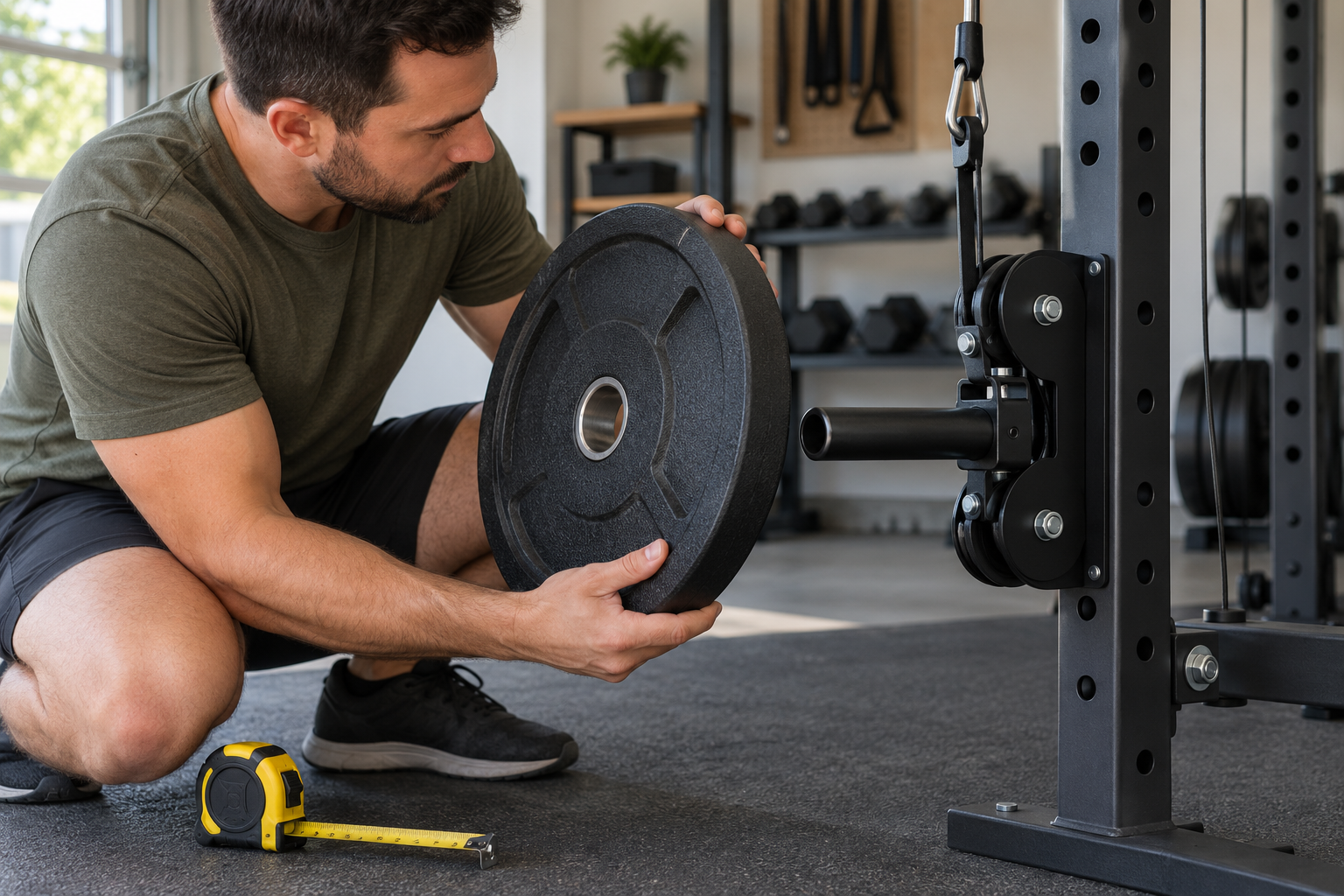
Will Your Weight Plates Fit a Home Gym Pulley Loading Pin?
Check the actual plate opening and loading-pin dimensions before you attach or load anything. A plate that looks close may not slide on freely, and a product listing that mentions standard or Olympic plates does not establish that every plate, collar, or attachment combination will fit your setup. If the fit is tight, forced, tilted, or uncertain, stop and ask the equipment maker to confirm compatibility.
What needs to fit?
A loading pin passes through the center opening of a weight plate. The plate opening must clear the pin shaft, while any sleeve, collar, strap, or connector must also seat as its manufacturer intends. Names such as “standard” and “Olympic” are useful clues, but labels alone do not identify every plate’s measured opening or every attachment’s usable dimensions. Coatings, inserts, manufacturing tolerances, and wear can affect what you see on the equipment in front of you.
Waxman lists its LAT and Lift Pulley System with an upgraded loading pin and says the pin can be used with standard or Olympic weight plates. The public listing does not provide a measured pin diameter or guarantee fit with every brand or plate design. Treat that statement as product-specific guidance, then confirm the actual pieces you own.
Check fit before assembling a loaded setup
- Identify each part. Find the exact model and any instruction sheet for the pulley attachment, plate, and connector. If parts are mixed brands or the model label is missing, do not assume compatibility from appearance.
- Inspect the plate opening. Look for a visible insert, deformation, cracks, burrs, or damage. If you have calipers and know how to use them, measure the opening at more than one point; do not scrape or alter the insert to make a plate fit.
- Check the pin specification. Use the maker’s published dimensions or ask support for the shaft diameter and approved plate types. Do not infer a diameter from a product photo or from the phrase “standard or Olympic.”
- Try the unloaded fit only as the instructions allow. With the pin detached from the cable or otherwise secured against movement, check whether the plate slides on and off without force and sits as designed. Keep fingers clear of pinch points. Never suspend a plate or pull on a cable to test an uncertain fit.
- Confirm retention and capacity separately. A plate sliding onto a pin does not prove that the full assembly is correctly secured or that a chosen load is allowed. Follow the attachment’s stated load limit, connector arrangement, and host-equipment instructions. Use the smallest applicable limit and do not exceed it.
Common fit checks that can mislead
Do not test compatibility by comparing only the plate label, its outside diameter, or how much weight it holds. Those details do not tell you whether the center opening clears a particular pin. A plate that starts onto the shaft but catches partway is not a confirmed fit. Likewise, a plate that slides on does not prove that the pin is properly attached to the pulley or that the host structure can support the selected load.
Check one plate at a time and keep the system unloaded while you identify the parts. If a sleeve or insert is loose, cracked, or visibly distorted, set that plate aside. If the instructions give a specific plate type, follow them; do not substitute a different size based on a rough visual comparison. When dimensions are provided in different units, convert carefully or ask the manufacturer to confirm the measured shaft and opening together.
What if a plate will not slide on?
Stop rather than hammering, grinding, lubricating, or stacking improvised spacers. Check whether the plate is intended for a different size system, whether an insert is damaged, and whether the pin is the correct part. Send the manufacturer the exact model names, clear photos, and your measurements; ask for written confirmation before using the combination. If the maker cannot confirm the fit, choose a verified compatible plate or attachment.
Before the first repetition
After compatibility is confirmed, follow the product instructions to assemble the system and secure every connector. Inspect the cable, pulley, stitching or hanging strap, and loading pin for visible wear or damage. Keep the travel path clear, begin with a conservative load, and move smoothly without jerking. Stop if a connector shifts, the cable frays, a plate rocks, or the system makes an unexpected movement. These checks do not replace the manufacturer’s manual or a qualified professional’s guidance.
Product details
The Waxman Fitness LAT and Lift Pulley System is listed with 70-inch and 90-inch cable options and a loading pin described for standard or Olympic plates. Its listing states a maximum load of 280 lb; that figure is not a recommendation for every host structure or setup. Verify the instructions and every component’s applicable limit before use.

Waxman Fitness LAT and Lift Pulley System
Choose the listed 70-inch or 90-inch cable option and verify your own plate and host-equipment fit. Listing price checked October 31, 2026: $43.00 USD. Price and availability may change; see product page.
Illustration: AI-generated for explanation; not a product photo, fit test, or measurement.
Leave a Reply