
No products in the cart.
How to Measure Home Gym Pulley Cable Reach Before Buying
Measure the cable’s actual route and the handle’s full travel before choosing a length. A cable that reaches the starting position may still run out of travel at the end of a pulldown, curl, or lift. The Waxman Fitness LAT and Lift Pulley listing names 70-inch and 90-inch sheathed cable options, but the page does not map each length to a particular exercise, anchor height, or room layout. Treat those lengths as listed options, not a guarantee that either fits your setup.
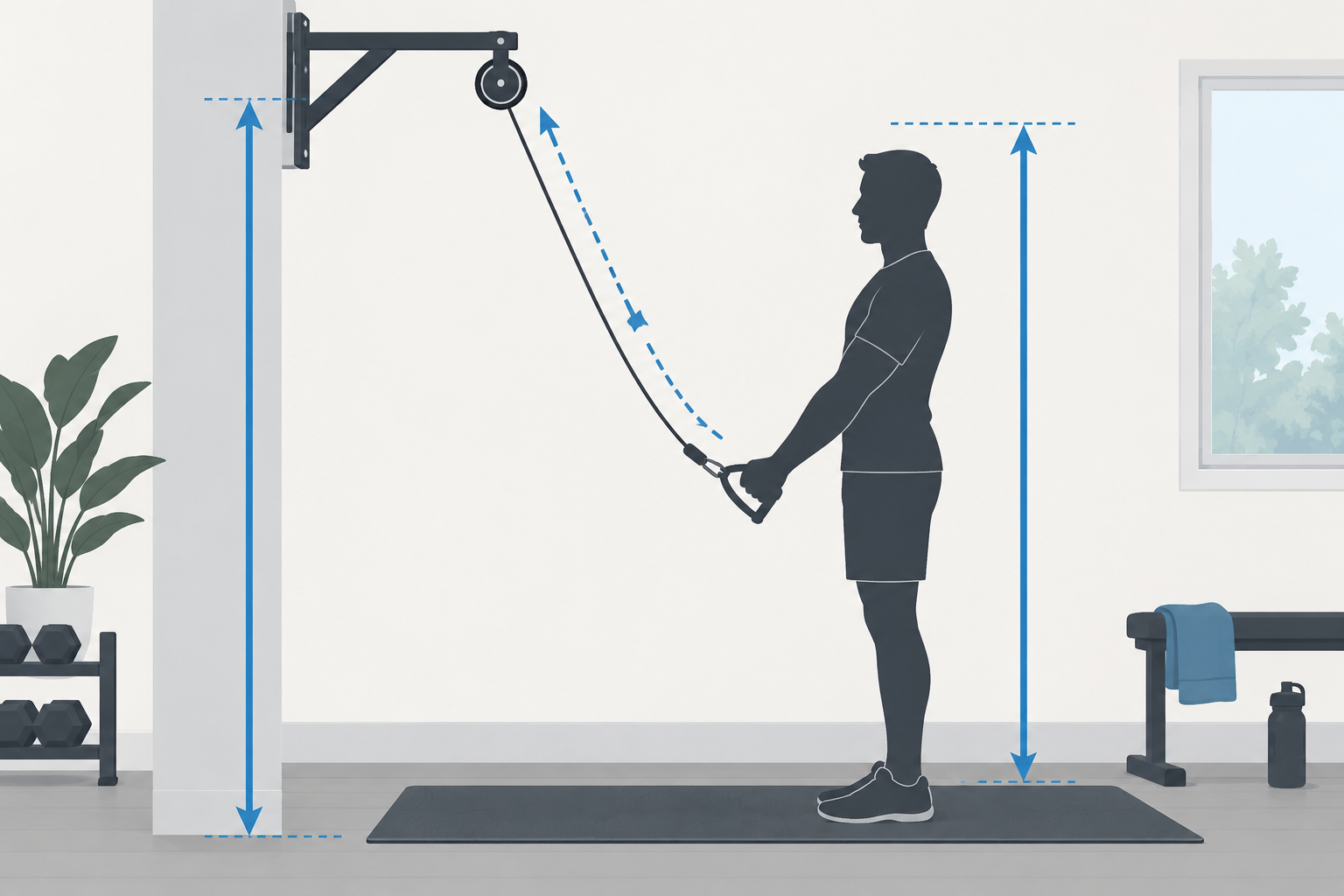
AI-generated illustration for measurement planning only. It does not show the exact Waxman product or tested dimensions.
Why the cable route matters more than a single room measurement
For an overhead setup, cable travels from the loading pin, around the pulley, and toward the handle. The useful length is affected by where the pulley sits, how the cable is routed, and how far the handle must move. A ceiling height alone cannot answer whether a cable fits. Nor does a listed cable length tell you how much usable movement remains after the system is installed.
Start by identifying the exact anchor point and attachment method allowed by the equipment instructions. The product listing describes attachment to a power cage, pull-up bar, beam, or another location where its hanging strap can be installed. That description does not certify every anchor or installation. Confirm the anchor is approved for the direction and loading of your planned exercise before measuring a route; if that is uncertain, stop and ask the equipment maker.
A practical measuring method before purchase
- Mark the pulley location. Measure from the floor to the point where the pulley will hang, and record the location relative to the rack or beam. Include the actual strap and pulley arrangement rather than measuring to a nearby ceiling point.
- Map the handle path. With the system unloaded and not being used for exercise, use a flexible tape or string to trace the intended cable path from the loading-pin connection, around the pulley, to the handle. Do not attach a weight or pull against an improvised anchor. Follow the product instructions for any assembly or checking procedure.
- Mark both movement endpoints. Note where the handle starts and where it should finish for the movement you plan to perform. A pulldown and a lift-up movement may need different travel. Check the full route at both endpoints and account for the cable segment that remains around the pulley and connected to the loading pin.
- Check user and plate clearance. The handle must reach the intended range without the user hitting a wall, ceiling, rack member, or furniture. The loading pin and plates also need room to move without striking the floor or another object. Keep the path clear; do not solve a reach problem by leaning, jerking, or standing on an unstable surface.
- Compare with the manufacturer’s stated measurement. Ask whether the 70-inch and 90-inch figures refer to the sheathed cable itself and how the maker measures usable travel. The product page lists both lengths but does not explain a universal measurement method or give a room-height chart. If the answer is not available, avoid assuming the longer cable is automatically right.
How to choose between a shorter and longer listed cable
A shorter cable may suit a compact arrangement if the full route and the desired handle movement fit without reaching the cable’s limit. A longer cable may provide more reach in some layouts, but extra length can also leave slack or change how the system hangs. Those are geometry considerations, not claims that one length is safer, smoother, or better for a particular exercise. Confirm the product’s instructions for correct cable routing and tension.
When considering this specific listing, ask the seller to confirm which cable length corresponds to the product variation you can order, the exact length measurement, and the permitted attachment arrangement. The page describes both 70-inch and 90-inch sheathed cables, pull-down and lift-up modes, and a loading pin. It also states a maximum load up to 280 lb; that is a listing claim for the pulley system and does not rate your rack, anchor, building structure, or the entire assembled setup.
Stop if the setup cannot be verified
Do not load the system if the cable binds, rubs sharply, becomes slack where it should be controlled, or cannot travel through the intended range. Do not improvise extensions, substitute hardware, or infer compatibility from a strap that happens to fit. If cable length, anchor approval, or clearance remains unclear after checking the instructions, ask the manufacturer or choose equipment designed for the space.
Product details

Waxman Fitness LAT and Lift Pulley System, Dual Cable Machine
Listing describes 70-inch and 90-inch sheathed cables, pull-down and lift-up modes, and a loading pin. The listing does not specify which length suits each layout.
$43.00 USD (page snapshot checked October 9, 2026). Price and availability may change; see product page.
This article is Codex-assisted and has not been represented as an independent equipment test or professional installation review.
Leave a Reply