
No products in the cart.
Can You Use a Cable Pulley on Any Pull-Up Bar?
No—do not assume a cable pulley is safe on any pull-up bar. The pulley’s own load rating does not certify the bar, its brackets, fasteners, doorway, rack, or the way the strap is attached. Use a bar only when its manufacturer and the pulley instructions allow that setup and the complete installed assembly is rated for the intended exercise. If the rating or compatibility is unclear, do not load it; ask the manufacturers or use a specifically approved anchor.
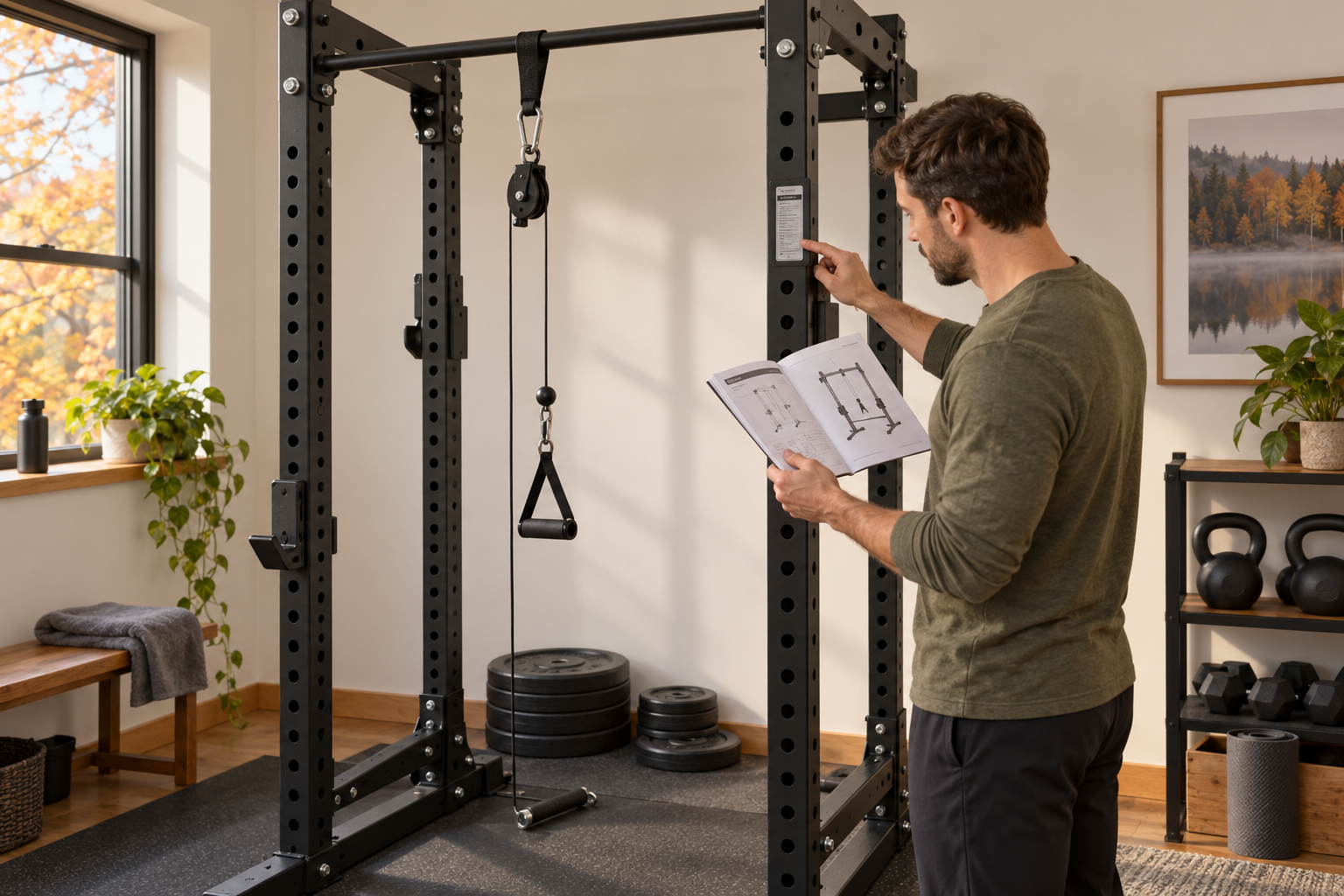
AI-generated illustration of a person checking a rack label and instructions. It is not a real installation, load test, or safety certification.
What the pulley listing does—and does not—establish
The Waxman LAT and Lift Pulley System listing describes 70-inch and 90-inch sheathed cables, a loading pin, and connection to a power cage, pull-up bars, beams, or another place where its hanging strap can be installed. It also lists a maximum load of up to 280 pounds. That is a product-page claim about the pulley system; it is not an independent test and does not mean every pull-up bar can safely carry 280 pounds of attached plates plus exercise forces.
The anchor is part of the load path. A bar can be sturdy for a person performing pull-ups yet not be approved for a suspended pulley that pulls in a different direction. A door-frame bar may rely on friction, trim contact, or a mounting method that its manufacturer does not approve for this kind of loading. Do not infer compatibility from the fact that a strap physically fits over the bar.
Check both sets of instructions before assembly
- Identify the exact bar and mounting method. Find the model label and the manual for the rack, wall-mounted bar, or doorway product. Confirm the manual permits a suspended accessory or cable loading in the direction you plan to use it. If it only describes bodyweight pull-ups, ask the manufacturer before adding a pulley.
- Check the pulley instructions and attachment path. Use only the supplied connection method and compatible components. Inspect the strap, buckle, cable, pulley, and pin for wear or deformation. Do not improvise with an unlisted extension, carabiner, knot, or second anchor.
- Find the rating for the assembled configuration. Confirm whether the bar’s stated capacity applies to the mounting and direction of force involved. The lowest-rated component governs; ratings from separate products cannot simply be added. A 280-pound pulley listing is not the rating of the bar or building.
- Confirm clearance. The cable, plate stack, handle, and your body need a clear path through the intended movement. Keep people, pets, furniture, and breakable objects away from the travel area. Stop if the bar shifts, the strap creeps, the cable rubs sharply, or the rack rocks.
- Assemble and test only as instructed. Follow both manuals and use the specified hardware. Do not perform a “test pull” with a heavy load to discover whether an uncertain anchor holds. If the maker cannot confirm the setup, choose a rated station instead.
Why a doorway bar deserves extra caution
Doorway bars vary: some wedge in place, some hook over a frame, and others use permanent fasteners. Their approvals and load directions are model-specific. A pulley can introduce a sustained or changing pull that differs from the use shown in the bar’s instructions. Do not attach to door trim, a beam, or a pull-up bar simply because it looks solid. For a permanently mounted bar, confirm its fasteners, substrate, and intended loading with the installation instructions or a qualified installer.
When to stop and ask
Do not use the setup if the bar’s model is unknown, the mounting is loose, its capacity is missing, the manuals conflict, or the pulley manufacturer has not confirmed compatibility. Stop if any part bends, slips, cracks, or makes an unexpected sound. Remove plates only after the cable is controlled and the assembly instructions say it is safe to do so; never put a hand in the path of a suspended load.
A compact pulley can be useful when paired with an anchor designed for it. The practical pre-workout question is not merely “Can the strap fit?” It is “Do the instructions and ratings approve this exact bar, installation, load direction, and exercise?” Without that evidence, choose a different setup.

Waxman Fitness LAT and Lift Pulley System, Dual Cable Machine
The listing describes 70-inch and 90-inch sheathed cables, pull-down/lift-up modes, and up to 280 lb maximum load as a product claim. That does not rate or approve an external pull-up bar. The listing showed $43.00 USD on October 9, 2026; availability was not stated in the reviewed page. Price and availability may change; see product page.
Sources
- Waxman LAT and Lift Pulley System listing, checked October 9, 2026
- TRX product safety guidance (general anchor-suitability principles; it does not certify the Waxman pulley or a specific pull-up bar)
- American Council on Exercise: controlled cable movement
Written with Codex assistance. No equipment load test, installation review, or human technical review is claimed.
Leave a Reply