
No products in the cart.
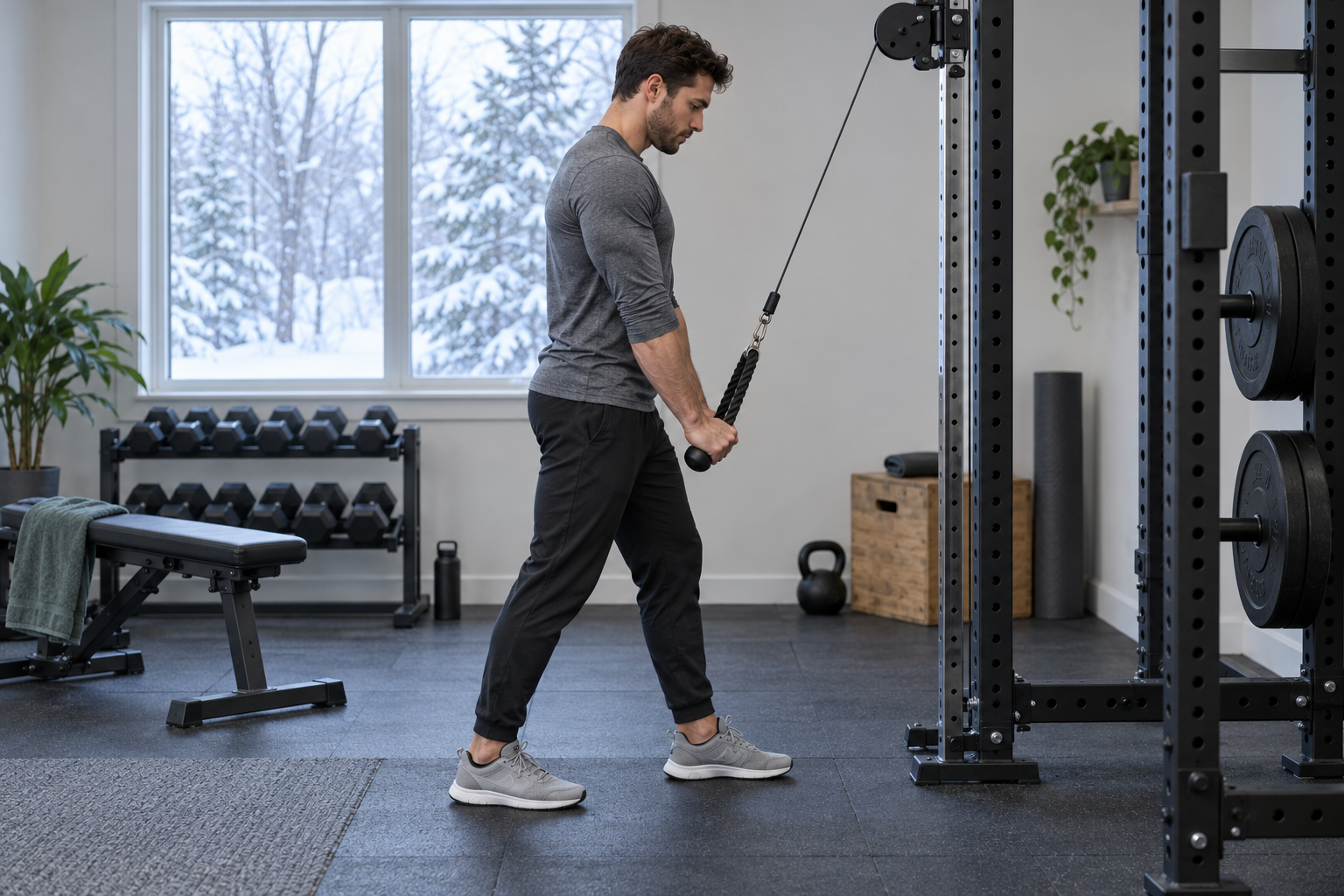
How to Do a Home Cable Triceps Pushdown Without Letting Your Elbows Drift
Quick answer: For a high-pulley triceps pushdown, stand close enough to reach the attachment without leaning, keep your upper arms near your sides, and bend and straighten mainly at the elbows. Choose a light load that lets your shoulders, torso, and wrists stay quiet. If your elbows swing forward, your body rocks, or you need to snap the rope down, reduce resistance or stop and recheck the setup.

Start with equipment and space
Use a high pulley and an attachment that the system instructions allow. Before loading plates, verify the rack or anchor is approved for the direction of pull, connectors are closed, the cable moves freely, and the structure does not shift. The product’s advertised maximum load applies to the listing’s pulley system; it does not certify a separate rack, door, beam, strap installation, or floor.
Clear the area behind you and around the plates. Check the rope or bar, cable sheath, pulley, clips, and loading pin for visible wear or looseness. If a component is damaged, the anchor rating is unknown, or the plates can strike nearby furniture, do not begin the set. Keep the attachment from snapping back when you connect or release it.
Set your stance and elbow position
Face the pulley with feet about hip-width apart or use a comfortable staggered stance. Soften your knees, stand tall, and brace gently. Hold the rope or bar with a full grip and neutral wrists. Bring your elbows near your sides, around the level of your mid-torso, then set your shoulders down without forcing them rigidly back.
American Council on Exercise (ACE) pushdown instructions emphasize keeping the elbows close, maintaining torso and wrist position, and controlling how far the elbows travel forward on the return. Those instructions are for cable-machine exercise variations; they offer useful movement cues, but do not establish compatibility or ratings for a home pulley attachment.
Perform a controlled repetition
- Begin with elbows bent and the attachment around upper-chest level, where you can maintain your posture without being pulled upward or forward.
- Exhale as you extend your elbows and press the attachment down. Keep upper arms close to your trunk rather than turning the movement into a whole-body push.
- Stop near comfortable elbow extension. Do not forcefully snap the joint straight or lean over the handle to finish.
- Return slowly, bending your elbows while keeping them near your sides. End the upward motion before the elbows have to drift far forward or your shoulders shrug.
A rope may separate slightly near the bottom if that is comfortable and allowed by the equipment instructions. Do not yank the ends apart or twist your wrists to manufacture a larger range. With a straight bar, keep both hands balanced and wrists in line with your forearms. In either case, smooth movement matters more than reaching a particular depth.
What elbow drift usually tells you
- Elbows move forward as you press: The load may be too heavy, or the cable line may pull you out of position. Reduce the resistance and adjust your distance in small steps.
- Shoulders roll forward or shrug: Reset with a lighter load and a comfortable shoulder position. Avoid forcing the shoulder blades into an extreme position.
- Torso rocks to start each rep: Stop using momentum. Shorten the range or lower the load until you can move without swinging.
- Wrists bend sharply: Regrip the attachment and align wrists with forearms. Switch attachment only if the product instructions permit it.
- Discomfort becomes pain: Stop the set. Do not push through sharp or worsening pain; consult a qualified fitness or health professional if the problem continues.
Winter home-gym check
Cold-season sessions often happen in garages or rooms that have been unused for a while. Before training, make sure the floor is dry and clear, the rack and seat are stable, and you have a brief general warm-up. This article does not prescribe a weight, repetition target, or rehabilitation plan. If you are new to resistance training or unsure about technique, ask a qualified trainer to check the movement in person.
Product details checked October 9, 2026. Price and availability may change; see the product page.

Waxman Fitness LAT and Lift Pulley System
Listing describes pull-down and lift-up modes, 70-inch and 90-inch cables, and included straight bar and triceps rope. Advertised system maximum: up to 280 lb; not an external anchor rating.
$43.00 USD (official listing checked October 9, 2026). Price and availability may change; see product page.
Sources and scope
- ACE: Triceps Pushdowns — cable-machine posture and elbow movement cues.
- Mayo Clinic: Strength training — general proper-form and pain guidance.
- Waxman product listing — product attachments, modes, advertised capacity and price snapshot.
Leave a Reply