
No products in the cart.
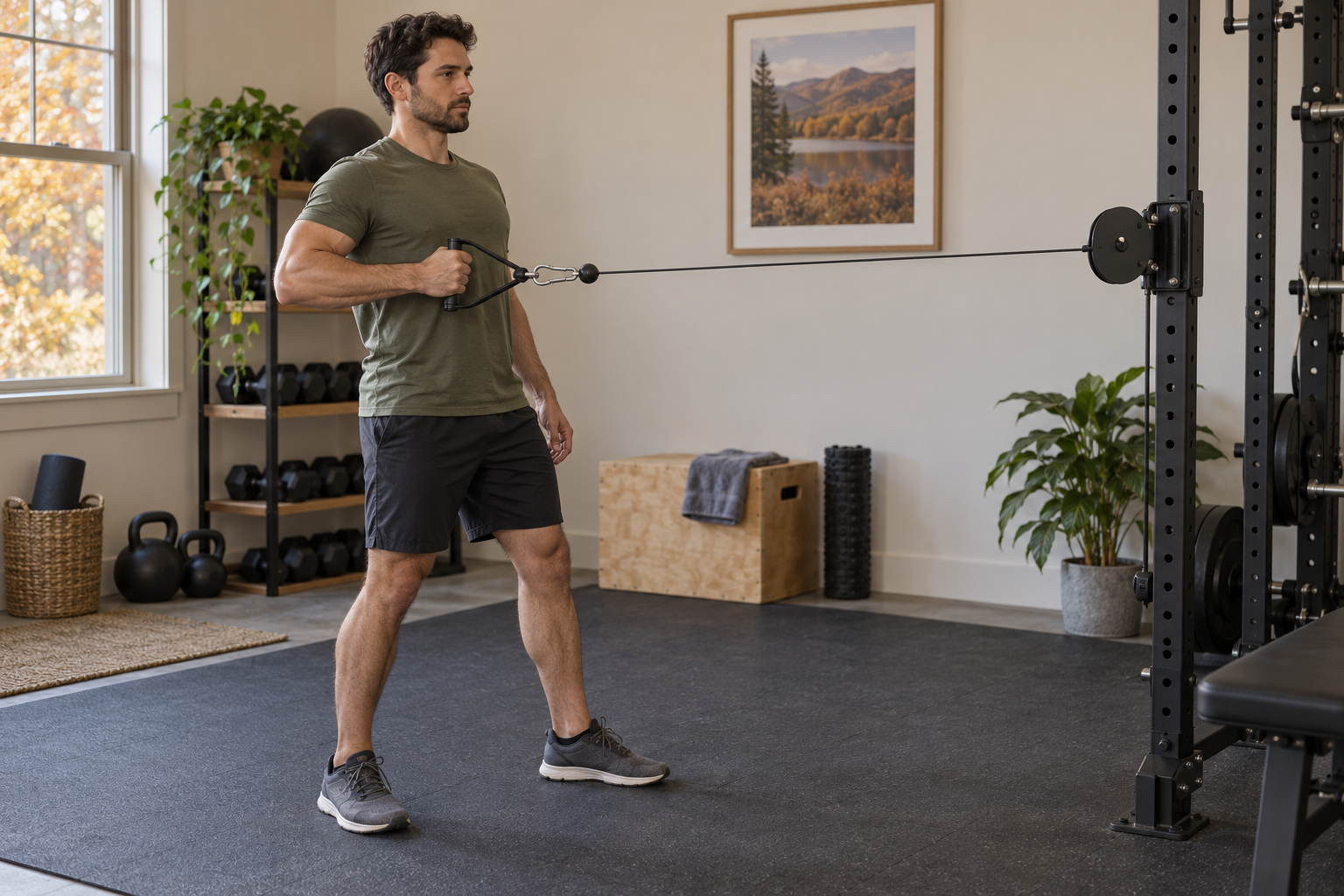
How Much Clearance Does a Home Gym Cable Pulley Need?
Quick answer: There is no single clearance measurement that fits every home cable pulley, exercise, and body size. Before loading the system, confirm that the full cable path, your body, the attachment, and any moving plates can travel without hitting a wall, rack, ceiling, furniture, or another person. Follow the exact equipment instructions; if the movement only works by changing an unapproved anchor or cable route, choose another setup.

This check is useful when a seasonal room change, holiday guests, or a newly rearranged home gym leaves less open floor space. A compact pulley may store easily, but the workout needs more room than the equipment occupies at rest.
Check the whole movement, not just the rack footprint
Start with the selected exercise and attachment. A standing row, pulldown, curl, or triceps movement puts the user in a different position and sends the cable along a different path. Measure neither by the machine’s footprint alone nor by the length of cable printed on a listing. Those details do not establish the clear floor area needed for your body, the full range of motion, or the support structure.
Before adding plates, stand where you expect to exercise and rehearse the movement with no load. Keep your feet in a stable position and move the handle slowly through the intended start and finish. Check overhead clearance if the attachment or cable rises, and check behind and beside you for furniture, windows, doors, shelves, pets, or people. Leave room to enter and exit without stepping over a loaded pin or cable.
Use a low-risk setup check
- Read the exact instructions. Confirm that the pulley, strap, connector, attachment, and proposed anchor are intended to work together. A product page’s list of possible connection points is not a rating for every bar, beam, door, or installation.
- Clear the route. Move loose objects and keep the walking path outside the cable and plate travel area. Do not place a chair, mirror, or storage bin where a handle or plate could strike it.
- Rehearse without resistance. Use the normal exercise motion at a controlled pace. The cable should not scrape a sharp edge, twist around a post, or pull you toward an obstacle.
- Check the loaded path cautiously. If the manual allows the setup, begin with the least practical resistance and a short, controlled movement. Stop if the anchor shifts, the plates swing, the cable catches, or you have to lean or twist to avoid a collision.
- Keep an exit route. You should be able to step away after the set without crossing under a suspended load or reaching through the cable path.
What a product listing can and cannot tell you
The Waxman Fitness LAT and Lift Pulley System listing describes 70-inch and 90-inch sheathed cable options, pull-down and lift-up modes, and connections to several kinds of support points where its hanging strap can be installed. It does not provide a universal room-clearance chart or certify an arbitrary anchor. Its stated maximum load is a product-page limit, not a recommended training weight and not a rating for the structure holding the strap.
For its own home-gym guidance, the American College of Sports Medicine advises choosing a space that works over the long term and does not disrupt housemates. That general advice does not give a cable-specific distance. If your exact manual does not resolve installation, routing, or load questions, contact the manufacturer rather than estimating from a photo or copying another person’s layout.
Signs the space or setup is not suitable
- The cable or attachment contacts the rack, wall, ceiling, or another object during the intended range.
- You must stand on an unstable surface, brace against furniture, or twist around an obstacle.
- Plates could strike a wall, floor, child, pet, or passerby, or there is no clear way to disengage safely.
- The anchor moves, the strap shifts, or the cable makes an unusual catch or noise.
- You cannot install the unit exactly as its instructions require.
Stop and unload only when the equipment is settled and you can do so safely. Do not compensate for limited space by shortening, knotting, rerouting, or attaching the cable to an unapproved point. A different exercise or another location is the safer choice when the room cannot accommodate the full movement.
Product details
Sources: Waxman product listing; American College of Sports Medicine, “3 Essentials for Building a Home Gym”. Prepared with Codex assistance. No product test or human editorial review is claimed.
Leave a Reply