
No products in the cart.
How to Calculate Barbell Weight When the Bar Is Unmarked
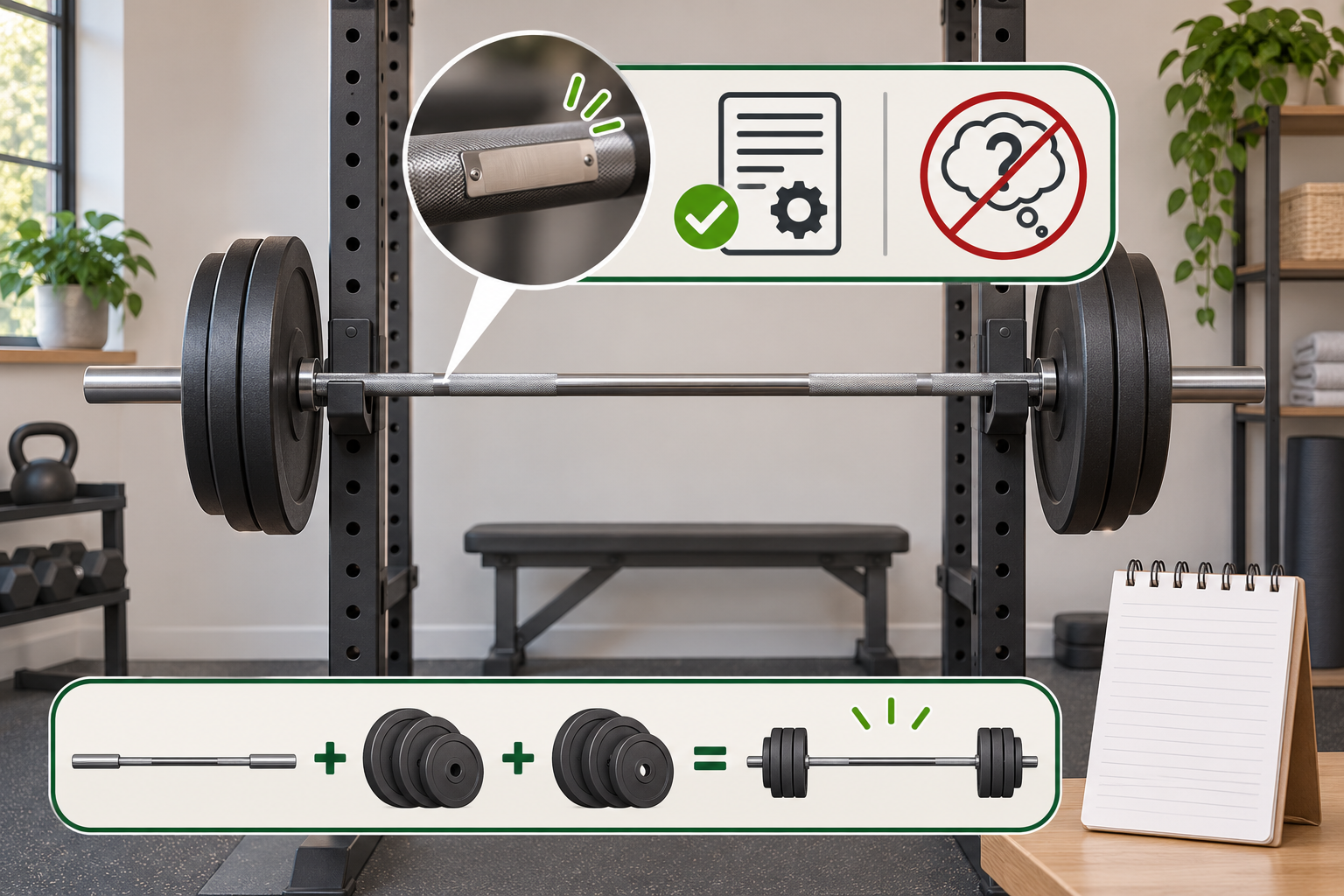
Quick answer: Add the bar’s own weight to every plate on both sides. If you want a competition-style total that includes collars, add the collars too; otherwise use the same convention each time you log a lift. When the bar has no readable weight marking, do not guess from its length, sleeve size, or the plates on it. Find the manufacturer’s specification or weigh the unloaded bar with a suitable scale before recording a precise total.
Cover: AI-generated illustration for explanation only; it is not a photograph or measurement of a specific barbell.
The basic total
A loaded barbell includes more than the plates. Start with the bar, then add the plates on the left and right sleeves. If the two sides carry the same stack, the arithmetic can be shortened:
Total = bar weight + 2 × (weight of the plates on one side)
If you are counting collars, add the weight of both collars as well. The International Weightlifting Federation’s loading rules define the competition total as the bar, both collars, and all loaded discs. Everyday workout logs may use a different convention for light spring collars. Pick one method, write it down, and use it consistently so that two training sessions can be compared fairly.
How to get the bar’s weight
- Look for a label or end-cap marking. Some bars identify their mass on an end cap or label. Record the unit as well as the number; a kilogram value is not interchangeable with a pound value.
- Check the exact manufacturer listing or manual. Match the model and version, not just the words “Olympic bar.” Bars with similar length or sleeve diameter can have different masses. For a used or unmarked bar, ask the maker or seller for the specification tied to its model.
- If the weight remains unknown, weigh it. Use a scale and a stable setup appropriate to the bar’s size. Keep the bar controlled and do not balance it precariously on a household scale. If you cannot weigh it safely or obtain a trustworthy specification, record the plate load separately and mark the bar weight unknown instead of inventing a total.
- Keep units consistent. Convert kilogram values to pounds or pounds to kilograms before adding. Use a calculator for mixed-unit equipment, and keep the unrounded values until the final total.
Standard competition equipment has defined weights under the relevant rules, but a home bar is not automatically competition equipment. Length and a two-inch sleeve help identify plate compatibility; they do not, by themselves, prove the bar’s mass. The manufacturer’s model-specific specification is the better source.
Count plates without double-counting
Read the marking on each plate and list the pieces on one side. If the bar is loaded symmetrically, double that side’s sum and add the bar. For example, if your unloaded bar is verified as 20 kg and one sleeve has a 10 kg plate plus a 5 kg plate, the plates total 15 kg per side. The two plate stacks total 30 kg, so the bar-plus-plates total is 50 kg before collars.
That example is arithmetic, not a claim about the weight of a particular product. Plate markings may use pounds or kilograms, and some plates may have a stated tolerance. If accuracy matters, use the plate’s marked unit and consider the manufacturer’s tolerance rather than treating every plate as laboratory-calibrated.
What if the sides are different?
For an unevenly loaded bar, do not double one side. Add the bar and each individual plate on both sleeves separately. Before lifting, compare the two sides and correct an accidental mismatch. Unequal loading can change how a bar behaves; this article does not replace coaching, equipment inspection, or a safe lifting setup.
Also check that the plates fit the sleeves and are secured with suitable collars before the set. Plate fit and total weight are different checks: a plate that slides onto a sleeve is not necessarily loaded or secured correctly, and the plate count does not verify that the bar is within its rating.
Keep a useful training record
Write down the bar model or verified mass, plate values, units, and whether collars are included. For example: “bar + plates, collars excluded” is clearer than an unexplained number. If you switch between bars, make a separate note for each one. That small record prevents a common logging error: counting the plates but forgetting the bar, or adding a standard-bar assumption to a lighter training bar.
If you cannot confirm a bar’s mass, you can still track the plates used, but label the record accordingly. Do not compare it directly with a total that includes a verified bar weight. For formal competition, follow the governing federation’s equipment and scoring rules rather than a home-gym convention.
Product details to verify before choosing a bar
A product title can contain specifications that need confirmation against the exact model listing. The Waxman barbell listing describes a 7-foot Olympic bar and two-inch weight compatibility. Its product images contain inconsistent bar-weight details, so this article does not state a verified mass or capacity. Confirm the current specification and rating with the seller before using those values in a load calculation.

Waxman 7-Foot Olympic Barbell
View current price and availability on the product page.
- The listing describes a 7-foot Olympic barbell with 2-inch weight compatibility
- Do not infer the bar’s mass or capacity from the title or image; confirm the exact specification for your model
The product page could not be fetched during this check; price, availability, bar weight, and capacity have not been reconfirmed. See the seller for current information.
Bottom line: Total the bar and all plates, and include collars only when your chosen convention calls for them. Verify the bar’s actual mass from a model-specific source; if you cannot, record the plates separately rather than guessing.
Sources
- International Weightlifting Federation: Loading — competition loading order and total of the bar, collars, and loaded discs.
- WaxmanUSA product listing — product identity and sleeve compatibility as previously checked in local research; live page timed out on November 3, 2026, and conflicting mass claims are omitted.
Sources checked November 3, 2026. No barbell was weighed and no lifting test was performed. Confirm equipment specifications and use an appropriate setup for your lift.
Leave a Reply