
No products in the cart.
How to Check a Smith Machine’s Safety Catches Before Lifting
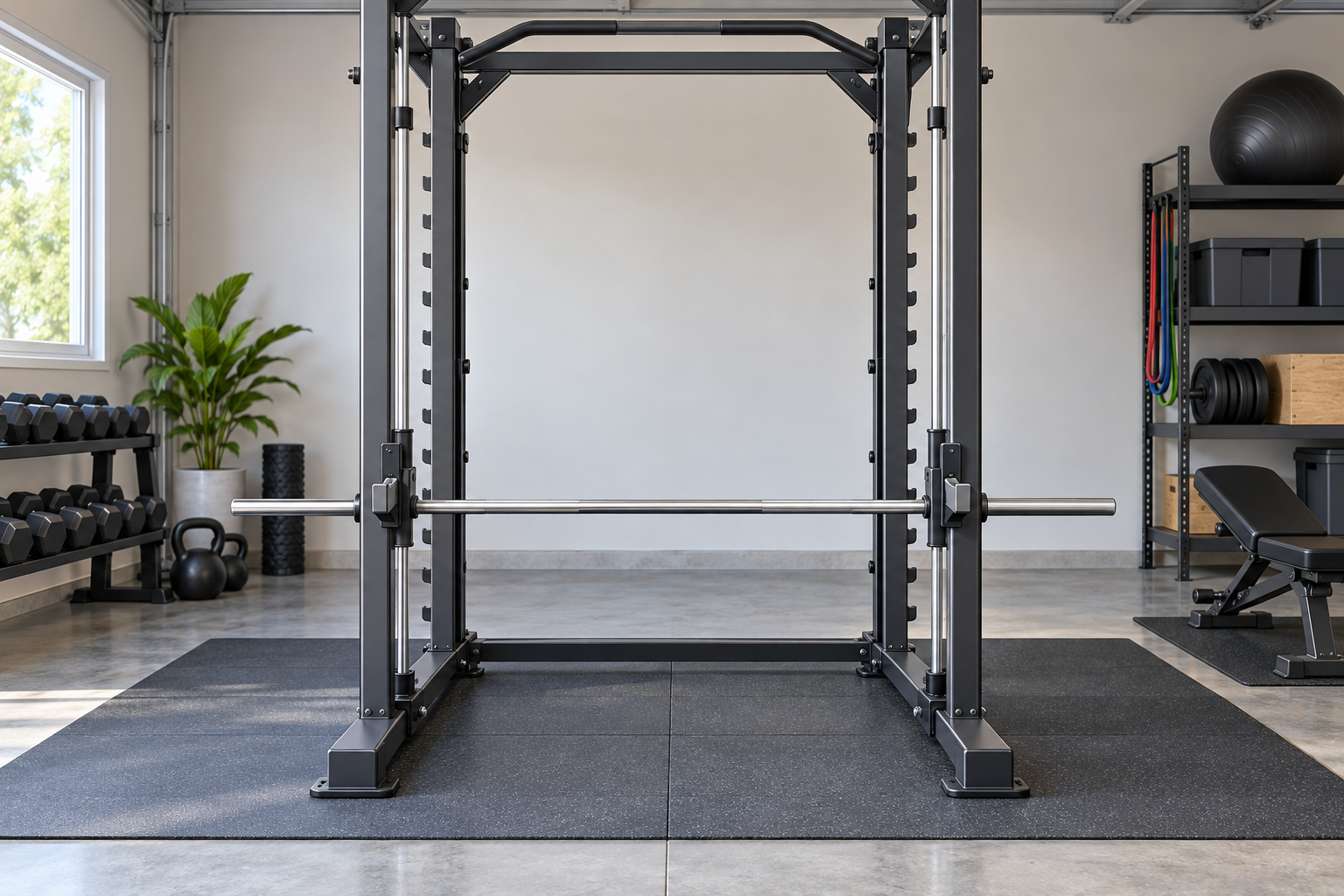
AI-generated illustrative cover; it is not a product photograph or a test image.
Before loading a Smith machine, identify how its bar hooks engage and where its safety catches sit. With the bar empty, confirm that the hooks rotate onto the rails, both sides engage at the same height, and the catches are positioned according to the exact machine’s instructions for the exercise. If anything is bent, loose, mismatched, or unclear, do not lift until the manufacturer or a qualified technician resolves it.
This check matters because Smith machines differ: bar paths, hook shapes, catch designs, and setup instructions are not interchangeable. Use the machine’s manual for its exact adjustment method. A product-page weight capacity is not a recommended working load and does not tell you where to set the catches.
Start with the machine unloaded
Remove plates and make sure the bar is secured in its resting position before inspecting it. Look over the rails, bar hooks, catches, fasteners, and frame for visible damage or movement. Check that the floor is stable and that the machine does not rock. Clear loose plates, bands, benches, and other objects from the bar’s travel and the area where you would step in or out.
Do not lubricate, tighten, disassemble, or modify components unless the manufacturer’s instructions call for that maintenance and explain how. A catch that sticks, fails to seat, or has a damaged retaining part is a stop-use condition. Mark the machine unavailable and contact the seller or service provider instead of trying to make it work.
Learn the bar’s lock and release motion
With no plates on the bar, use the manual’s instructions to rotate or move the bar into its locked position at several points along the rail. Confirm that both hooks seat completely and that the bar remains supported when you release your hands. Then practice releasing it while standing clear of pinch points. Do not assume that a familiar machine’s motion applies to this model.
Observe both sides, not just the side nearest you. If one hook engages while the other remains free, or if the bar tilts, binds, or moves unexpectedly, stop. Do not use a catch or hook as a substitute for a damaged guide, loose fastener, or misaligned frame.
Set the safety catches for the planned movement
Use the manual’s procedure to place both catches at the same height. The right setting depends on the exercise, your body position, range of motion, and the machine design. For a squat, for example, the bar must be able to travel through the intended range without contacting the catches during a controlled repetition, while the catches still need to limit travel if you cannot complete the movement. A universal notch number cannot be given safely.
Before adding meaningful weight, rehearse the movement with the empty bar and verify that you can reach, rotate, and re-rack it without twisting or losing balance. If the setup feels unfamiliar, ask a qualified trainer to help you establish a suitable range and position. Keep your head, hands, and other body parts away from the bar’s path and pinch points.
Test progressively and stop on warning signs
After the unloaded checks, use a light load and a controlled range to confirm that the bar moves smoothly and both sides remain aligned. Increase load gradually only if the setup remains stable and you can maintain good form. Mayo Clinic advises learning proper technique, using a weight you can control, and stopping when an exercise causes pain; those general training principles do not replace the equipment manual.
- Stop for scraping, sudden resistance, uneven movement, a loose catch, or a bar that will not lock reliably.
- Do not exceed the manufacturer’s instructions or use a published maximum capacity as a personal training target.
- Do not train beneath a bar that is supported by only one engaged hook or one catch.
- Keep other people clear while checking and moving the bar.
What if the manual is missing?
Find the exact model name and contact the manufacturer or seller for the correct instructions. Do not infer a setting from another Smith machine, a video of a different model, or a photograph. If the machine has no identifiable instructions, a visibly altered catch system, or damage that affects secure engagement, leave it unused until the correct information or repair is available.
Product information
The Waxman Smith Machine (model WAX-SM-S02) listing identifies safety spotter arms among the included components. That listing does not establish a setup height or substitute for the manual for your exact unit.

Waxman Smith Machine, model WAX-SM-S02
Official listing describes a multi-station machine with safety spotter arms and a listed overall capacity of 2,200 lb. Capacity is a product specification, not a suggested personal load. Price checked October 30, 2026: $1,999.90 USD on the listing. Price and availability may change; see product page.
Sources
- Waxman official product listing (model, listed components, specifications and current displayed price; checked October 30, 2026).
- Mayo Clinic: Weight training—proper technique (general strength-training guidance).
This article is practical information, not individualized medical or training advice. Follow your exact equipment manual and consult a qualified professional if you are unsure how to use the machine safely.
Leave a Reply