
No products in the cart.
How to Check Whether Weight Plates Fit an Olympic Barbell
Quick answer: Identify the bar’s sleeve type before buying plates. A standard Olympic bar uses sleeves close to 2 inches (about 50 mm), while many “standard” home-gym bars use sleeves closer to 1 inch. The names are confusing, and the plate’s center opening—not its outside diameter or listed weight—determines whether it can slide onto a bar. Check both measurements and the manufacturer’s compatibility notes before ordering.
Why “standard” is not a reliable size description
Retailers use “standard” in different ways: sometimes to mean a common Olympic barbell, sometimes simply to distinguish a smaller home bar from an Olympic model. A listing may describe a plate as “standard,” but that word alone does not tell you its bore diameter. Olympic plates commonly have an opening sized for a sleeve around 50 mm. Rogue Fitness, for example, states that its Olympic plates fit standard Olympic barbells with 50 mm sleeves. That is a useful reference for the category, not a guarantee that every bar or plate sold under a similar label matches.
Weight also does not establish fit. Two plates with the same weight can have different center-hole sizes, materials, thicknesses, and intended bar types. A plate that does not fit the sleeve should not be forced, filed, or modified to make it fit.
How to check the bar and plates you already own
- Find the exact model. Look for a label, receipt, or manufacturer product page. Check whether it identifies the bar as Olympic and gives sleeve diameter. Do not infer the sleeve size from the bar’s length alone.
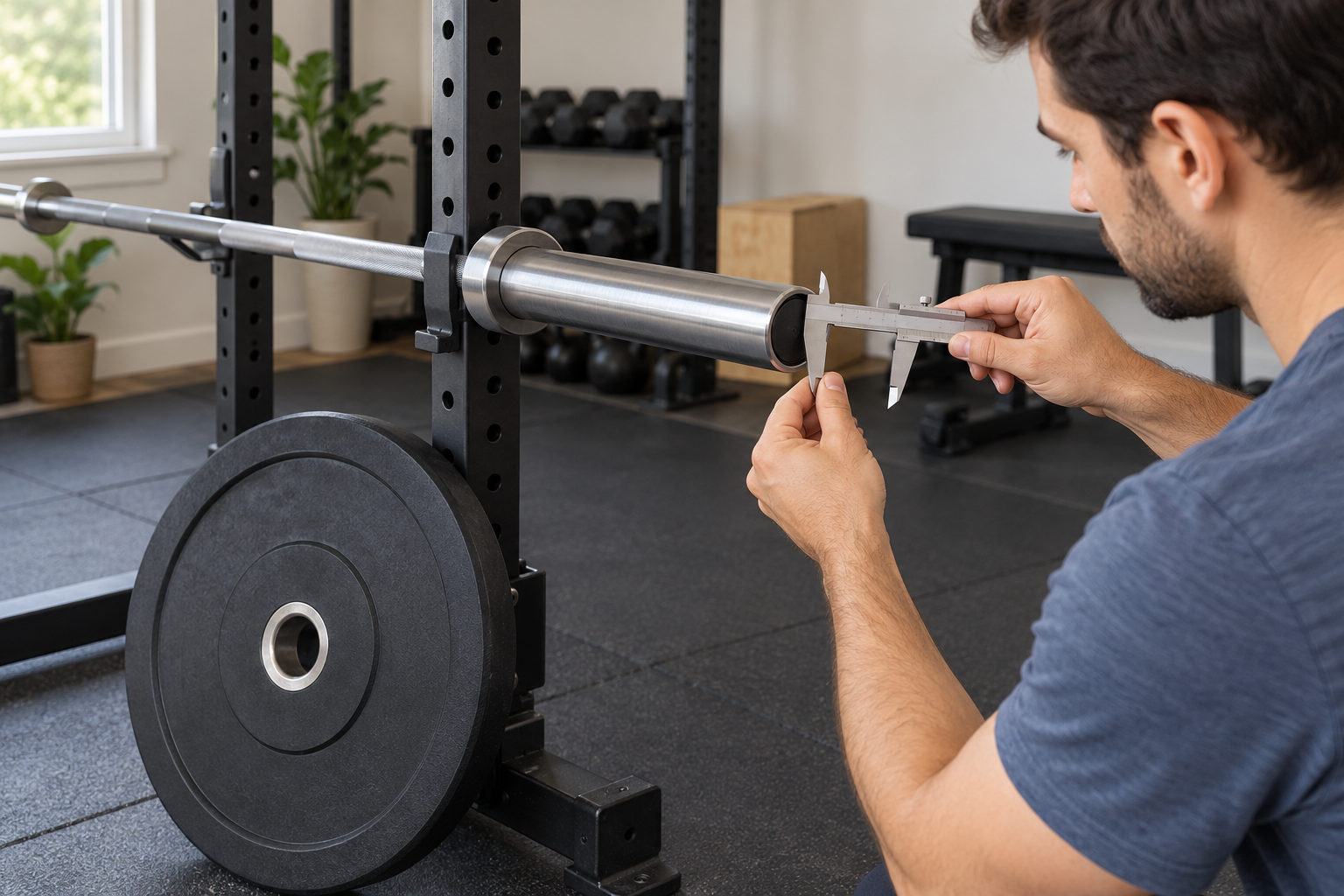
- Measure the sleeve. If specifications are missing, use a caliper across the smooth loading sleeve, away from collars, threads, or end caps. A ruler can help distinguish a roughly 1-inch sleeve from one close to 2 inches, but a caliper is better for borderline measurements. Measure more than one point if the sleeve is not perfectly uniform.
- Check the plate opening. Measure the inside diameter of the center hole, not the outer hub. The opening must clear the sleeve. Coatings, manufacturing tolerances, and wear can affect how snugly a plate fits.
- Read the maker’s compatibility statement. Prefer an explicit sleeve or collar-opening measurement over a vague “standard” label. If the bar and plate specifications disagree or are absent, ask the seller before purchasing.
- Test gently with the bar unloaded. A compatible plate should slide over the sleeve without hammering or binding. Keep the bar stable and your hands clear of pinch points. If it catches, stop and confirm the sizes; do not use a plate that only moves when forced.
What about collars and plate movement?
After confirming the plate fits, select collars designed for that sleeve diameter. A collar that is too large may not secure the plates; one that is too small will not fit. Follow the collar maker’s instructions and check that plates are retained before lifting. A close fit between the center hole and sleeve does not replace collars, and no article can determine whether a worn, bent, cracked, or damaged bar is safe to use.
If a plate slides freely but rattles substantially, inspect the plate opening, sleeve, and collar rather than assuming the sound is harmless. Do not lift with visibly cracked plates, loose sleeve components, or a bar that appears bent. When equipment condition is uncertain, stop and consult its manufacturer or a qualified equipment professional.
A quick buying checklist
- Write down the bar’s exact sleeve diameter and model.
- Confirm the plate’s center-hole diameter and stated bar compatibility.
- Check whether measurements are in inches or millimeters.
- Confirm the collar matches the same sleeve size.
- Do not rely on “standard,” plate weight, or a product photo by itself.
For a concrete example, the Waxman 7-foot Olympic barbell listing describes a bar intended for 2-inch standard weights. Check the listing for current specifications and compatibility before pairing it with plates; this example does not establish fit for a different model or aftermarket sleeve.

Waxman 7ft Olympic Barbell
Listed as a 45 lb bar for 2-inch standard weights. Confirm the current listing and your plate dimensions before purchase. View current price and product details.
Price and availability may change; see product page.
Cover illustration: AI-generated diagram for illustration; it is not a product photograph or a measurement of a specific bar.
Bottom line
Match measured sleeve diameter to the plate’s center opening and confirm the manufacturer’s stated compatibility. When dimensions are unclear, stop and ask before buying or lifting. A careful unloaded fit check can prevent a frustrating purchase, but it cannot replace equipment inspection or the maker’s instructions.
Leave a Reply