
No products in the cart.
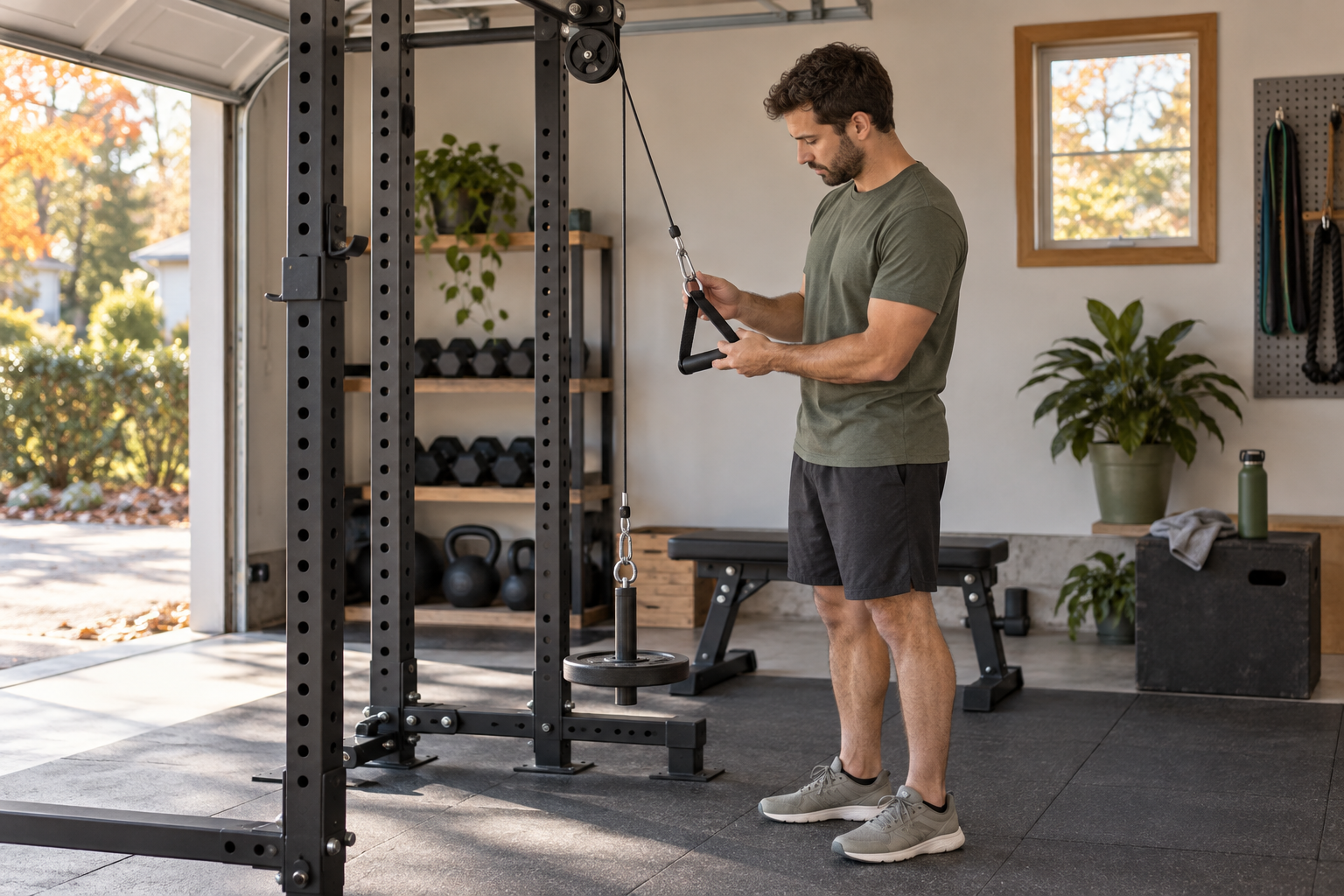
How to Choose a Safe Starting Load for a Home Cable Pulley
Quick answer: There is no universal starting weight for a home cable pulley. First confirm that the complete system is installed as its manufacturer directs. Then choose the lightest load that lets you rehearse the intended movement smoothly through its full range, without swinging, jerking, or losing control. Increase resistance gradually only while the setup and your technique remain comfortable. A product’s maximum load rating is a limit, not a recommended first weight.
Check the equipment before choosing plates
A cable system transfers force through several parts: the anchor, pulley, cable, connector, loading pin, plates, and handle. Before loading it, check the instructions for the exact system and confirm that the anchor and every component are compatible. A product page that says a system can connect to a power cage or another support does not certify every rack, beam, pull-up bar, or home-built anchor for every load.
Inspect the cable, pulley, carabiners, pin, clamp, and anchor for visible damage or looseness. Confirm that the pin and plates are assembled in the prescribed order and that the attachment is closed securely. Keep people, pets, and objects out of the path of the suspended plates. If the instructions do not explain how your planned anchor should be installed, stop and ask the manufacturer before use.
Rehearse the movement with no added plates
Set the pulley height and handle for the exercise you intend to perform. With no plates added, take the starting position and move the handle slowly through the planned range. Check that the cable stays routed in the pulley, does not rub against the frame, and does not go slack or reach a stop unexpectedly. Make sure the suspended pin has clearance from the floor and nearby equipment throughout the movement.
This unloaded rehearsal checks the setup and travel; it does not prove that the anchor is safe under load. If the cable binds, a connector shifts, the support flexes, or you cannot keep the movement controlled, do not add plates. Correct the installation using the manufacturer’s instructions or get qualified help.
Choose the first resistance by control, not by a number online
Once the system passes its setup checks, select the smallest practical load allowed by the equipment instructions. Use a familiar movement and a controlled pace. The resistance should let you start and return the handle without a sudden tug, body swing, shortened range, or strained grip. Stop the set before technique changes. A lower starting load is appropriate if you are new to the movement, returning after time away, or unsure how the cable will feel.
Cable systems do not all feel alike. Pulley arrangements can change the relationship between the plates and the force at the handle, while friction and the attachment also affect the movement. Therefore, do not transfer a dumbbell number, a weight-stack label, or another machine’s setting directly to a different pulley. Change one small increment at a time and reassess the same movement under the same setup.
Progress in small, repeatable steps
- Record the setup. Note the anchor, pulley position, handle, plate load, stance, and range so your next session starts from the same configuration.
- Keep early repetitions controlled. Use a load that allows a smooth start and return without bouncing the plates or leaning to move them.
- Change one variable. If the movement stays controlled and comfortable, make only a small load increase or adjust repetitions—not both at once.
- Repeat before increasing again. Confirm that the same setup remains stable and the movement remains comfortable across sessions. There is no need to progress on a fixed calendar.
- Stop for warning signs. Stop if you feel sharp pain, lose control, hear unusual hardware noise, see cable damage, or notice any movement in the anchor or connectors.
The U.S. Physical Activity Guidelines recommend increasing activity gradually over time. That broad guidance supports a measured approach, but it does not prescribe a starting plate weight for this particular machine. A qualified exercise professional can help adapt a program to your experience and goals. If you have a health condition, recent injury, or pain with exercise, seek advice from a clinician before changing your training.
Understand the product rating
The Waxman Fitness LAT and Lift Pulley System listing describes pull-down and lift-up modes, detachable handles, 70-inch and 90-inch cables, and a loading pin. Its page lists a maximum load of up to 280 pounds. That listing statement is not a safe working-load calculation for your rack or a starting-load recommendation. Follow the system instructions and the lower applicable limit for any component in your actual setup; if a component’s limit is unknown, do not infer it from the pulley listing.
The product page displayed $43.00 USD when checked October 9, 2026. Availability was not stated in the page content reviewed. Price and availability may change; see the product page.

Waxman Fitness LAT and Lift Pulley System
Listing describes 70-inch and 90-inch sheathed cables, detachable handles, and pull-down/lift-up configurations. Confirm anchor compatibility and setup limits before adding plates.
$43.00 USD · Checked October 9, 2026. Availability was not stated. Price and availability may change; see product page.
Written by Codex from the linked product and public fitness guidance. No product test or independent human review is claimed. Cover image: AI-generated illustration, not a product photo or test result.
Sources
- Waxman product listing (features, stated maximum load, price, and official product image checked October 9, 2026).
- U.S. Department of Health and Human Services, Physical Activity Guidelines for Americans, Second Edition (gradual increase guidance).
- American College of Sports Medicine, 5 Things to Know About Creating an Effective Resistance Training Plan (general adult resistance-training guidance; not a machine-specific starting-load specification).
Leave a Reply