
No products in the cart.
Flat or Adjustable Weight Bench: Which Fits a Home Gym?
Quick answer: Choose a flat bench if your planned workouts use only a level backrest and you value a simple, fixed setup. Choose an adjustable bench if you will regularly use incline or decline positions and the added frame, adjustment hardware, and footprint work in your room. The best choice depends on the movements you actually plan to do, the bench’s documented limits, and whether you can keep every setting secure.
A bench is one part of a workout setup, not a complete program. If a movement is unfamiliar, follow a qualified coach’s guidance or the equipment instructions; this comparison does not prescribe an exercise plan.
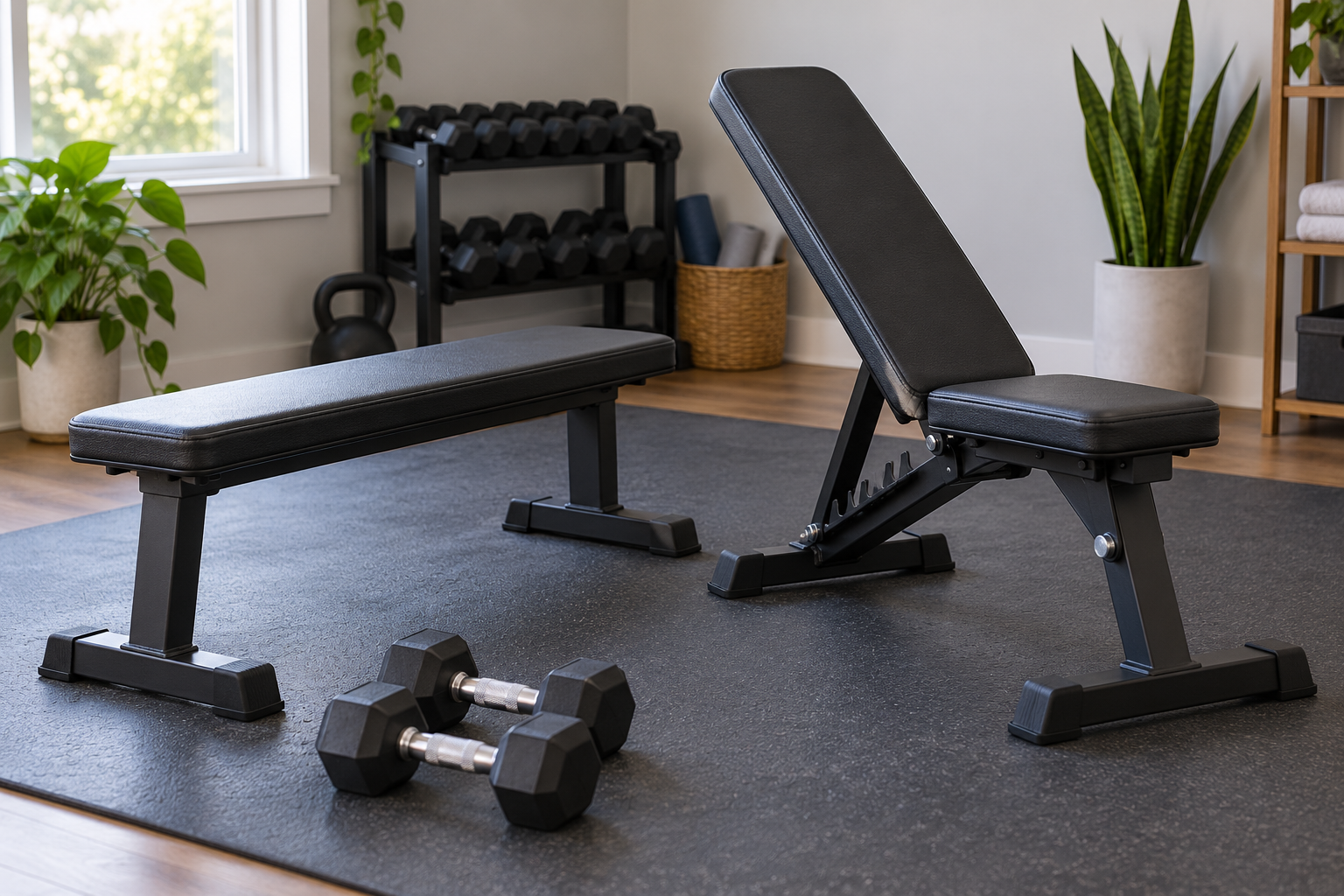
Cover image: AI-generated illustration comparing generic flat and adjustable benches; not a product photo, demonstration, or safety test.
What does a flat bench do well?
A flat bench provides one level surface for movements that call for a horizontal position, such as a flat dumbbell or barbell chest press. Its fixed shape can make it easier to understand, reposition, and check before a set. It also avoids a backrest adjustment mechanism, though construction quality, dimensions, and rated capacity still matter. “Flat” does not automatically mean lightweight, compact, or compatible with a particular rack.
A flat bench may be the practical choice if your routine is limited to flat pressing, supported rows, or seated movements where a level seat is sufficient. Before buying, verify the assembled length and width, height, maximum supported load, and whether the bench can be stored upright or moved out of the way. Do not assume those details from a product photograph.
When does an adjustable bench add value?
An adjustable backrest can change your body position for exercises such as incline presses. The American Council on Exercise’s exercise library describes an incline chest press on an angled bench and a separate flat chest press. That makes the distinction useful when a training plan includes both positions. An adjustable bench may also let several users choose among different supported angles.
The tradeoff is that an adjustable model has more moving parts and more positions to verify. Confirm that the backrest and seat are fully engaged in the selected notch or pin before use, and change positions only as the manufacturer directs. If the mechanism will not lock, do not load it. The marketing phrase “full body” does not mean every movement is suitable for every bench or user.
Use your exercise list to decide
| Your likely use | What to compare | Question to ask |
|---|---|---|
| Mostly flat presses | Stability, pad size, height, footprint | Does a fixed level surface meet the movements I plan to do? |
| Flat and incline work | Available backrest angles and adjustment method | Can I set and lock the positions my plan requires? |
| Shared home gym | Range of settings, user fit, setup time | Can each person adjust it safely and comfortably? |
| Limited floor space | Folded or stored dimensions, weight, moving path | Where will it go between sessions? |
Measure the space with the bench in use, not only while it is folded or pushed against a wall. Include room to sit, lie down, move weights into position, and walk around the setup. If the bench will pair with a rack, compare the bench’s dimensions and position against that exact rack and its safety equipment. Confirm compatibility with the manufacturer; similar-looking benches and racks are not necessarily a matched set.
Check the details before ordering
Look for a manual or product page that states assembled dimensions, supported load, adjustment settings, included components, and any rack compatibility. A bench’s advertised angle positions should match the positions shown in its instructions. If a title and description disagree, ask the manufacturer to confirm the exact specification before treating it as a deciding feature.
The Waxman adjustable bench listing is an example of why that check matters: its page title says “7 Back Positions,” while the product description enumerates six angles—85°, 60°, 45°, 30°, 0°, and −15°. The listing shows $269.00 USD and in-stock availability when checked October 27, 2026, but the position-count wording is inconsistent. Confirm the count with Waxman if it affects your decision. The example does not establish that this bench fits a particular rack or room.
Simple decision rule
If you know you will use only a flat surface, a fixed bench may be enough. If your plan regularly uses both flat and angled positions, an adjustable model offers more configuration choices, provided its fit, adjustment mechanism, and capacity suit your setup. Compare the exact dimensions and instructions, leave working space around the equipment, and do not choose based on a claimed angle count that the listing itself does not resolve.
For any bench, stop if a frame or locking part is damaged, loose, or unstable. Follow its manual and ask the manufacturer about uncertain limits or compatibility before loading the equipment.
Sources
- American Council on Exercise, Incline Chest Press — example of an angled-bench exercise setup.
- American Council on Exercise, Chest Press — flat-bench exercise description.
- Waxman adjustable bench product listing — name, adjustability, listed positions, image, price, and availability checked October 27, 2026.
Written with Codex assistance. No equipment test or individualized training assessment was conducted; no independent human review is claimed.
Leave a Reply