
No products in the cart.
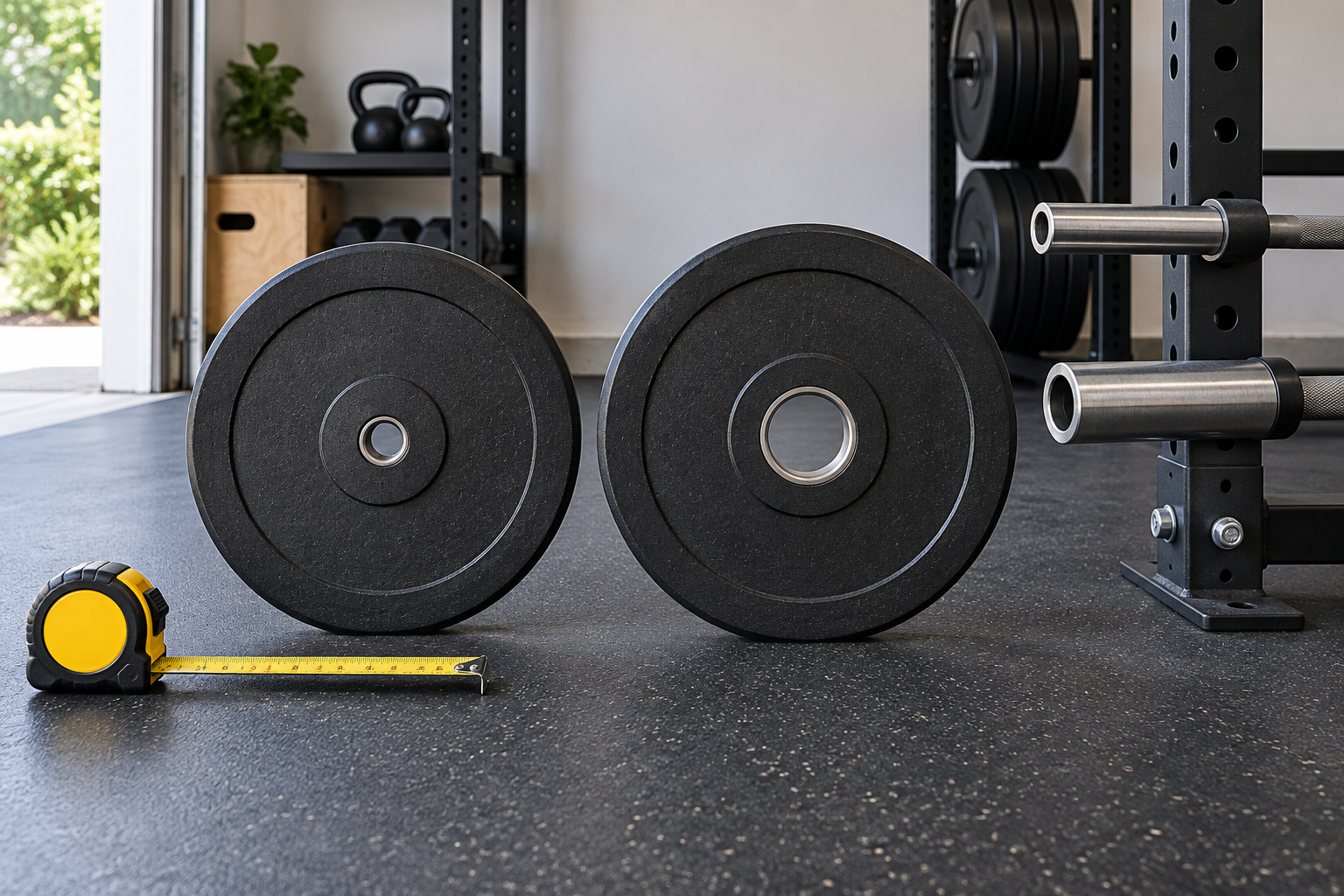
How to Check Whether Weight Plates Fit Your Barbell
Cover illustration: AI-generated illustration, not a product photo or fit test.
Quick answer: Match the plate’s center opening to the diameter of the bar’s loading sleeve. In common home-gym labeling, “standard” plates are made for roughly 1-inch sleeves, while “Olympic” plates are made for roughly 2-inch sleeves. The names describe different fit systems; a plate that is too small will not slide on, and a much larger opening will not be a secure match. Check the actual equipment specifications before loading anything, because labels and dimensions can vary.
Find the part that has to match
The bar’s loading sleeve is the end section where plates sit. It is not necessarily the same diameter as the bar’s center shaft. Look for a manual, product label, or manufacturer listing that states the sleeve diameter. For a plate, find the center-hole or bore measurement. A maker’s description of “1-inch” or “2-inch” may be a nominal size, so use the specific model documentation when a close fit matters.
Standard plates commonly pair with a sleeve near 1 inch (about 25 mm); Olympic plates commonly pair with a sleeve near 2 inches (about 50 mm). The distinction is supported by equipment makers’ sizing guidance, but those rounded labels are a starting point, not a promise that every plate and sleeve from different brands will fit identically. For example, REP Fitness explains that Olympic bars use 2-inch sleeves and that 1-inch standard plates do not fit those sleeves. Check the exact bar and plate models rather than relying on color, weight, or appearance.
A simple compatibility check
- Identify both models. Read the bar and plate labels, then locate their manuals or product specifications. Do not infer the size from a plate’s weight or finish.
- Compare the two measurements. Match the plate bore to the bar sleeve specification. If one listing gives millimeters and the other inches, convert carefully; 25.4 mm equals 1 inch. Do not force a plate that binds or use a loose fit as if it were correct.
- Inspect before loading. Check for a bent sleeve, cracked plate, damaged insert, burrs, or debris. Stop if a plate will not slide on smoothly or appears unusually loose. Do not grind, drill, or modify a plate or bar to make them fit.
- Check the complete setup. Verify the bar’s load rating, collars or other retention method, and the rack or machine instructions. Correct diameter alone does not establish that the bar, collars, rack, or user setup is suitable for a particular load or exercise.
Can a 1-inch plate go on a 2-inch bar?
Usually, no: a smaller center opening cannot pass over a larger sleeve. A larger-hole plate on a smaller sleeve may slide on, but it can shift and should not be treated as compatible unless the equipment maker specifically approves that combination and provides the correct adapter. A sleeve adapter changes the interface; it does not increase the bar’s rated capacity or make every plate safe to use.
Do not improvise with loose tubing, spacers, tape, or homemade collars. Use only an adapter intended for the exact bar and plate arrangement, and follow its instructions. If documentation is missing, contact the equipment maker or replace the mismatched item instead of testing it under load.
When several plate types share a room
Keep standard and Olympic plates in clearly separate, labeled groups. Store each group on a holder whose post or support is specified for that plate type. Before buying a mixed set, inventory the bars, adjustable dumbbell handles, and machine storage posts already in the room. That simple check can prevent buying plates that cannot be used with the equipment you own.
Waxman lists its Weight Plate Storage Rack as fitting 1-inch and 2-inch plates. That is a listing claim about the holder; it does not establish a load rating or mean the plates themselves interchange on a bar. Verify the rack’s mounting and capacity instructions for your wall and setup before use.
Quick decision table
| What the equipment says | What to verify |
|---|---|
| Standard / 1 inch | Plate bore and bar sleeve are specified for the same system |
| Olympic / 2 inch | Plate bore and bar sleeve are specified for the same system |
| Adapter or mixed sizes | Written approval for the exact models and safe retention method |
| No readable specification | Pause and ask the manufacturer; do not guess from appearance |
The practical rule is simple: confirm both specifications, inspect the parts, and stop if fit or retention is uncertain. A correct size is only one part of a safe lifting setup.
Related storage option

Waxman Weight Plate Storage Rack
Listed fit: 1-inch and 2-inch plates. The product page does not establish a load rating in the details checked, so confirm mounting and capacity instructions before installation.
$109.00 USD (checked October 30, 2026). Price and availability may change; see product page.
Sources: REP Fitness bar and plate sizing guidance; Waxman product listing. No equipment fit test was performed for this article.
Leave a Reply