
No products in the cart.
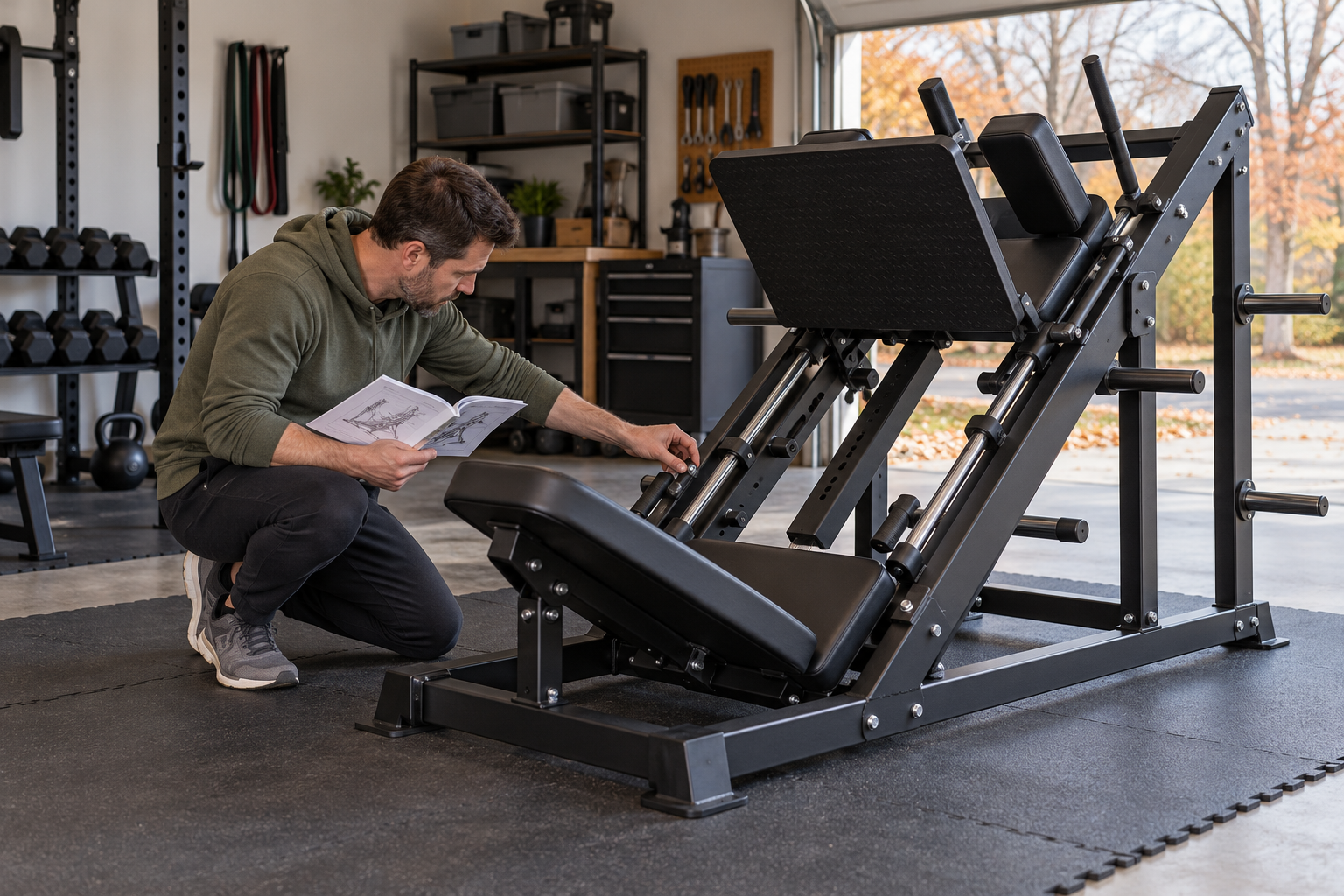
Before Your First Leg Press Workout: A Home Gym Setup Check
Before using a newly assembled home leg press, pause and compare the machine with its exact assembly and owner instructions. Check that the frame is on the intended surface, the fasteners and moving parts match the manual, and the safety and lockout mechanisms are understood. Do not load plates or exercise if a part is missing, a connection is loose, the carriage moves unexpectedly, or the instructions do not answer a safety question. A product listing is not a substitute for the model-specific manual or a setup inspection.
Start with the exact model instructions
Keep the manual, hardware list, and product identification together. Confirm the model and configuration on the paperwork match the equipment in front of you. If instructions are missing, incomplete, or appear to describe a different version, contact the seller or manufacturer before proceeding. Do not infer bolt locations, tightening values, lubrication points, or adjustment steps from a video or from another machine that looks similar.
For example, the WAXMAN Leg Press Hack Squat Machine listing describes a two-in-one plate-loaded unit with three-level adjustable safety limiters and foldable handrails. Those listing details identify features; the listing does not provide a complete first-use inspection procedure. Use the instructions supplied for your exact unit to learn how each feature is positioned and checked.
Check the setup area before testing movement
- Use a clear, dry area with enough room to approach and leave the machine without stepping over plates, tools, packaging, or cords.
- Compare the assembled machine’s footprint with the available space. The WAXMAN listing gives assembled dimensions of 77.5 × 38.3 × 57.4 inches; those measurements do not establish operating clearance or floor suitability.
- Look at the floor and the machine’s contact points. If the floor is uneven, soft, damaged, or the equipment rocks, stop and ask the manufacturer or a qualified professional how to resolve it. Do not wedge loose material under the frame unless the manual specifically directs it.
- Keep children, pets, and visitors out of the setup area while you inspect and test the equipment.
Inspect visible connections and moving parts
With no one on the machine and no plates loaded, make a slow visual check against the manual’s parts diagram. Look for hardware that appears absent, a misaligned component, a damaged pad, a pin or stop that is not seated as instructed, or a cable, bearing, or guide that appears displaced. Do not put fingers in pinch points or reach under a moving carriage. If the manual specifies a sequence or tool for checking fasteners, follow that sequence and its stated limits; do not guess a torque value.
Next, learn how the machine is meant to move and lock. Follow the manual’s unloaded test instructions, keeping your body clear of the carriage path. Confirm you can identify the prescribed stop or lock position without forcing a part. Do not treat a brief unloaded movement as proof that the equipment is safe under load. Stop if movement binds, shifts, makes a new grinding or impact sound, or fails to stop where the instructions say it should.
Resolve problems before adding weight
Take a photo of any questionable part and note the model, the part name or diagram number, and the step in the manual where the issue appears. Contact the seller or manufacturer through its official support route. Keep the machine unused until you have a clear answer and the condition matches the instructions. Do not improvise replacement hardware, remove a guard, modify a stop, or assume that a listed capacity answers a question about assembly or stability.
Once the setup checks are complete, keep the manual nearby and make any first session conservative. Select the mode, adjust the stops, and load equipment only as the manual explains. A machine listing may state a maximum capacity, but that number is not a recommended personal training load and does not replace correct setup, user judgment, or professional advice when needed.
Quick first-use checklist
- Correct model and complete instructions confirmed.
- Assembly visually matches the supplied parts diagram and steps.
- Frame is stable on an appropriate, clear surface.
- Stops, locks, and adjustments are understood from the manual.
- Unloaded movement check follows the manual and reveals no issue.
- Any uncertainty is resolved with the manufacturer before loading plates.
For a large machine, save the manual and support correspondence with the purchase records. This makes later maintenance and parts questions easier to answer without relying on memory.
Editorial illustration: AI-generated and illustrative only; it is not a product photograph, assembly guide, or test.
Leave a Reply