
No products in the cart.
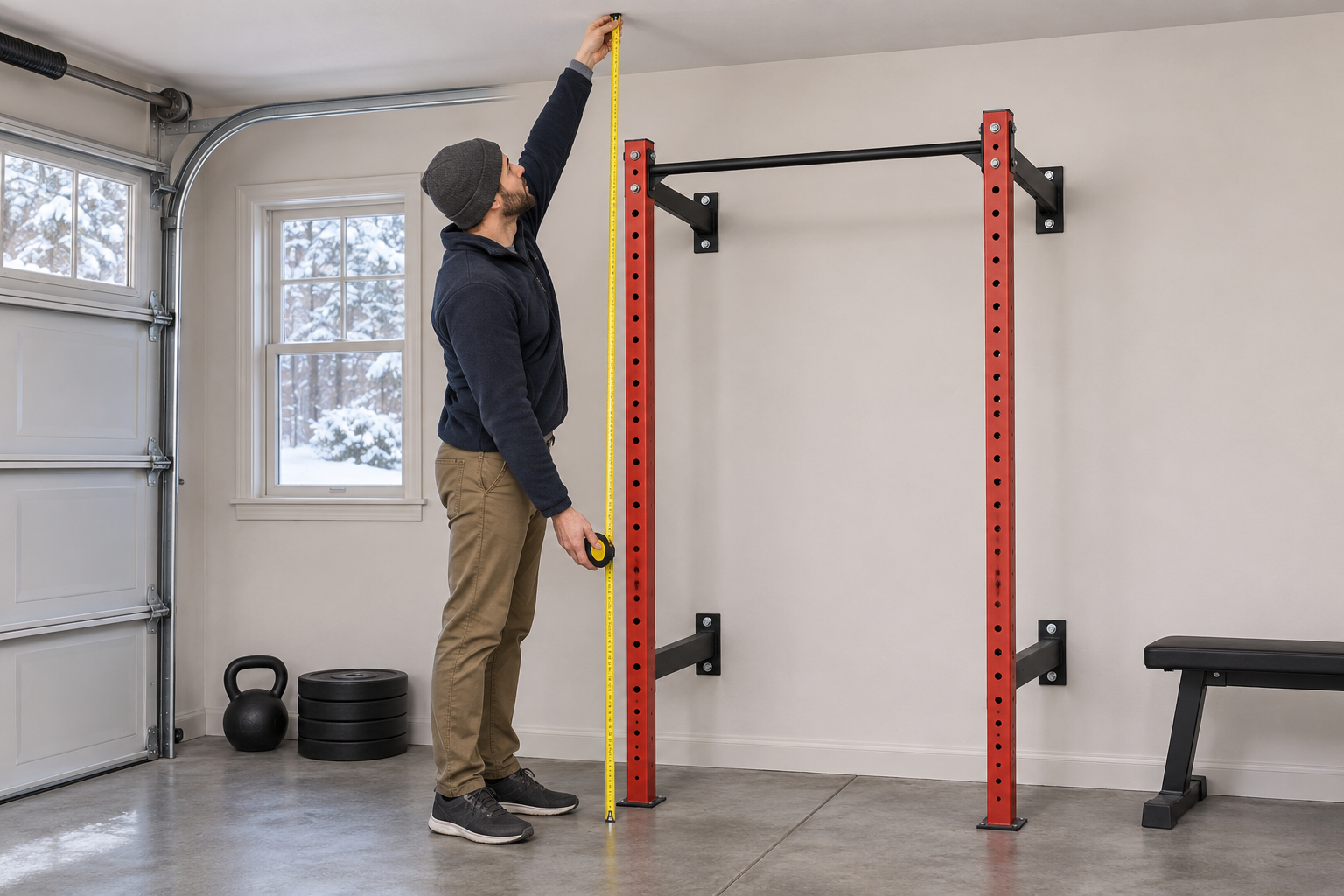
Will a Wall-Mounted Squat Rack Fit Your Garage Ceiling? Measure These Points First
Quick answer: Measure from the finished floor to the lowest ceiling obstruction over the rack’s planned position, then compare that measurement with the rack’s full assembled height and the space needed for the movements you intend to do. Include garage-door tracks, openers, lights, pipes, and ceiling joists. A rack that fits on paper may still leave too little headroom for pull-ups or a loaded bar. Follow the exact model’s installation instructions and ask the manufacturer about any unclear dimension before buying or mounting.
Measure the lowest point, not the middle of the ceiling
In a garage, the ceiling is rarely one uninterrupted flat plane. A door track, opener rail, light fixture, duct, or sloped ceiling can reduce the useful height in one small area. Mark the rack’s proposed footprint on the floor, then measure vertically at several points within that footprint. Record the lowest clear measurement. If the garage door moves through that area, check the clearance with the door both open and closed.
Measure from the surface the rack will actually stand on. A platform, rubber flooring, or raised threshold changes usable height. If you plan to place a bench beneath the rack, account for its position and any movement of a barbell, not just the rack frame.
Separate the frame height from the exercise space
Product dimensions describe the equipment; they do not define a safe room layout for every user. For example, the Waxman folding wall rack listing gives an overall frame height of 85.8 inches and separately describes its pull-up bar at 89 inches above the ground. Treat those as two different reference points: the frame’s top and the bar’s location. Confirm the exact installed dimensions in the instructions for the version you are considering.
Then ask what will happen above the bar. A person’s height, grip, range of motion, footwear, and the exercise all affect the space needed. The listing does not provide a universal ceiling-clearance recommendation for every user or garage. Do not assume that subtracting the frame height from the room height proves that pull-ups will fit comfortably. If your ceiling is close to the bar or you are uncertain, choose a lower setup, omit overhead movements, or ask the manufacturer for model-specific guidance.
Check the folded and open positions
A folding rack still needs usable space when open. Mark its width and projection from the wall on the floor with painter’s tape. Include room to load a bar, position a bench, move plates, and walk around the equipment without crossing a door path. A folded rack can reduce the frame’s projection, but the stored position must not block the garage door, a parked vehicle, a utility panel, or an exit.
Measure the bar and plate path as well. A bar may extend beyond the uprights, and a loaded bar needs room for plates to be added and removed. The actual room envelope depends on the bar, attachments, bench, and how you train. Use the dimensions for the exact rack and accessories rather than assuming that a product labeled “folding” takes no space.
Make a simple clearance check
- Mark the rack footprint and intended wall location.
- Measure floor-to-ceiling height at several points and note the lowest obstruction.
- Compare the exact model’s assembled height and pull-up-bar height with that measurement.
- Sketch the open and folded footprint, including a bench, bar ends, plates, and your walking route.
- Check that doors, vehicles, lights, and utility access remain usable.
- Read the manufacturer’s installation instructions before drilling or mounting anything.
Do not improvise the mounting plan
Wall-mounted strength equipment depends on the wall structure and the hardware specified by its manufacturer. This guide cannot identify your wall framing or confirm that a particular surface can support a rack. Do not mount into drywall alone, substitute fasteners, or treat a product’s advertised capacity as proof that your wall installation is adequate. If the instructions do not clearly match your wall or the included hardware, stop and ask the manufacturer or a qualified installer.
Waxman describes its folding rack as a wall-mounted unit and provides installation guidance with the product. Its listing identifies 60-by-60-millimeter, 13-gauge steel uprights, but these specifications do not determine the capacity of a particular wall or installation. Follow the model-specific documentation and local building requirements.
Product reference
The Waxman folding wall rack is one example to measure against, not a fit recommendation. Its official listing showed $299.99 USD and in-stock structured availability when checked November 11, 2026. Product dimensions and availability can change; confirm details with the seller before ordering.

Waxman 2.36-inch Folding Wall-Mounted Squat Rack
Listed frame height: 85.8 in; pull-up bar described at 89 in above ground. Steel uprights: 60 × 60 mm, 13 gauge. Confirm the exact model dimensions and required installation conditions for your space.
$299.99 USD · checked November 11, 2026. Price and availability may change; see product page.
Sources and limits
- Waxman product listing: dimensions, upright specifications, and installation guidance.
- Waxman Warranty & Product Support: ask for product-specific assistance.
Written by Codex from the linked product information. No room inspection, installation, load test, or human review is claimed. Measure your own space and use the manufacturer’s instructions; this guide cannot certify a ceiling or wall as suitable.
Leave a Reply