
No products in the cart.
How to Organize Cable Attachments in a Shared Fall Garage Gym
Answer: Give every cable handle a named storage place, disconnect it only as the machine’s instructions permit, and keep the cable travel and walking route clear before the next person trains. In a shared fall garage gym, the best system is simple: one attachment in use, other handles on approved hooks or a separate stable organizer, and a brief check that no loose item can enter the pulleys. A built-in hook is storage, not a load-bearing exercise point unless the maker says so.
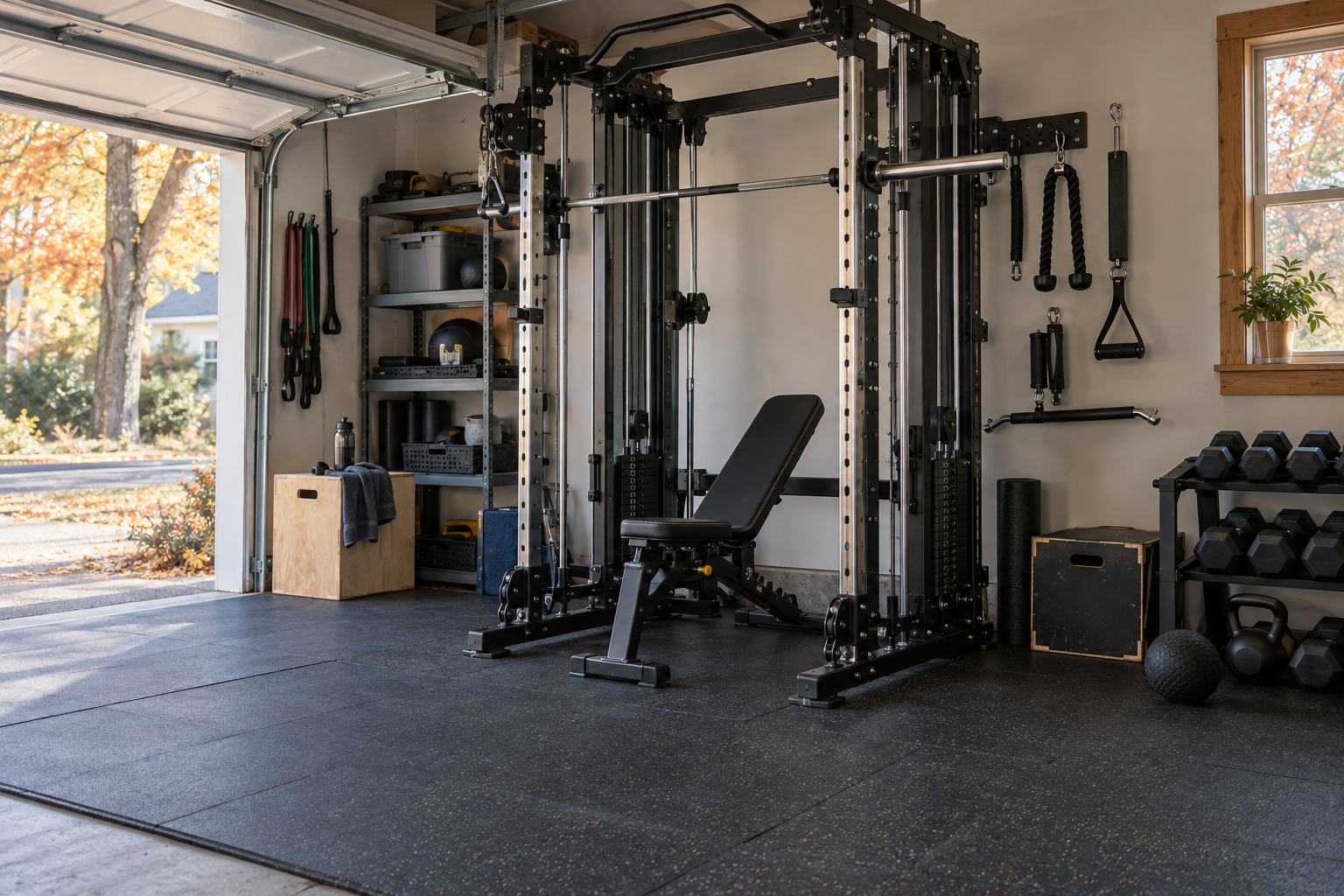
Featured image: AI-generated illustration of a generic garage gym. It is not a photograph of the Waxman package below or a verified safe setup.
Start with a list of what actually arrived
Lay out the accessories that belong to your own machine and compare them with its packing list and manual. Common cable handles may look similar but have different grip shapes, lengths, and attachment hardware. Do not assume that every loose handle in a garage came with the new rack, or that every item in a marketing photograph is supplied in your selected package. Put unmatched or damaged parts aside until their identity is clear.
The Waxman Smith machine and cable crossover package, SKU WAX-SM-001-CP, is one example of a large shared setup. Its official store listing describes five rear top hooks for accessories and a central storage crossbeam. Those are useful places to investigate for the listed model, but the article does not establish a safe hanging load or fit for a third-party handle. Check the delivered unit and current manual before placing equipment on a hook.
Make the changeover sequence repeatable
- Finish the set and bring the moving parts to their prescribed rest position. Keep hands clear of the cable and pulley path.
- Follow the machine’s instructions to remove the current handle. Never force a carabiner gate or detach a handle while the cable is moving or under unexpected tension.
- Inspect the handle, connector, and visible cable end for damage or a gate that does not close. Stop using a questionable part and consult the maker.
- Place the removed handle in its assigned storage spot, then connect the next handle only as directed for that cable station.
- Before the next repetition, look at the full travel path and confirm that a second handle, plate, towel, or box cannot catch the cable.
This is an organization sequence, not a replacement for the manufacturer’s setup procedure. If the manual for your exact rack or cable attachment is missing, ask the seller for it rather than using a generic online clip as a substitute. A person sharing the gym should be able to identify which connector belongs to which cable station without guessing.
Keep storage out of the moving envelope
Put approved hanging items where they do not touch a moving bar, weight carriage, pulley, or garage door. Test the area with the machine stopped and without a person lifting. Long ropes can be looped only as the maker permits; avoid tight bends that could damage their own fibers, and do not wrap a rope around a cable or pull-up bar just to save space. A small separate bin may suit clips and collars better than an overhead hook.
The product listing also describes six weight-plate holders, but it does not supply a verified holder load limit in the material used for this article. Those posts are not general-purpose pegs for backpacks, extension cords, or yard tools. Store plates only as the actual rack instructions allow. This is a different question from choosing plate locations around a leg press: here the goal is to keep cable accessories identifiable and away from moving parts after every shared session.
Make room for the fall garage routine
October often brings cars, wet shoes, and seasonal boxes back into a garage. Mark a walking route between the door and the gym area, then check it with the car parked in its usual position. Do not leave a handle on the floor where it can be stepped on, rolled over, or hidden under a mat. Store moisture-sensitive accessories away from visible water intrusion and follow their care instructions; do not make an unverified claim that a hook or cabinet will prevent corrosion.
Agree on a reset rule for everyone who uses the rack: return one handle before taking another, put small connectors in one labeled container, and report a damaged part immediately. A photo of the properly stored setup can be a useful household reference, but it should show your actual machine rather than a stock picture. Review the system after a week; if people keep leaving one handle on the floor, its assigned spot may be inconvenient or too high.
Do a final walk-around
Stand at the rack and look upward, along each cable, and around the base. Confirm that stored handles are not touching active cables, that connectors are closed where the manual requires, and that the route to the door remains open. If a hook, pin, or bracket moves unexpectedly, stop and correct it before another workout. The outcome you want is a visible, repeatable setup for the next person, not the maximum number of accessories on the frame.
Prepared with Codex assistance from the current public WaxmanUSA product data. No hands-on equipment test, installation approval, or human review is claimed.
Leave a Reply