
No products in the cart.
How to Plan a Leg Press Delivery Route Before It Arrives This Fall
Answer: Before a fall delivery of a plate-loaded leg press, measure the entire route from the drop-off point to the intended assembly space, reserve a clear staging area, and confirm the current carton details with the seller. A machine’s assembled footprint is not a shipping-box measurement, and an open garage door is not proof that the cartons will pass an interior doorway. Plan the move before anyone opens a box or tries to lift a component.
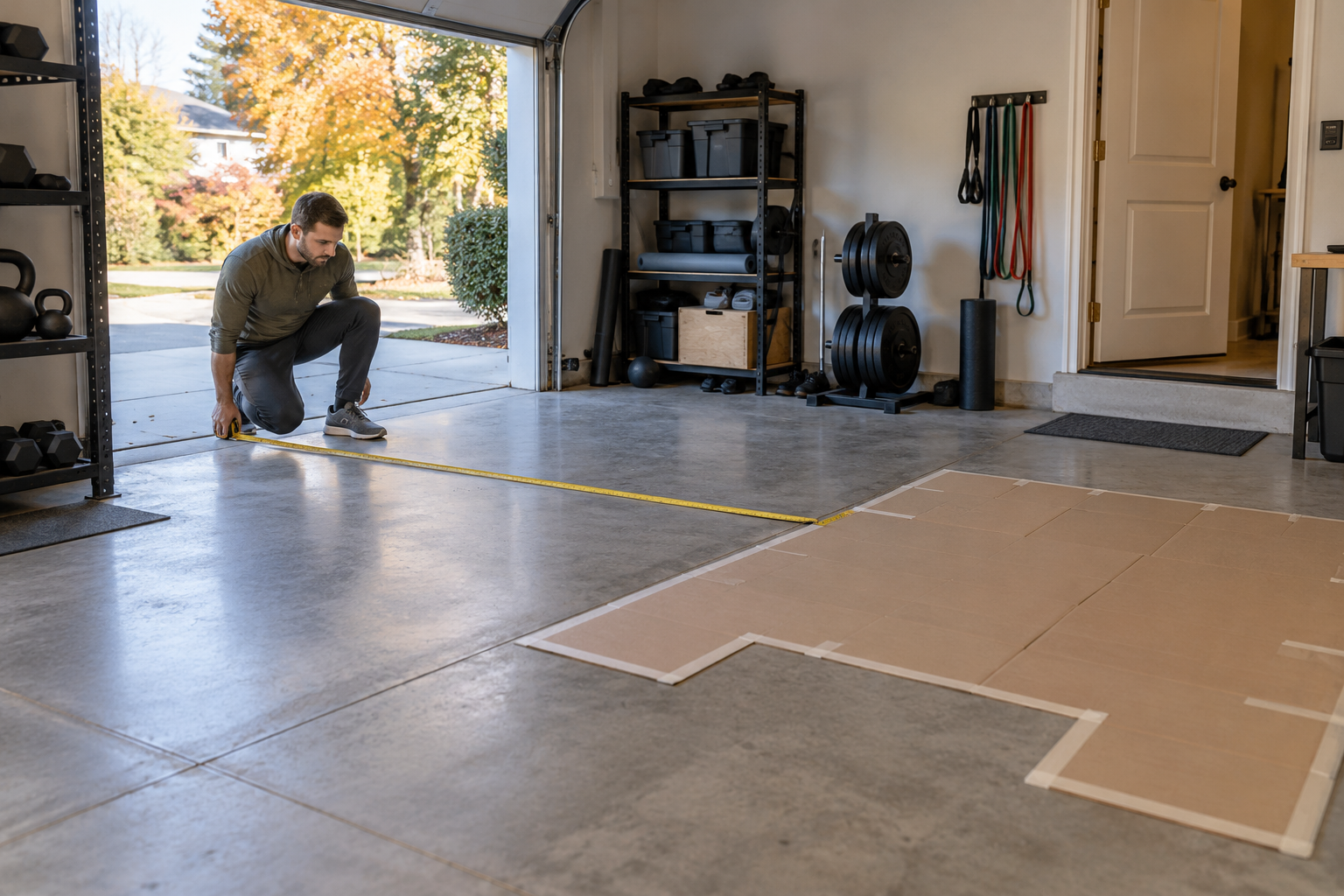
Featured image: AI illustration of a generic pre-delivery measuring exercise, not a product photo or a record of an actual installation.
Start with the actual route, not the machine photo
Draw the trip that every carton must take: delivery point, threshold, garage or hallway, any turn, and final staging spot. Record the narrowest usable doorway width and height after accounting for handles, trim, and doors that do not fold completely out of the way. Check low ceiling beams, steps, slopes, and the space needed to turn a long package. Measure with the doors in the position you will use on delivery day.
For a garage gym, leave room for a vehicle path, storage doors, and a person to walk around the work area. The American College of Sports Medicine asks people evaluating fitness facilities to look for safe walking paths through equipment areas. That is a useful planning principle at home, although it does not provide a fixed clearance for this machine.
Confirm what is arriving
The Waxman leg press/hack squat bundle listing describes a machine with a 340 lb color plate set. It says the machine ships in three boxes that may arrive separately. The listing does not establish the final number, size, or weight of every package in your particular order, including the plates. Ask the seller or carrier for the current carton list and delivery service before assuming one person can move the shipment.
Compare those carton measurements with your route. A tight turn can fail even when the doorway is wide enough. If there is no safe path, resolve the delivery plan with the carrier or seller; do not remove protective packaging in a driveway merely to force a fit. Keep the order record and carton labels so missing or damaged items can be identified after delivery. That later inventory step is separate from this advance route check.
Plan handling without guessing a safe lifting weight
Clear shoes, bikes, loose mats, and seasonal storage bins from the path. Check for wet leaves, ice, or uneven pavement on the day. A NIOSH-hosted materials-handling guide emphasizes planning the lift and clearing pathways before moving materials. Workplace guidance is not a personalized home-lifting assessment, but the same hazards are easy to overlook in a crowded garage.
Do not use the bundle’s total plate weight as a carton weight. The plates and machine components may arrive in different packages. Choose help, a suitable dolly, or professional handling based on verified actual packages and your route; do not improvise a solo lift because a box has handles. If anyone has a condition that limits lifting, arrange appropriate assistance. Keep children and pets out of the route while heavy cartons are being moved.
Reserve a dry staging and assembly zone
Mark the intended equipment location on the floor using a cardboard or painter’s-tape outline, but treat it as a planning tool, not a specification. Confirm the exact assembly and operating clearances in the instructions for the delivered version. The public listing and its images have shown conflicting machine dimensions, so this article intentionally gives no numerical footprint. Measure the actual room and check the current manufacturer instructions before purchase or assembly.
Set aside a clean, dry area where cartons can be opened without blocking an exit or a household walkway. Keep small hardware in labeled containers and retain packaging until the inventory is complete. Do not assemble on a visibly wet or unstable surface. If you discover water intrusion or an uneven floor, solve that site problem before installation.
Five questions to settle before ordering
- What are the current carton dimensions, weights, and delivery terms for this exact bundle?
- Will each carton clear every door, turn, and step on the route?
- Who will move the packages, and what equipment will they use?
- Where will the cartons sit without blocking daily access?
- Which current assembly instructions and operating clearances apply to the delivered model?
If any answer is unknown, keep the route plan provisional. A seller-confirmed delivery plan is more useful than an attractive floor sketch that ignores the cartons.
Prepared with Codex assistance from the linked public sources. No delivery, lifting test, or hands-on product inspection is claimed.
Leave a Reply