
No products in the cart.
Can You Put a Home Gym Rack on Carpet? Check These Points First
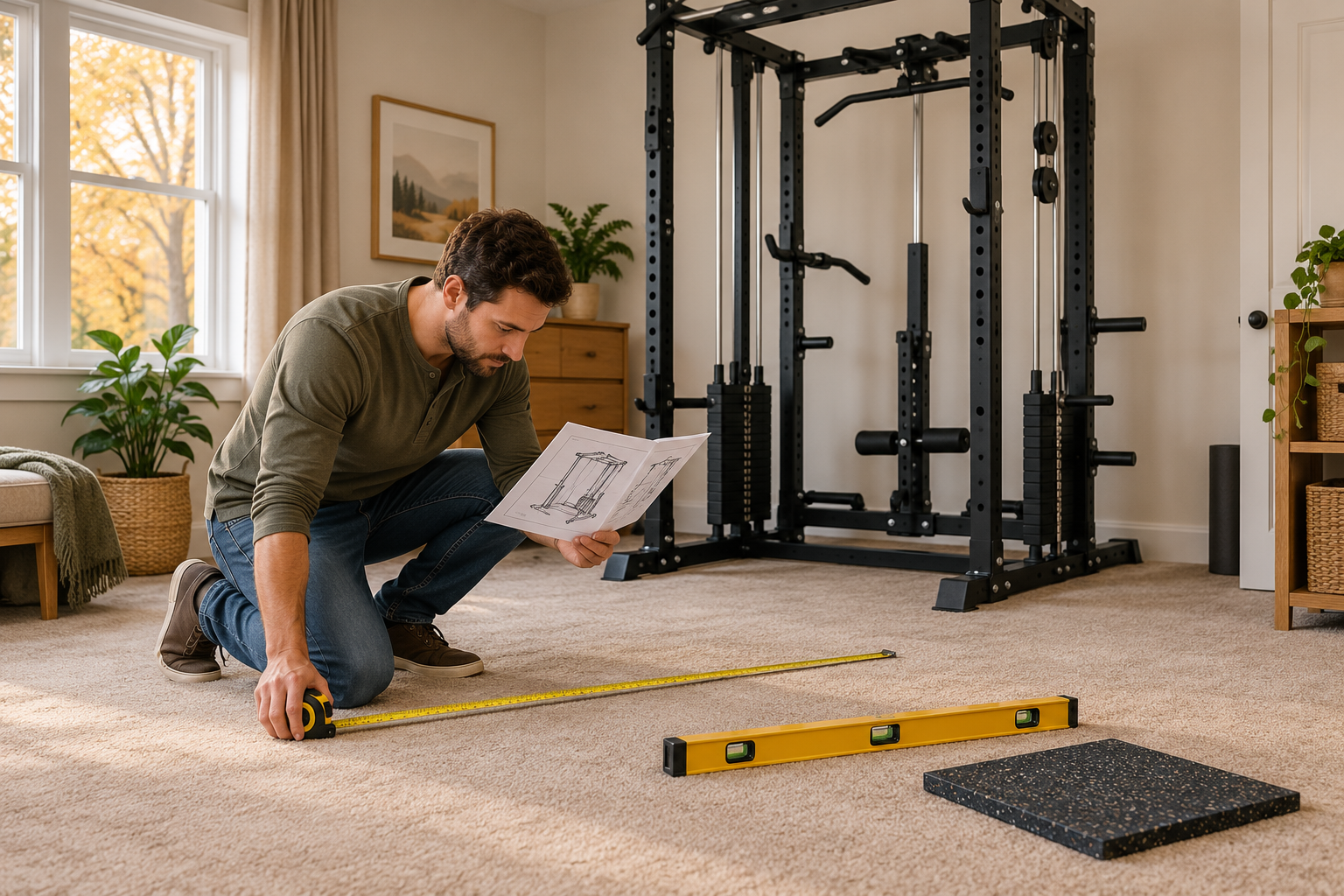
Cover illustration: AI-generated planning illustration. It is not a product photo, a flooring test, or a structural inspection.
Short answer: Do not assume a carpeted room is a suitable installation surface for a large home gym rack. Before assembly, check the exact equipment manual for floor, leveling, anchoring, and clearance instructions; inspect the carpet and subfloor for unevenness or movement; and ask the manufacturer if the instructions do not address carpet. A loose mat or a quick “it feels stable” check cannot confirm that a particular machine is supported correctly.
This question often comes up when colder weather moves workouts indoors or a spare room is being converted into a gym. The practical goal is to protect the room while creating a stable, manufacturer-approved setup. Carpet thickness, padding, seams, wear, and the condition of the floor beneath it differ from home to home, so one household’s setup is not proof that another will work.
Start with the exact model’s instructions
Find the assembly and owner documents for the model you have or plan to buy. Check for instructions about the permitted floor surface, leveling feet, anchoring, clearances, assembly sequence, and whether the equipment should remain in one location. Follow the delivered manual and any manufacturer updates for your exact model and configuration.
If the manual does not mention carpet, do not fill the gap with a general rule from a forum or a product listing. Contact the manufacturer or seller with the model number, a description of the carpet and padding, the room location, and the planned use. Ask whether carpet is permitted and whether the machine needs to be anchored or placed on a particular surface. Save the answer with the manual.
A product’s advertised weight capacity or a photo of the machine in a finished room does not answer the floor-surface question. Those details do not show how your carpet, underlay, or subfloor will behave under the installed unit and its intended use.
Inspect the surface before bringing the equipment in
Before delivery or assembly, clear the proposed footprint and examine the room in good light. Look for carpet seams or edges that cross the footprint, a thick or soft pad, wrinkles, worn patches, dampness, and visible changes in floor level. Check whether the floor has a noticeable slope or movement. This is a screening step only; it is not a structural assessment.
- Measure the planned footprint and mark it with removable tape so you can see how it fits without dragging a heavy frame across the carpet.
- Check doors, walkways, windows, outlets, and the machine’s full movement area. Keep a clear route for assembly and later use.
- Locate the manual’s instructions for leveling and anchoring. Do not improvise shims, cut the carpet, drill into the floor, or attach the machine to a wall unless the manufacturer specifically directs it and the building owner permits it.
- Ask the flooring installer or property owner about hidden seams, underlay, radiant heat, or other conditions if you are unsure what is below the surface.
Stop and get qualified help if the floor is visibly damaged, damp, unusually uneven, or moves under ordinary use. Renters and condo owners should check with the owner or building manager before altering flooring or anchoring equipment.
Do not treat a mat as a structural fix
A protective mat can be useful for a different purpose, such as catching ordinary scuffs or giving a person a defined area for floor exercises. The International Sports Sciences Association discusses a yoga mat on carpet as an option for foot stability during exercise. That advice is about a person exercising on the floor; it does not approve a heavy rack, establish floor capacity, or say that a mat corrects compressible padding.
If the manufacturer permits a mat under your specific machine, use only a type and thickness the instructions allow. Check that it lies flat and does not create a new rocking, sliding, or tripping problem. Do not stack scraps, foam tiles, or plywood under the feet as a workaround. If you cannot confirm that the floor and mat combination is acceptable, wait for the manufacturer’s answer before assembling or using the equipment.
Recheck after installation and seasonal room changes
Assemble the unit exactly as directed and have the number of people specified in the instructions help with lifting. Before a workout, verify that all feet are in contact as intended, required anchors are installed, and the frame does not rock or shift during the manufacturer’s prescribed setup check. Do not load the machine to “test” an uncertain floor.
Keep the room dry and the movement area clear. A seasonal reset can move rugs, add storage, or change where weights sit; revisit the manual if the equipment is relocated or reconfigured. Stop using it if it begins to rock, shift, or behave differently, and contact the manufacturer rather than tightening or modifying parts by guesswork.
Quick decision checklist
- The exact manual allows carpet: Follow its surface, leveling, and anchoring steps, then complete its setup checks.
- The manual is silent or unclear: Ask the manufacturer about your exact model and carpet setup; wait for an answer before use.
- The floor is uneven, damp, damaged, or moving: Do not install the equipment until the underlying condition is assessed.
- You are relying on a mat to solve rocking or softness: Pause. A mat is not evidence that the floor or installation is suitable.
Bottom line: Carpet may or may not be allowed for a particular rack. The reliable decision comes from the exact manufacturer instructions and the condition of the actual room—not from a generic mat recommendation or an online weight figure.
Example product listing
The Waxman WAX-SM-S02 listing describes a Smith machine with a squat rack, lat-pull-down system, and cable crossover. The listing does not establish that carpet is suitable for installation; confirm surface requirements with the exact manual or manufacturer before purchase or assembly.

Waxman Smith Machine, Squat Rack and Cable Crossover — WAX-SM-S02
$1,999.90 USD (listed price checked October 17, 2026)
Listed features: Smith machine, squat rack, lat-pull-down system, and cable crossover. The listing does not confirm carpet compatibility or room-specific installation requirements.
Price and availability may change; see product page. Check the current manual and model details before buying.
Sources
- Waxman product listing — product identity, model name, described stations, current listed price, and official product image; checked October 17, 2026.
- International Sports Sciences Association, “Home Gym Essentials for Clients Who Can’t Make it to the Gym” — discusses a yoga mat as a possible aid to foot stability on carpet during floor exercise; it does not assess heavy-machine installation.
This is general planning information, not an engineering determination or installation approval. Written with Codex assistance; no product or flooring test was performed, and no professional review is claimed.
Leave a Reply