
No products in the cart.
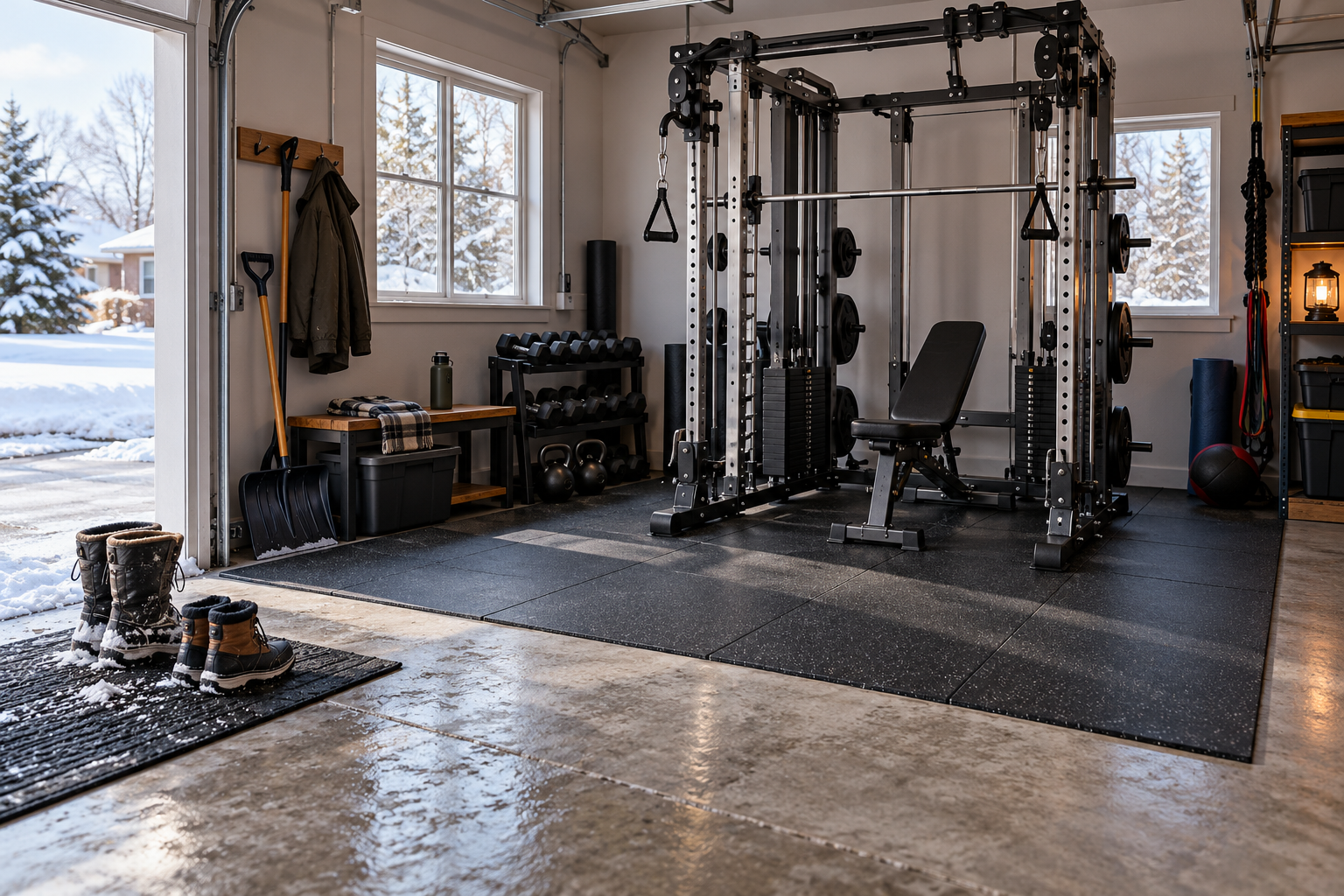
How to Protect a Garage Gym Floor Under a Smith Machine This Winter
Cover: AI-generated illustrative scene. It is not a Waxman product photo or a tested floor installation.
Short answer: Before placing a strength machine in a winter garage, identify the floor material, read its care and warranty guidance, and choose a stable, non-staining protection layer that spreads contact without rocking. Keep snow, road salt, and wet footwear away from the equipment footprint. Do not assume a thick rubber mat is safe for every vinyl floor, or that a machine’s advertised load capacity describes the load at each foot. If you cannot confirm the floor’s point-load limits or the equipment maker’s placement instructions, ask the flooring and equipment manufacturers before assembly.
This is a floor-care and setup checklist, not an engineering assessment. A heavy Smith machine concentrates static weight at a small number of supports, while lifting, cable pulls, and plate handling add movement. Floor type, subfloor construction, slab condition, moisture, and the machine configuration all change what protection is suitable.
Start with the exact floor and machine documents
Find the flooring label, invoice, installation paperwork, or product manual. “Vinyl,” “wood,” and “concrete” are broad categories: wear layers, floating or glued installation, underlayment, coatings, and slab condition matter. Note the manufacturer’s rules for concentrated loads, mats, moisture, and warranty exclusions. If the floor is leased or shared, check the property owner’s requirements too.
Next, match the gym equipment’s model and package to its current manual. Package variants can have different dimensions, accessories, and total weights. Record the assembled footprint, support locations, and any anchoring or clearance directions. Do not turn a maximum load or capacity statement into a floor-load calculation; it does not tell you the force at each foot or how a particular floor will respond.
Choose floor protection without creating a new problem
Use only a protective surface that the flooring manufacturer permits. A stable platform or mat may help contain grit and spread contact, but its material and thickness must suit both the floor and equipment. On resilient vinyl, Shaw advises against mats with latex or rubber backings because they may discolor the floor; its guidance also calls for large, non-staining floor protectors under heavy furniture and appliances. That is useful evidence for vinyl care, not a universal approval of a particular gym mat.
For wood or laminate, follow that floor maker’s guidance on moisture, indentation, and finish compatibility. For a concrete slab, inspect for cracks, uneven areas, and signs of water before setting up. A mat cannot repair a damaged slab or establish that a suspended floor can carry a concentrated load.
- Ask the floor maker whether a barrier is required between the covering and floor.
- Check that the protective layer lies flat and does not compress unevenly under machine feet.
- Keep seams, curled edges, and loose pieces out of walking paths.
- Do not place improvised shims under equipment supports to compensate for an uneven floor.
Manage winter moisture and grit around the setup
In winter, slush and de-icing residue can be tracked into a garage and trapped beneath a mat. Put a separate entry tray or walk-off mat near the door, outside the machine footprint, and wipe up water promptly. Before covering the floor, let wet surfaces dry. If a slab or wall has recurring seepage or condensation, address the moisture source rather than sealing dampness beneath an impermeable layer.
Inspect beneath removable protection periodically, using the flooring maker’s cleaning instructions. Look for trapped moisture, discoloration, grit, cracked tiles, or a mat that has shifted. Stop and seek advice if the surface changes or the equipment rocks. Never drag a loaded machine across finished flooring; plan the route, clear obstacles, and use the manufacturer’s moving instructions or qualified help.
Set up, then recheck before training
Dry-fit the protection layer first and confirm that the machine sits level on a stable surface. Assemble and anchor only as the model’s documentation directs. Keep required access to the garage door, electrical panel, water heater, and exit path. After setup, inspect each support, check for movement, and verify that cables and moving parts do not contact walls, stored items, or overhead tracks.
Recheck after the first few sessions and after any winter cleanup that moves the machine or mat. Look for indentations, shifting, moisture, or new noises. If the floor begins to deform, the frame becomes unstable, or the recommended protection is unclear, stop using the setup until the equipment maker and flooring professional advise you. A pad is not a substitute for a structurally sound, level installation.
When to get professional guidance
Ask a flooring installer or building professional to assess a raised wood floor, visible cracking, soft spots, water intrusion, or a machine whose supports fall across joints or damaged areas. Ask Waxman support about the exact model, package, assembly, and placement requirements. Provide the model name, floor type, photographs, and the intended location. Keep the written answer with your manuals.
Product reference: Waxman Smith Machine, 2200 lb capacity, garage package with 340 lb color plates. The manufacturer listing gives an assembled footprint of about 74.09 × 83.07 × 87.04 inches for this package; confirm the selected package and current documents before planning placement. The 2,200 lb figure is a product capacity claim, not a floor-load rating. Current listed price: $2,399.90 USD (checked October 29, 2026); price and availability may change. View the current product listing.
Takeaway: Verify both manufacturers’ instructions, use floor-compatible non-staining protection, control winter moisture and grit, and stop if the surface or frame is unstable. There is no one mat that is safe for every floor.
Prepared with Codex assistance from the linked manufacturer and flooring-care information. No hands-on product or floor testing was performed.
Leave a Reply