
No products in the cart.
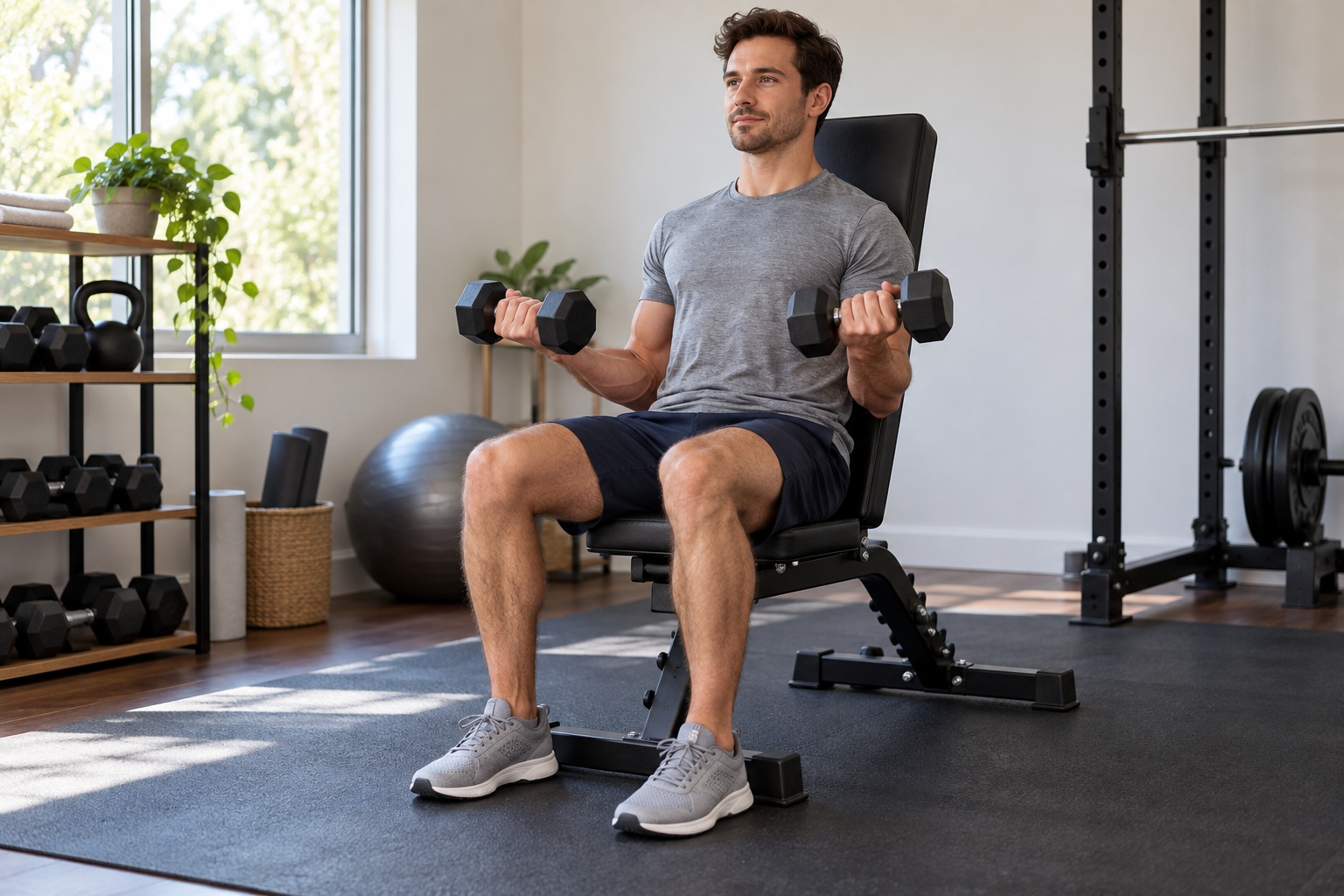
How to Set Up a Seated Dumbbell Curl on a Weight Bench
Illustration: AI-generated for general explanation only. It is not a product photograph, coaching session, or tested demonstration.
Quick answer: For a seated dumbbell curl, sit with your back comfortably supported, feet planted, and arms relaxed near your sides. Use a light load you can move without rocking your torso or bending your wrists. Curl by bending at the elbows, then lower slowly. Stop if you feel pain or cannot keep control. The American Council on Exercise’s seated curl guide uses a supported sitting position and emphasizes steady torso, shoulder, and wrist alignment.
This is a simple exercise, but a stable setup makes it easier to notice when a dumbbell is too heavy. The steps below are general information, not individualized coaching or medical advice. If you have an injury, symptoms, or a health condition that affects exercise, ask a qualified clinician or fitness professional for guidance.
Set up the bench before picking up dumbbells
- Choose a level floor. Set the bench where it will not rock or slide. Check that its frame is fully open and any adjustment mechanism is locked as described in its manual. Do not use a bench with a loose pin, damaged part, or unstable base.
- Use a supported, comfortable position. Adjust the backrest only to a position the manufacturer allows for seated exercise. Sit far enough back that your upper back can rest against the support without forcing your head forward. Keep your hips on the seat rather than balancing on its edge.
- Plant your feet. Place both feet flat on the floor. If they do not reach comfortably, choose a stable, nonslip foot support that cannot move. Do not perch on an unstable object or lift your heels to make the bench fit.
- Set the dumbbells down within easy reach. Pick them up one at a time without twisting sharply or leaning far to the floor. If the weights are hard to move into position, use lighter ones or ask for help. Keep the floor around the bench clear.
Perform a controlled seated curl
Start with your arms by your sides and your wrists in a comfortable straight line with your forearms. Hold each dumbbell securely, without squeezing so hard that your forearms tense before the curl begins. Keep your shoulders relaxed and your torso upright against the support.
Exhale as you slowly bend your elbows and bring the weights toward your shoulders. Keep your upper arms close to your sides and avoid leaning back, shrugging, or swinging the dumbbells. Stop at the highest point you can reach while maintaining control; there is no need to force the weights against your shoulders.
Inhale as you lower the dumbbells smoothly toward the starting position. Do not let them drop or snap your elbows straight at the bottom. Use a range that feels comfortable, and keep your wrists aligned instead of letting them fold backward or forward. The goal is a repeatable movement, not the heaviest load or the longest possible range.
Choose a load you can control
There is no single starting weight that fits every person. Begin with a light pair or practice the motion without weights. A suitable load lets you complete the intended repetitions without leaning back, changing your wrist position, shrugging, or speeding through the lowering phase. If your body starts helping the curl, set the weights down and reduce the load or rest.
You do not need to train to failure to check your setup. End the set while you can still control the dumbbells and place them down deliberately. If one side moves differently, try lighter weights or curl one arm at a time only if you can maintain a steady posture. Avoid balancing a dumbbell on your thigh while leaning far to retrieve the other.
Troubleshoot common setup problems
- Your back leaves the support: reduce the load and slow down. If you still need to rock, stop the set.
- Your wrists bend: adjust the grip and use lighter dumbbells. Choose the hand position that keeps your wrist comfortable and aligned rather than forcing a particular angle.
- Your shoulders shrug or elbows drift: reset with the weights at your sides and make the curl smaller. If the movement remains uncomfortable, stop.
- Your feet slide or the bench shifts: do not continue. Recheck the floor, bench setup, and foot support before trying again.
- You feel sharp, increasing, or unusual pain, numbness, dizziness, or loss of control: stop. Seek qualified advice when symptoms persist or concern you.
A seated curl is optional. If the bench position does not fit your body, try a different supported setup or another movement recommended by a qualified professional. Do not force your body into the bench simply because it has an adjustable backrest.
About the bench shown
The Waxman Adjustable Weight Bench listing describes three cushions and an adjustable backrest. The product page lists it at $269.00 USD when checked October 28, 2026. Its title and description differ on the number of back positions, so verify the exact configuration and instructions before use. This product has not been tested for this article.

Waxman Adjustable Weight Bench
Listed at $269.00 USD on October 28, 2026. The product description includes three cushions and an adjustable backrest; confirm the exact configuration on the official page.
Price and availability may change; see the product page.
Sources
- American Council on Exercise, Seated Biceps Curl (supported starting position, controlled elbow motion, and wrist alignment).
- Waxman Adjustable Weight Bench official listing (product identity, image, description, and listed price checked October 28, 2026).
Leave a Reply