
No products in the cart.
Can a Smith Machine Go on an Upstairs Floor? What to Verify First
Short answer: Do not decide that a Smith machine is safe on an upstairs floor from its advertised lifting-capacity number. Before ordering or installing a large rack, obtain the machine’s actual assembled weight and the total load you expect to keep on it, then have the floor evaluated for the exact room and location by a qualified structural engineer or the building’s responsible professional. If you cannot verify those details, place the equipment on a suitable ground-level slab or wait for professional guidance.
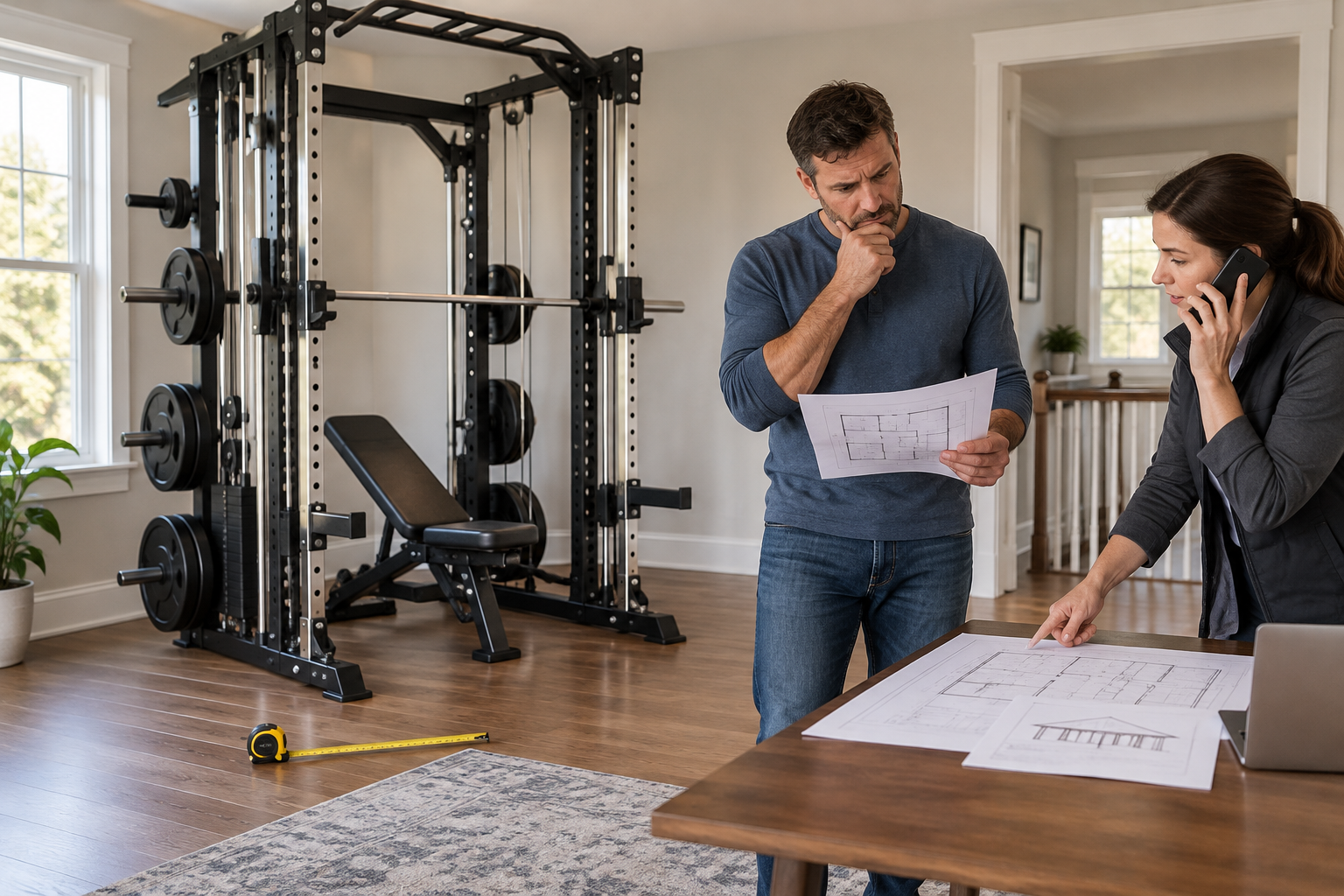
Cover image: AI-generated conceptual illustration of planning a home gym with a structural professional. It is not a product photo, engineering drawing, or floor assessment.
Capacity is not the same as machine weight
A product’s “maximum capacity” describes a stated equipment limit; it does not tell you how heavy the machine itself is, how much weight you will store on it, or whether the building floor can support the combined setup. A user, plates, storage pegs, a bar, and movement during exercise add loads beyond the empty frame. The product listing for Waxman’s M4 Smith machine says its maximum capacity is up to 2,200 pounds, but the listing does not state the assembled machine’s own weight. Do not treat 2,200 pounds as the machine’s weight or as a floor rating.
Floor structure is also not assessed by dividing the total equipment weight by the whole room area. Weight is transferred through the machine’s feet or base, and the floor’s framing, supports, condition, span, and the equipment’s position affect how those loads are carried. A machine that fits physically may still need a structural review before it is placed upstairs.
Collect the information before delivery
Ask the seller or manufacturer for the complete assembled weight, the footprint and base contact points, whether stored plates count toward the rating, and any anchoring or floor requirements. Confirm the exact package: Smith machines, cable stations, storage pegs, and accessories can differ by configuration. If the seller cannot provide assembled weight, request it before moving forward. A shipping weight is useful but may include packaging and is not a substitute for the assembled equipment figure.
List what will be in the room at the same time: the machine, plates stored on it, bars, benches, dumbbells, the people using the area, and any other heavy items. Include how the equipment will be used. Controlled lifting is different from dropping weights or repeated impact; do not assume the floor or machine is designed for dropped loads unless the manufacturer and a qualified building professional confirm that use.
Who should review an upstairs installation?
For a house, ask a licensed structural engineer or another qualified professional who can review the actual floor framing and equipment location. Provide the floor plan if available, the joist direction and span if known, the manufacturer’s equipment data, and the planned stored load. Do not cut into the floor or remove a ceiling to inspect framing yourself.
In a condo, apartment, or rental, contact the building manager or owner first. There may be building rules, limits on heavy equipment, or a required review process. The building’s records or original plans may help, but only a qualified professional should interpret them for a specific installation. A general residential load number found online cannot confirm the condition or capacity of your individual floor.
If a structural professional says the proposed setup needs a different location or load plan, follow that recommendation. Moving the machine closer to a wall or adding a board underneath is not a substitute for an assessment. A mat may protect the finish or reduce some noise, but it does not certify structural capacity.
Warning signs and practical limits
Visible sagging, new cracks, soft spots, damaged framing, or unusual movement are reasons to stop and seek professional advice. The absence of visible damage does not prove that an upstairs floor is suitable. Do not test the floor by assembling the machine, loading plates onto it, or performing a heavy lift. If you hear new cracking or feel movement during ordinary use, stop using the equipment and keep others away until the floor is assessed.
Plan the delivery route separately from floor capacity. Measure the doorway, hallway, stairs, turns, and landing; ask the seller for the carton dimensions and package weights. Do not carry heavy sections alone or assemble the machine in a place that blocks an exit or access to building services. The Waxman product page lists dimensions of 87.2 inches high by 71 inches long by 48 inches wide, but those dimensions do not establish delivery clearance or floor suitability.
Use the product listing carefully
The Waxman M4 listing describes a combined Smith machine, rack, cable crossover, and pull-up station, with a stated maximum capacity up to 2,200 pounds. It also gives the assembled dimensions noted above. It does not publish the assembled machine’s own weight or a residential upstairs floor approval. Ask Waxman for the model-specific weight and installation guidance, then share those details with the professional reviewing the floor.

Waxman M4 Smith Machine Home Gym Package
Listing dimensions: 87.2 × 71 × 48 inches; listed maximum capacity: up to 2,200 lb. The page does not state machine weight or certify upstairs installation.
Price checked October 28, 2026: USD $2,499.00. Price and availability may change; see product page.
Decision checklist
- Get the exact assembled weight and setup requirements from the manufacturer.
- Calculate the planned equipment and stored-load inventory, without treating a product capacity as a floor rating.
- Ask the building owner or a qualified structural professional to review the actual floor and location.
- Use only the location and activity the reviewer approves; do not drop weights unless that use is specifically cleared.
Bottom line: An upstairs room should not be approved by a quick math estimate or by the machine’s maximum capacity label. If the manufacturer cannot provide actual equipment weight or the floor has not been assessed for the planned setup, pause the installation and get model-specific information and professional guidance.
Sources
- Waxman M4 Smith Machine listing — product identity, dimensions, published maximum capacity, current price; no machine weight or upstairs floor approval stated.
- Structural Building Components Association, Special Floor Loading Considerations in Typical Residential Construction — explains that large concentrated loads can require consideration beyond typical floor-truss design; it is general industry guidance, not an assessment of a particular home.
Written with Codex assistance. No structural inspection, load calculation, or product test was conducted, and no independent human review is claimed. Price and product details were checked October 28, 2026 and may change.
Leave a Reply