
No products in the cart.
Can You Mount a Folding Squat Rack to Drywall? Check the Wall First
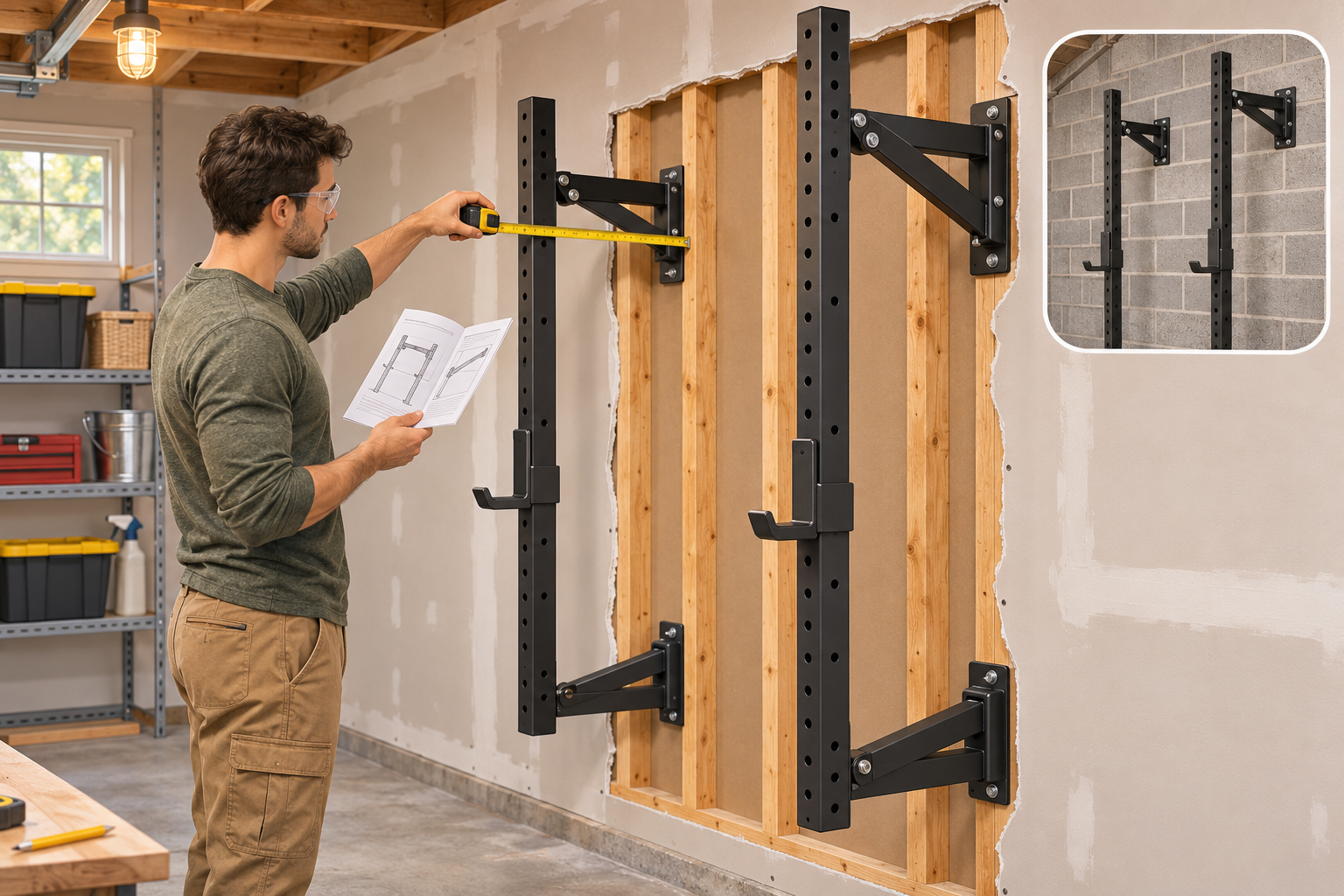
Cover: AI-generated illustration of a generic wall-mounted rack and a person reviewing instructions. It is not a product photo, installation guide, or load test.
Short answer: Do not attach a folding squat rack to drywall alone. Before buying or drilling, identify the wall structure and follow the exact rack maker’s installation instructions. A wall-mounted rack transfers force into its fasteners and the building structure; drywall anchors by themselves do not establish that the wall can safely support the equipment. If the required attachment method is unclear, pause and ask the manufacturer or a qualified installer.
This guide helps you decide what to verify, not how to engineer an installation. Wall assemblies vary, and different racks use different brackets, fasteners, spacing, and reinforcement. A product’s advertised capacity is not proof that a particular wall or improvised mounting method is suitable.
Why drywall is not the mounting structure
Drywall is a finish layer. It can conceal wood framing, metal framing, masonry, utilities, and changes in construction. A toggle or plastic drywall anchor may hold a light household item under its intended conditions, but that does not make it an appropriate substitute for the structural attachment specified for a rack used with a barbell. Exercise creates changing forces as the bar is unracked, re-racked, or moved, and a folding design also applies force through its wall brackets.
Do not choose fasteners from a general online chart or copy another rack owner’s installation. The rack maker’s instructions and the building’s actual construction must agree. If the manual specifies a particular substrate or fastener and your wall does not match, stop rather than adapting the hardware by guesswork.
Identify the wall before ordering
Start by locating the exact rack manual and reading its wall, fastener, spacing, and clearance requirements. Then determine what is behind the finish at the proposed location. A stud finder can help locate framing, but it does not certify a stud’s size, condition, spacing, or connection to the building. Do not assume every wall is framed the same way, or that a magnet or tapping test is enough to approve a load-bearing attachment.
- Wood framing: Confirm that the manual permits this construction and specifies how the rack brackets engage the framing. Check required spacing and any included mounting board or stringer. Do not substitute shorter screws or attach only to the wall covering.
- Metal framing: Do not assume a standard hollow metal stud can accept the same fastener as wood. Get written guidance for the exact rack and wall assembly from the manufacturer or a qualified building professional.
- Brick, block, or concrete: These are not interchangeable substrates. The manual must identify an approved installation method for the specific masonry, and the selected anchors must match that method. If the wall is hollow, damaged, veneered, or uncertain, get professional advice.
- Unknown or mixed construction: Do not drill until the structure and hidden utilities are identified. Renters should also obtain the owner’s approval before making structural changes.
Check the complete installation plan
Measure the rack’s operating and folded footprint, the bar’s full travel, ceiling height, and a clear route around the exercise area. A rack that physically fits can still be unusable if it blocks a door or forces a lifter to work close to windows, vehicles, or other people. Check whether the manual requires a spotter, safety arms, or other compatible parts for the lifts you plan to perform.
Confirm what is included in the specific package. Similar listings may differ in mounting hardware, brackets, accessories, or dimensions. Ask the seller to identify the current manual and the included fasteners for the selected configuration. Do not infer compatibility from a product photograph, a neighboring model, or a listed weight capacity.
When to stop and get help
Pause if the wall is cracked, damp, unusually thin, or covered by paneling; if framing locations do not match the installation pattern; if the fasteners in the box do not match the manual; or if you cannot verify what is behind the proposed holes. Have a qualified contractor or building professional assess the wall where required. Ask the rack manufacturer to clarify model-specific instructions. A professional assessment is especially important for steel framing, masonry, shared walls, and older construction.
After an approved installation, inspect it as the manual directs before each use. If a bracket shifts, a fastener loosens, the wall cracks, or the rack moves unexpectedly, stop using it and contact the manufacturer or installer. Do not “test” an uncertain mount by loading it with a barbell.
Product reference
If you are comparing a folding wall rack, review the exact package, current manual, mounting requirements, dimensions, and included hardware before ordering. Waxman 2.36″ × 2.36″ Folding Wall Mounted Squat Rack is an example of a product listing to examine; this article does not verify that it suits your wall or give installation approval. View current price and product details. Price and availability may change; check the listing. Product details checked November 18, 2026; the official page did not load during this review, so current price, image, and installation documentation were not confirmed.
Sources
- Waxman product listing (product reference only; official page timed out during review).
- Matrix installation recommendations (illustrates that anchoring instructions are equipment- and construction-specific; it does not establish requirements for Waxman products).
- PRx Performance wall-mount FAQ (manufacturer-specific guidance; not transferable to another rack).
This is general planning information, not structural engineering advice. Follow the manual for your exact equipment and consult a qualified professional when wall construction or installation requirements are uncertain.
Leave a Reply