
No products in the cart.
When Should You Stop Using a Home Gym Cable?
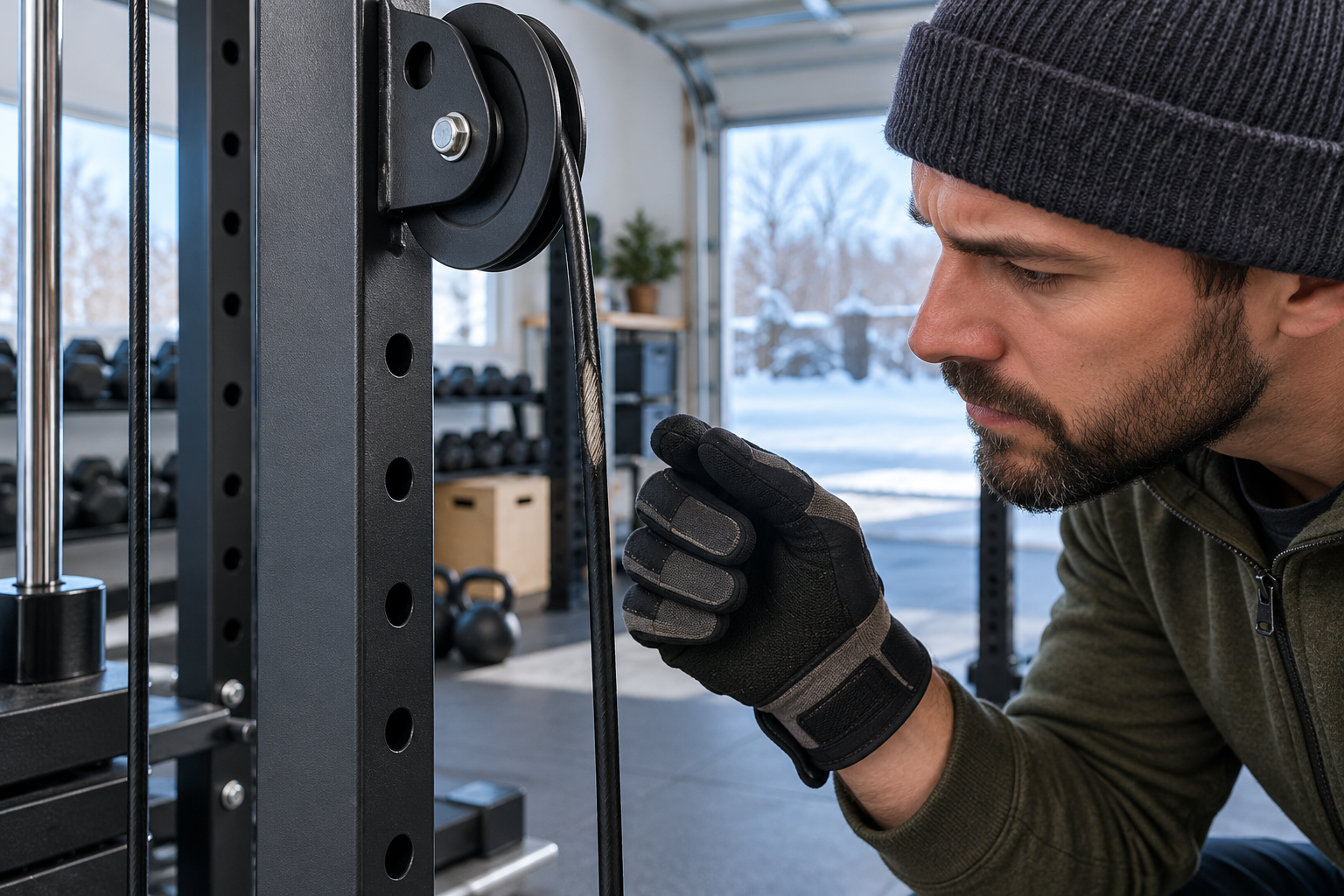
Illustrative AI-generated image; not a product photo or a test of cable condition.
Quick answer: Stop using a home gym cable station if you see fraying, exposed wire, a crack or bulge in the covering, a kink, a separating end fitting, or cable travel that binds or changes unexpectedly. Keep other people away from the station, unload it only if you can do so without handling a damaged or tensioned cable, and follow the exact equipment manual or contact the manufacturer for inspection and replacement. Tape, a knot, or a heavier replacement cable is not a safe repair.
Why a small cable defect deserves attention
A cable can carry substantial force while appearing thin and flexible. Wear can be hidden under a sheath or concentrated near an end fitting and pulley, where the cable repeatedly bends. A visual check cannot establish its remaining strength. Because the potential failure is sudden, use a conservative rule: if you find an abnormality or cannot tell whether the cable is damaged, take that station out of service until the manufacturer or a qualified repair professional advises you.
This guidance applies across home gym equipment types; it is not a Waxman repair procedure or a substitute for your machine’s manual. Models use different cable constructions, attachment methods, inspection intervals, and replacement parts. For example, Waxman’s LAT and Lift Pulley System listing describes sheathed cables in 70-inch and 90-inch lengths and a pulley setup. Those listing details do not establish a universal inspection schedule or confirm compatibility with other machines.
Warning signs to look for
- Fraying or exposed strands: fuzzy fibers, sharp wire ends, or metal strands protruding through or beyond the sheath.
- Cracked, split, or peeling covering: a damaged sheath may hide deterioration underneath, even when the wire is not yet visible.
- Bulges, flattened spots, or a change in diameter: these can suggest internal damage or deformation.
- Kinks, twists, or unusual bends: a cable that no longer lies or moves smoothly may be compromised or routed incorrectly.
- Loose, shifted, or separating end hardware: inspect the connection points for movement, damage, or a cable end pulling away.
- New binding, rubbing, or uneven movement: the cause may be a cable, pulley, alignment, or another component. Do not assume that adding lubricant or tightening a fitting will solve it.
BodyCraft’s equipment manual identifies sheath cracks, twisting, bulges, fraying, flattening, kinks, and separating cable ends as warning conditions; for certain exposed or deformed cable conditions it says to stop using the machine and replace the cable. Use that as a reason to take visible damage seriously, not as a replacement specification for another brand. Follow the inspection and repair instructions for your own model.
How to check without creating extra risk
- Make the area safe. Stop the exercise, set down an attachment if it is stable, and keep others from using the station. Do not pull hard on a suspect cable to “test” it.
- Use the manual’s inspection method. If the instructions call for inspection only while unloaded, follow that. Never put fingers near a moving pulley or between a cable and a sheave. Avoid running bare fingers along a cable that may have broken strands.
- Look along the accessible route. Check the full visible length, bends, pulley entry points, stops, and end fittings. Do not dismantle guards or tensioned components unless the manufacturer’s procedure specifically says how.
- Record what you see. Take a photo from a safe distance and note the equipment model and location of the defect. This can help support staff identify the correct part.
- Get model-specific direction. Contact the equipment maker or a qualified service technician about inspection, part number, installation, and any related pulley damage. Keep the station unavailable until the repair is complete and the manual’s return-to-use checks are satisfied.
Do not improvise a repair
Do not wrap a worn section in tape, tie a knot, clamp a new end onto a damaged cable, or substitute a cable based only on apparent length or thickness. The cable, end fittings, pulley path, and load rating work as a system. A replacement that looks similar may have a different construction or termination and may not be suitable. Do not reuse a damaged cable after trimming off the visible defect.
Price and availability may change; see the current Waxman product page for the LAT and Lift Pulley System. The listed configuration and price are not a recommendation to retrofit that accessory to another machine; check compatibility and the instructions for your exact setup.
When the station can return to use
Resume only after the damaged part has been assessed and replaced or repaired according to the equipment maker’s procedure, all connections and guards are back in place, and the specified checks pass. If the cable still rubs, binds, slips, or moves differently, stop again and request service. A pre-use inspection can identify a reason to pause; it cannot certify a cable or machine as safe.
Waxman lists its LAT and Lift Pulley System at $43.00 USD on the product page checked October 31, 2026. The page describes 70-inch and 90-inch sheathed cables, two exercise modes, and a loading pin. Confirm included components, fit, and current details on the listing before ordering. Price and availability may change.

Waxman Fitness LAT and Lift Pulley System
70-inch and 90-inch sheathed cables · listed at $43.00 USD (checked October 31, 2026)
Check exact compatibility and included parts on the product page. Price and availability may change.
Leave a Reply